• New Post Alerts By Email

  • Syndication

    RSS
    Atom
  • Tags

  • Archives

Russians in London: Russian and Jewish radicals

In this post, the penultimate in the series, instead of focusing on a single figure, I’m going to explore one of the lines that connects Russian radicals, and in particular their agitational/publishing activities, to the work of their Russian-Jewish counterparts. Some may suggest that this stretches the definition of ‘Russians’ too far, as Jews would not have identified as Russians, but I have my reasons. Certainly, Rudolf Rocker questions this last assumption:

It was incredible to me that people who had suffered so much in Russia, where Jews were treated as pariahs from the cradle to the grave, should retain such affectionate feeling for the country. These Jewish proletarians seemed to belong in spirit still to Russia. It could hardly be called patriotism. It was love of their native places, of the towns and villages where they had grown up and spent their early years. (p. 93)

The Rusian Socialist Group’s Appeal to Public Opinion equally observes Russian Jews’ ‘deep-roooted love for the country of one’s birth’, ‘in spite of the regime of tyrannical oppression’ they had escaped, and that many refugees retained economic ties with Russia (p. 17). Aside from revealing more complex feelings about Russia than one might expect, these quotations also indicate another reason for including Jews: the oppression they suffered placed them, regardless of their politics and religious views, in a similar position vis-a-vis the Russian government to that of the radicals. Indeed, Russian government rhetoric frequently lumped Jews and radicals together (Appeal, pp. 15-16, Rocker, p. 87), in order to justify the persecution of both groups and incite the general population against them. This, in turn, created a common cause; we saw in a previous post that Kropotkin spoke at protests against Jewish oppression, and his was not a lone voice. The various socialist clubs that sprang up around the East End in these years were (unlike the Russian socialist parties, it must be said) diverse and tolerant establishments where Russians and Russian Jews would regularly meet and interact. As Halpern and Reinharz point out:

Jewish workers were virtually the only Eastern Europeans among whom a Russian radical could conduct propaganda and agitation. The intelligentsia in these cities did not have to seek out the people idealistically, like the populists in Russia, but were thrown in with them by necessity, since many of them had to become proletarians in order to support themselves (p. 225).

So it is difficult to exclude the Jewish component of radical activity from the Russian one, and, I would argue, limiting to attempt it. I should note that my definition of ‘Russian’ is also flexible in that, as I consider the question of persecution by the Russian state to be significant, by ‘Russia’ I mean the Russian Empire, i.e. including parts of Belarus, Poland, Latvia, Lithuania etc, rather than the territory of what we now call the Russian Federation.

Pyotr Lavrov (1823-1900)

Pyotr Lavrov, the narodnik (populist), was, in any case, definitely ethnically Russian. He was perhaps most famous for his Historical Letters (1870), which in great part inspired the ‘going to the people’ movement in the 1870s. By this time Lavrov was already living in Europe, having escaped from exile in 1868. He lived mainly in Paris and Zurich, but also spent a couple of very important years in London. His first visit was in April 1871, during the Paris Commune; he was sent first to Brussels ‘to seek aid for the Commune from the General Council of the International’ (Pomper, p. 122), and from there went to London to visit Marx and Engels. Lavrov’s relationship with Marx is the subject of some disagreement. Pomper states that the two men ‘established lasting, if not always cordial or friendly relations’ (p. 122), but Eaton paints a more positive picture, describing them as ‘good friends’ despite some ideological disputes, and pointing out that it was to Lavrov that Eleanor Marx gave her father’s Russian books after his death (p. 102). Certainly it appears to be the case that Marx did not entertain the sort of hostility towards Lavorv that characterized his relations with other Russians, and it seems quite likely that ‘Lavrov’s radical assessment of the significance of the Commune as a new form of proletarian government actually influenced Marx’ (Pomper, p. 123). Paradoxically, Soviet historians and Marxist-Leninist theoreticians, obliged to emphasize Marx’s primacy in all things, played down any such influence.

Lavrov saw himself primarily as an internationalist rather than a Russian socialist (Kimball, p. 32), but as the spiritual father of the more moderate wing of Russian populism (as opposed to the Bakuninist insurrectionists), he felt he had no choice but to take on editorship of the Russian socialist journal Vpered! (Forward!) in 1872. It was this that brought him to London, along with his assistant Valerian Smirnov in March 1874. They moved from Zurich with the journal’s printing equipment to Tollington Park, near Finsbury Park. According to Fishman, the flat was at no. 3 (p. 102), but he has the dates wrong, referring to December 1875. But in Spring 1875, Pomper states, the journal had moved round the corner to 3 Evershot Road (p. 173). It was to move again, in May 1876, also round the corner, to 57 Fonthill Road (Pomper, p. 198). This was, I think, the first Russian commune in London. For the next two years or so, the editors and writers of Vpered! lived and worked alongside the compositors: ‘There were no salaries, and everyone shared both menial and intellectual work – athough Lavrov exhibited such incompetency in the former area that his colleagues were always quick to relieve him of any manual task’ (Pomper, p. 174). This does rather bring to mind certain academics who manage to wriggle out of administrative duties with similar displays of incomptence, but by all accounts Lavrov was a very endearing figure, as this assessment by Turgenev suggests: ‘The words are terrible, but the glance is gentle, the smile is most kind, and even the enormous and unkempt beard has a tender and peaceful character’ (letter to Annenkov, 1879, cited in Pomper, pp. 125-6).

His peaceful beard notwithstanding, Lavrov’s relations with Smirnov were not particularly warm: the latter ‘apparently had no feelings of friendship for Lavrov, but regarded him as the only suitable editor for the journal and refused to see it fall into the hands of less competant thinkers and writers. Smirnov seems to have been more concerned with guarding the integrity and dignity of the journal than anything else’ (Pomper, p. 193). Lavrov, meanwhile, considered himself much more a thinker than a propagandist, and found the work on the journal a terrible strain. But he continued to produce articles for Vpered!, including ‘To Whom Does the Future Belong? A Conversation of Logical People’ (Komu prinazdlezhit budushchego? Razgovor posledovatelnykh liudei, 1874), a curious dramatized debate between different factions and types. It’s perhaps most notable for its setting, as described in the opening sentence:

This was in one of those poor London taverns near Clerkenwell, at the sort of hour when taverns are largely empty, and the rare visitors drop in by chance to ask for a mug of beer or a glass of gin. But in one part of a quite dirty room sat several people… (p. 9).

One assumes that Lavrov was therefore familiar with Clerkenwell, possibly from visiting the Patriotic Club, but so far (I haven’t yet had chance to read the whole thing) I’ve come across no further indication of a precise location he had in mind.

The journal may have been growing in circulation, but it was always financially insecure (at one point it was bailed out by Turgenev; Pomper, p. 173), and Smirnov’s determination to keep it going saw him constantly battling against Lavrov’s attempts to stand down. There were also more ideological disputes. The final area of disagreement was over whether the St Petersburg group should have an influence over Vpered! Lavorv, feeling isolated in exile, wished to break away, but Smirnov felt that the journal’s supporters in Russia were crucial and had to be taken into account (Pomper, 195). As a result of this split, Lavrov moved out of the commune and rented a flat at 21 Alfred Place, near Tottenham Court Road, between Chenies Street and Store Street (Pomper, p. 198). Lavrov was suffering very badly with his nerves by now, and only the peace of the British Museum calmed him (Pomper, p. 199). The journal carried on for a brief spell under Smirnov, but ceased publication in May 1877, and Lavrov left London.

One of the compositors and designers for Vpered! and a member of the commune (who sided with Smirnov in the final dispute; Pomper, p. 195), who also wrote articles for the journal on Russian Jewish affairs (Sapir, pp. 33, 35-43) was Aaron Lieberman, nicknamed ‘Lobster’ (Pomper, p. 174). But Lieberman, originally from Vilno, was much better known as the founder of the first Jewish Socialist Union in London. He arrived in London in the summer of 1875 and sought employment as a teacher at a Jewish school, but was rejected because of his poor English (Fishman, p. 101). Before the end of the year he had joined the commune and was learning how to set type. As Fishman puts it, ‘Lieberman tramped the streets of East London and soaked himself in the atmosphere of the ghetto. Encouraged by Lavrov and Smirnov, he resolved to set up a permanent dual-purpose organisation: to spread socialism and unionise the Jewish workers at the same time’ (p. 103). With Lazar Goldenberg, another Jewish worker on Vpered! (Rocker, p. 54), Lieberman set up a meeting on 20 May 1876 at their friend Leib Wainer’s house at 40 Gun Street, Spitalfields, and the ten men present formed the Hebrew Socialist Union (Fishman, pp. 104). Lavrov and Smirnov were both present at the inaugral meeting (Rocker, p. 54), and the union met 26 times at East End addresses such as 8 Leman Street, and Zetland Hall, Mansell Street, Goodman’s Fields, between then and the end of the year, and had a maximum membership of 40 (Fishman, pp. 104-5). Its aims were mutual aid and education, and its programme was printed in Vpered! no. 37, before being translated into Hebrew and smuggled back into the Pale of Settlement (Fishman, pp. 107-10). Lieberman became unpopular, however, and left London in mid-December 1876; the union held its final meeting shortly after this (Fishman, p. 124).

21 Elder Street, Spitalfields

The end of Lieberman’s story is not a happy one; arrested in Vienna in February 1878 and, after a long period on remand, tried in Berlin in April 1879, he spent a further 8 months in prison. On his release, he returned to London almost destitute, taking lodgings at 21 Elder Street, Spitalfields (Fishman, pp. 128-9). The house looks smart today, but it was a very poor area, and the unrefurbished house next door reminds us of its humble past. Lieberman continued his propaganda activities, contributing articles on Russia to Johann Most’s London-based newspaper Freiheit, and offered his services to Narodnaia volia (The People’s Will; Fishman, p. 130), but was turned down as unreliable. Whether because of disillusionment with his hopes of contributing to the workers’ cause, as Rocker states (p. 56), or because of an unhappy love affair, as Fishman claims (p. 131), Lieberman left London for New York, and hanged himself in his lodging house in Syracuse on 18 November 1880.

One of Lieberman’s friends in his final months in London was Morris Winchevsky (real name Leopold Benzion Novokhovich), born near Kovno in Lithuania. He had been involved with Jewish socialist groups and publications prior to his arrival in London in 1879, and in 1884 he began the first Yiddish socialist newspaper, Der Poilisher Yidl (Rocker, p. 57). Its offices were at 137 Commercial Street, and the main focus of the paper was on immigrant life and helping newcomers settle in, and it also ‘held a watching brief on rising anti-Semitism’ (Fishman, p. 147). Poilisher Yidl only lasted nine months, but the following year, Winchevsky helped to found the socialist newspaper Arbeter Fraint, later edited by Rudolf Rocker. The new press was set up at 282 City Road, with editorial offices at 29a Fort Street, Spitalfields. The first editor was Philip Kranz, born Jacob Rombro in a stetl in Podolia, Russia. Fishman states that ‘The first editorial sounded the call for a united front of all socialist organisations against the capitalist system’ (p. 152).

Winchevsky was known for writing in a popular, folsky style that appealed to readers (Rocker, p. 57), and this explains his other main claim to fame, as an author of popular Jewish songs. This history is explored in a recent edition of The Cable, and a CD by Klezmer Klub, Whitechapel Mayn Vaytshepl, features some of Winchevsky’s songs. In 1894, Winchevsky, like many Jewish immigrants, left London for New York. Although he continued to work for radical causes, I assume it was his background in popular music rather than anarchist publishing that led to a school and community centre in Toronto being named after him. In any case, the fact that he wore these different hats conjours up a somewhat cuddlier image than East European anarchists usually gained in popular perception at that time.

That popular perception will be the subject of my final post in the series (for now – I will return to the subject later in the year when I’ve had chance to do some more research), as I conclude my consideration of this question of Russian and Jewish radicals by examining two significant incidents.

Sources

The Committee of Delegates of the Russian Socialist Groups in London, An Appeal to Public Opinion: Should the Russian Refugees be Deported? (London: National Labour Press, 1916)
Henry Eaton, ‘Marx and the Russians’, Journal of the History of Ideas, 14.1 (1980), 89-112
William J. Fishman, East End Jewish Radicals, 1875-1914 (London: Duckworth, 1975)
Ben Halpern and Jehuda Reinharz, ‘Nationalism and Jewish Socialism: The Early Years’, Modern Judaism, 8.3 (1988), 217-48
Alan Kimball, ‘The Russian Past and the Socialist Future in the Thought of Peter Lavrov’, Slavic Review, 30.1 (1971), 28-44
Vivi Lachs, ‘Yiddish Song and the Politics of Jewish Prostitution’, The Cable, 14 (2010), 22-4
Philip Pomper, Peter Lavrov and the Russian Revolutionary Movement (Chicago and London: Chicago University Press, 1972)
Rudolf Rocker, The London Years, trans. Joseph Leftwich (Nottingham: Five Leaves; Oakland, CA: AK Press, 2005)
Boris Sapir, ‘Lieberman et le Socialisme Russe’, International Review for Social History, 3 (1938), 25-88
Russians in London: Lenin

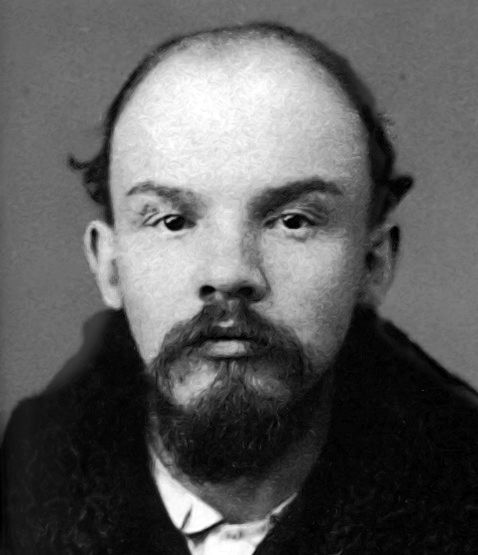
Vladimir Ilych Ulyanov, mugshot from 1895 arrest, St Petersburg

I’m no fan of Lenin, but he spent a good deal of time in London, so must be included in this series. I haven’t chosen this mugshot as an expression of my disapproval – it’s just that most of the photos that are available were taken after the revolution, and this one is the closest I could find in date to his first, and longest, visit to London. No doubt posing for portraits was not really a priority for an underground revolutionary.

But if pictures are scarce, source material on Lenin’s connections with London isn’t a problem, at least in terms of its availability. The difficulties lie elsewhere. Obviously no sort of history involves the unambiguous recitation of ‘the facts’, but works about Lenin bear greater resemblance to hagiography than history, and Krupskaya receives much the same treatment. When I read that ‘one is amazed by her rich memory, expressive style and accuracy … Grief and the pain of her loss sharpened Krupskaya’s memory, and those first years of revolutionary work and life together seemed as clear as yesterday’ (Muravyova, p. 21), I truly wondered whether I had read the same Reminiscences of Lenin as the authors of Lenin in London (and whatever the inadequacies and inaccuracies of the latter work, it is the main source on this topic, so all page references given are to this book, unless otherwise stated). The excesses of Bolshevik-speak occasionally provide amusement, as when they quote M. Essen on Lenin in Switzerland: ‘He climbs up a wonderful mountain, yet he isn’t thinking about the mountain at all, but about the Mensheviks’ (p. 106), but generally it’s just turgid. There’s also the need to read between the lines, particularly where Stalin and Trotsky are concerned, because of the re-writing of Soviet history. Despite these problems, I’ve used a number of Soviet sources, as a) many of them are available on the net, and many of these are contemporary(-ish), and b) Western sources, having other axes to grind, are generally less concerned with the details of location that interest me. Helen Rappaport’s recent book Conspirator: Lenin in Exile, tells a good story, but [comment withdrawn] has a rather relaxed approach to citing sources, which makes it extremely difficult to check some of the claims she makes.

Lenin and Krupskaya left Germany because of increased persecution by the police, and arrived in London in mid-April 1902 to transfer the publication of Iskra, the newspaper of the Russian Social Democratic Labour Party (RSDLP). They were met at Charing Cross station by a fellow exile, Nikolai Alekseev, and used his address (14 Frederick Street, off Gray’s Inn Road) for correspondence at first, before finding accommodation ‘two steps’ from there, according to a letter from Lenin to Plekhanov (p. 19), at 30 Holford Square, Pentonville. The house is no longer there, and the block of flats that was built in its place, planned in the early 1940s, was originally going to be called Lenin Court. By the time it was completed a decade later, enthusiasm for things Soviet had waned, to say the least, and it was called Bevin Court instead. You can read more about it in this BBC article.

The Ulyanovs spent just over a year in London, living in Holford Square under the name of Richter and upsetting the bourgeois landlady Mrs Emma Yeo with their bohemian behaviour, which apparently included hanging curtains on a Sunday (p. 23). It is worth noting that Lenin always stayed around the fairly salubrious environs of Bloomsbury and Pentonville. His excuse was proximity to the British Museum, but am I alone in suspecting that he wasn’t actually that keen on rubbing shoulders with the proletariat, at least not on a regular basis?

At first there were practical difficulties, not least with language. Lenin and Krupskaya had translated Beatrice and Sidney Webb’s Industrial Democracy whilst in Siberia, but neither had any real experience of spoken English. The Takhtarevs – Konstantin, the former editor of Rabochaia mysl’, and his wife Apollinaria Iakubova from the St Petersburg group, living nearby at 20 Regent Square (only nos. 1-18 of the original houses are still standing) – took Lenin and Krupskaya under their wings and helped them in this respect, despite ideological differences. In May 1902 Lenin advertised in the Atheneum journal and was soon exchanging lessons with a Mr Raymond (or Rayment, according to Rappaport, p. 77), who worked for the publisher George Bell & Sons, a clerk, Mr Williams, and a worker named Mr Young (no relation) (p. 35). Predictably, Lenin in London informs us that the speed with which our hero mastered spoken English was nothing short of miraculous.

Lenin spent the mornings working at the Reading Room at the British Museum (and was highly impressed with ‘the world’s richest library’, as Krupskaya called it, but not by the museum). His ticket number was A72453. He then conducted Iskra business on the way home (continuing the tradition of Russian radical publishing in London).

Marx Memorial Library, Clerkenwell Green

The offices of Iskra were at 37a Clerkenwell Green (now the Marx Memorial Library) – Harry Quelch, the editor of the British Social Democrat weekly, Justice, made their printing press available, with Iskra just having to provide its own typesetters (p. 40). Numerous addresses where Iskra workers and other activists and sympathizers lived were used for correspondence. These included: the flat of L. Deutsch, narodnik, Social Democrat and member of the Emancipation of Labour group, at 26 Granville Square, off King’s Cross Road (p. 48); 22 Ampton Street, off Gray’s Inn Road, the new address of Nikolai Alekseev from October 1902; the flats of British Social Democrats A. Hazell, at 85 Avenell Road, Highbury, V. C. Clews, at 62 Mildmay Grove (near Newington Green), and W. Woodroffe, at some distance from the others at 26 Barset Road, Nunhead (not ‘Barsett Road, Nanhead’, as Lenin in London has it, pp. 76-80).

Houses on Sidmouth Street

In addition, the Iskra editorial board rented a 5-room flat in Sidmouth Street, again just off Gray’s Inn Road, and this became a commune. Most of the sources I have read do not record the house number (Rappoport gives it as no. 14, p. 74), and in any case only three of the original houses survive. Julius Martov and Vera Zasulich (the latter had previous lived in London between 1894 and 1897 and, like Lenin, had made great use of the British Library; Bergman, p. 106) lived there in absolute squalor, by all accounts, and it was frequented by many visiting Russians, such as Plekhanov in September 1902 (p. 85) and, in the same month, a group of Social Democrats who had escaped from Lukyanovo prison in Kiev, including Maxim Litvinov (p. 91), future Soviet ambassador to the United States. Trotsky also visited when he arrived in October 1902; Lenin in London omits to mention this visit, but, perhaps surprisingly, given that it was written in 1933, Krupskaya does. Lenin also gave a number of speeches, including one on ‘the programmes and tactics of the Socialist-Revolutionaries’ at Liberty Hall, Whitechapel, on 29 November 1902 (p. 184), and on 21 March 1903 he spoke at a meeting to commemorate the anniversary of the Paris Commune at the New Alexandra Hall, Jubilee Street, Mile End. Louise Michel was another of the speakers (p. 185).

But all work and no play makes Volodya a dull revolutionary, and we learn that in between his extraordinary feats of intellectual labour and tireless activities for the revolutionary cause, Lenin enjoyed exploring London. He particularly liked walking in Primrose Hill and visiting Regent’s Park zoo (pp. 102-4), but many of his leisure activities do seem to have been connected with his work: he regularly attended Speakers’ Corner in Hyde Park to listen to speeches, and visited socialist churches, including Seven Sisters’ Church on Seven Sisters’ Road (pp. 94-7). As Krupskaya tells us:

Ilyich studied living London. He liked taking long rides through the town on top of the bus. He liked the busy traffic of that vast commercial city, the quiet squares with their elegant houses wreathed in greenery, where only smart broughams drew up. There were other places too – mean little streets tenanted by London’s work people, with clothes lines stretched across the road and anaemic children playing on the doorsteps. To these places we used to go on foot. Observing these startling contrasts between wealth and poverty, Ilyich would mutter in English through clenched teeth: “Two nations!”

In May 1903, following a decision by the Iskra board to move to Geneva, which Lenin alone opposed, the Ulyanovs left London. But they returned soon afterwards, when the 2nd congress of the RSDLP was forced to move from Brussels because of police persecution, and reconvened in London, under the guise of an Anglers’ club, according to Alan Woods. The first session was held on 11 August 1903 (29 July o.s.) at the Communist Club at 107 Charlotte Street. The building that now stands there houses UCL student residences. For more on the history of the club, see Keith Scholey’s pamphlet. There don’t appear to be any records on where subsequent sessions were held.

The usual suspects were present: Trotsky, Plekhanov, Zasulich, Martov, Axelrod… According to tradition this was the congress at which the Russian Social Democrats split into the Bolsheviks and Mensheviks, but in fact it was not at this stage a definitive rift. Few of the Soviet sources in any case give much detail on the substance of the differences. Most seem more interested in who was in which faction and what those factions were called than in the ideological differences between them – the description in the Short Course History of the Communist Party of the Soviet Union (Bolsheviks) is pretty typical in this respect. I suppose the idea is that the correct line (i.e. Lenin’s line) is beyond question and therefore doesn’t even need stating. If you are interested in some of the nitty-gritty, Lenin’s speeches are probably the best source, and Alan Woods gives an account that is very sympathetic to Lenin, but reasonably straightforward. After the congress, probably on 24 August 1903, Lenin led a group of Bolsheviks to Highgate Cemetery to visit the grave of Karl Marx (p. 141).

Two years later, in the wake of the 1905 revolution, the third RSDLP congress – the first Bolshevik congress – was held in London, from 12 April to 10 May 1905. There were between 40 and 50 delegates representing the various Bolshevik committees and the central committee (p. 150), including Lunacharsky and Bogdanov (Woods). Lenin, who chaired the congress, and Krupskaya, stayed around the corner from their old Holford Square Flat, at 16 Percy Circus, now marked with a blue plaque. There were also delegates staying at 9 and 23 Percy Circus (p. 149). I have not come across any details about where the sessions of the congress were held.


The Water Rats, once the Pindar of Wakefield

Lenin in London does have details of some of the extra-curricular activities: visits to the National Gallery and the theatre, the zoo and the Natural History Museum, the British Library and Highgate Cemetery, and also to a pub on Gray’s Inn Road, the Pindar of Wakefield (the book has ‘Pindor of Walkfield’, p. 149 – here and elsewhere, the translator obviously didn’t do much in the way of checking the spelling of English place names), which Lenin apparently frequented when he lived in the area. It’s now called The Water Rats, and is a well known music venue, notable, among other things, for hosting Bob Dylan’s first British gig in 1962. Another pub Lenin was known to visit with his comrades, and possibly one of the venues used for the congress, was the Crown and Woolpack, St John’s Street, Clerkenwell, now The Chapel hairdressing salon.

The Crown Tavern, Clerkenwell Green: Lenin and Stalin did not drink here

A third social venue, the Crown Tavern on Clerkenwell Green, proudly flaunts its reputation as the pub in which Lenin met Stalin for the first time at the 1905 congress, and the story is repeated in the BBC report on Lenin’s London haunts. Alas, this is a myth. Lenin may well have drunk in the pub during that congress or at other times, and possibly had a pint with Stalin at a later date (although the evidence doesn’t support this either), but Stalin most definitely wasn’t at the 1905 congress. Even the sycophantic Marx-Engels-Lenin Institute biography of Stalin, which tries its best to affiliate Stalin to Lenin’s victories and decisions from the earliest possible stage, doesn’t manage to place him at the scene, and states that the two men first met at the Bolshevik congress in Finland in December 1905-January 1906.

Tower House: Stalin stayed here?

Stalin was, however, in London for the 5th RSDLP congress in 1907, but where he stayed is a source of some confusion. According to most sources, he lodged at Tower House, Fieldgate Street, Whitechapel (then a notorious doss house, now an improbably smart refurbished block advertising loft-style apartments to let). This article by Robert Service from the Evening Standard claims Stalin stayed at ’77 Jubilee Road’. There is no such place in the East End and I assume he means Jubilee Street. Rappaport says that after surviving  couple of nights in Fieldgate Street (she calls the building Rowton House), Stalin moved to the greater comforts of ‘Jubilee Road’ (p. 156).

The 1907 congress was a much bigger affair than the Bolshevik event of 1905, with over 300 delegates. I’ve seen different breakdowns. Lenin in London says there were 103 Bolsheviks, 97 Mensheviks, and others from the Social Democratic parties of Poland, Latvia and Lithuania, and the Bund (pp. 165-6). Stalin claims there were 92 Bolsheviks and  85 Mensheviks. Woods has 89 Bolsheviks and 88 Mensheviks. According to Woods, the Menshevik delegates included Plekhanov, Martov, Axelrod, Deutsch and Dan, and the Bolsheviks Lenin, Zinoviev, Kamenev, Nogin, Bogdanov, Tomsky and others. Trotsky was present as a non-factional delegate, and others present included Maxim Gorky and Rosa Luxemburg. Felix Dzerzhinsky was due to attend but was arrested en route. Stalin, apparently, ‘had no voice in the proceedings as he had no credentials from any recognised party organisation in the Caucasus’ (Woods, part 3). Unsurprisingly, the Marx-Engels-Lenin Institute biography paints a somewhat different picture, saying that Stalin took an ‘active part’.

Brotherhood Church, Southgate Road

The main congress was held from 13 May to 1 June (30 April-19 May o.s.) at the Brotherhood Church,  on the corner of Southgate Road and Balmes Road, on the Islington/Hackney border. It’s now been replaced by an unprepossessing block of flats. But there was also a Bolshevik congress held at a socialist club in Fulbourne Street, off Whitechapel Road on 10 May (p. 167), A BBC4 programme, Watching the Russians, followed the trail of Russian revolutionaries in London, and William Fishman states that the door on the far left of the picture below led to this club. On 3-7 June, the second congress of the Latvian Social Democrats was held at King’s Hall, Commercial Road, Whitechapel (p. 172).

Fulbourne Street, Whitechapel: the Bolshevik congress of 1907 was held in this building

I have not come across any reference to where Lenin lodged during this visit, but Gorky, with whom he spent a good deal of time (they had only met once previously, but consolidated their friendship during the congress), stayed at the Imperial Hotel, Russell Square, and Lenin worried that the damp there would affect his health (pp. 176-7). In their spare time Lenin and Gorky visited the British Museum, and ‘the delegates warmly remembered … a discussion with Lenin on the grass in Hyde Park’ (p. 179) – a slightly unexpected picture. There are also reports that Lenin was seen drinking tea at the workers’ club at 165 Jubilee Street, Whitechapel, established by Rudolf Rocker’s Jewish anarchist group and the newspaper Arbeter Fraint (Fishman, p. 264). As he was in the area for the satellite conferences, this seems not unlikely – the club was not exclusively used by anarchists – but I’m less sure about the story that he created a scene by accusing another person at the club of being a Russian police spy and was arrested in the subsequent disturbance (Graur, p. 99). I haven’t found any other reference to Lenin being arrested in London. Other connections are made with the Jubilee Street Club by Rappaport. She says the inaugural meeting of the RSDLP congress was held there on 10 May (p. 156). This is not supported by other sources. The Whitechapel meeting was of the Bolshevik faction only, and the Fulbourne Street location seems much more likely. Her claim that Kropotkin was also there (introducing ‘his friend’ Lenin to a detective outside the club, p. 157), and indeed present at some of the main sessions of the congress, suggests a misunderstanding of the nature of the revolutionary movement. Nothing else I have read puts Kropotkin anywhere near the scene, and it seems highly improbable that he would have had any involvement with either the congress or Lenin.

In May 1908, Lenin returned to London to work in the British Library. He lodged at 21 Tavistock Place, near his old haunts of Sidmouth Street and Regent Square, and spent his time preparing materials for writing Materialism and Empirio-Criticism, which was published the following year. Lenin’s final, brief, trip to London was in Autumn 1911. He stayed at 6 Oakley Square, near Mornington Crescent (p. 188), and gave a lecture on ‘Stolypin and the Revolution’ at the New King’s Hall, Commercial Road, on 11 November (p. 193).

Sources

Jay Bergman, Vera Zasulich: A Biography (Stanford, CA: Stanford University Press, 1983)
Central Committee of the C.P.S.U.(B.), ed., History of the Communist Party of the Soviet Union (Bolsheviks). Short Course (International Publishers, 1939)
William J. Fishman, East End Jewish Radicals, 1875-1914 (London: Duckworth, 1975)
Mina Graur, An Anarchist ‘Rabbi’: The Life and Teachings of Rudolf Rocker (New York: St Martin’s Press; Jerusalem: The Magnes Press, 1997)
N. K. Krupskaya, Reminiscences of Lenin, trans. Bernard Isaacs (International Publishers, 1970)
Marx-Engels-Lenin Institute, Stalin (Moscow: Foreign Languages Publishing House, 1947)
L. Muravyova and L. Sivolap-Kaftanova, Lenin in London: Memorial Places, trans. Jane Sayer (Moscow: Progress, 1983)
Helen Rappaport, Conspirator: Lenin in Exile (New York: Perseus, 2010)
Keith Scholey, The Communist Club (London: Past Tense, 2006)
Alan Woods, Bolshevism: The Road to Revolution (London: Well Red Books,1999)

Kropotkin: an addendum

I’ve finally got round to reading Rudolf Rocker, The London Years, trans. Joseph Leftwich (Nottingham: Five Leaves; Oakland, CA: AK Press, 2005). It’s a powerful and readable book, even if the translation is a bit clunky. Among many points of interest, it contains a couple of marvellous descriptions of Kropotkin that really give a very strong impression of the man. Rocker first got to know Kropotkin in 1896, and was a regular visitor to his house in Bromley thereafter. As I said in my previous post, Kropotkin also visited Rocker, and worked at Dunstan Houses, and frequently spoke at the Jubilee Street Club. The first passage is a general appraisal:

I remained closely connected with Kropotkin from the day I first entered his house in 1896 till he returned to Russia after the Revolution of 1917. The longer I knew him the more I admired and loved him. He was a man of great personal charm and kindliness, with all his great learning modest and unassuming, and with a burning passing for justice and freedom. He was in his personal life ad his personal relations the same man who wrote Mutual Aid. There was no cleavage between the man and his work. He spoke and acted in all things as he felt and believed and wrote. Kropotkin was a whole man. He was one of the greatest happenings in my life. I was never a man to worship an idol. I could never be blind to a man’s faults, however great I thought him. What bound me to Kropotkin was his warm humanity, his unshakeable sense of justice. Justice was no abstraction to him. It was the expression of his real fellow-feeling with other people. I am sure he never made anyone feel small in his presence. He was a great soul (pp. 75-6).

The second is a description of the first protest meeting against the Kishinev pogrom, held in early May 1903 in Hyde Park (before the mass meeting of 21 June I mentioned in the previous post):

Outstanding among the many speakers was Peter Kropotkin. I still carry a picture in my mind of Kropotkin as I saw him that day, his face pale with emotion, his grey beard caught by the wind. His first words were hesitant, as though choked by his deep feeling. Then they came rushing out fiercely, each word like the blow of a hammer. There was a quiver in his voice when he spoke of the suffering of the victims. He looked like some ancient prophet. All the thousands who listened to him were moved to their depths (p. 86).

Russians in London: Pyotr Kropotkin

The geographer and anarchist Prince Pyotr Kropotkin first arrived in England in July 1876, fresh from his legendary escape from the Peter and Paul fortress in St Petersburg. He lived briefly in Edinburgh, and earned a living writing for The Times and the journal Nature, but it would be another ten years before he settled in London. His first visit to London was in July 1881 to attend the International Anarchist Congress. Most sources suggest this took place at a pub in Charrington Street, Somers Town (Quail, p. 16) that has been identified in this timeline (p. 37) as the Brewer’s Hall (no longer there, but at no. 59, according to the Dead Pubs website). George Woodcock states that the congress began on 14th July on Charrington Street, and included ‘a fair array of the celebrated names of anarchism. Malatesta and Merlino, Kropotkin and Nicholas Chaikovsky, Louise Michel and Emile Pouget’ (Anarchism, pp. 241-3). However, Stan Shipley notes that ‘The Radical (23 July 1881) reports a congress held on Monday July 18th at the Cleveland Hall, Fitzroy Square, with […] speeches from Marie Le Compte, the transatlantic agitator, Louise Michel, and Kropotkin’ (p. 60).

Kropotkin moved with his wife Sophie to Islington in October of the same year, and with Chaikovsky was active ‘touring the metropolitan radical clubs to collect money for the Red Cross Society of the People’s Will’ (Shipley, p. 13), to support those imprisoned after the assassination of Tsar Alexander II.

One meeting at which Kropotkin spoke in May 1882, held at the Patriotic Club, Clerkenwell Green (now the Marx Memorial Library), erupted into an argument between George Standring, editor of The Republican, and Charles Murray of the Manhood Suffrage League, over whether this Red Cross was a political or a philanthropic movement. At this meeting Kropotkin also met the young anarchist Ambrose Barker, and accepted his invitation to speak at the Stratford Dialectical and Radical Club (Shipley, p. 36), so this undated handbill (reproduced from Shipley) advertising ‘Prince Krapotkine’s’ [sic] appearance on 4th June must also be from 1882.

But despite such activity, Kropotkin’s first stay in London was not a happy experience, and he left a year later, apparently unable to bear the solitude, and declaring in his Memoirs of a Revolutionist ‘Better a French prison than this grave’ (II, 254). And a French prison was indeed where he ended up, following his arrest in December 1882 for belonging to the International Working Men’s Association (the First International).

After his release in January 1886, Kropotkin and his wife arrived back in London in March 1886, staying at first with his fellow exile Sergei Stepniak-Kravchinsky in St John’s Wood. He immediately became involved in political and propaganda activities, stating in his Memoirs, ‘[t]he socialist movement was in full swing, and life in London was no longer the dull, vegetating existence that it had been for me four years before. We settled in a small cottage in Harrow’ (II, 306). Some might see a contradiction between these two sentences, but I couldn’t possibly comment. The attractions of Harrow apparently included the proximity of his old comrade Nikolai Chaikovsky (Morris, p. 60) and a nice garden (both Kropotkin and his wife were keen gardeners). I have not yet been able to establish the precise location of this house.

Freedom Press Publishers and Bookshop, Angel Alley, Whitechapel

That first summer in London was a difficult period; Sophie was severely ill with typhus, and Kropotkin received news of his brother’s suicide, shortly before he had been due for release from Siberian exile (George Kennan describes his encounter with Alexander Kropotkin in Siberia and the Exile System, I, 325-33). By October 1886 Kropotkin had written the majority of the first issue of the anarchist-communist monthly journal Freedom, published by Charlotte Wilson, which was the first step to the foundation of the Freedom Press, still located in Whitechapel today. Aside from this, and resuming his scientific journalism, again for The Times and Nature, he also spoke at workers’ and anarchists’ meetings around the country, and met both middle- and working-class anarchists.

Fishman has a good deal of information on this (pp. 193-268). On 1 November 1890, Kropotkin appeared at a meeting at the Mile End Assembly Hall (site of the Tower Hamlets Mission), alongside Stepniak-Kravchinsky, Feliks Volkhovsky, Eleanor Marx, William Morris and others, to protest against persecution of Jews in Russia (p. 193; handbill reproduced from Fishman). The following year, on 11 November, Kropotkin was one of the speakers at a memorial meeting for the Chicago Martyrs at the South Place Institute (the Ethical Society, which later moved to Conway Hall, Red Lion Square); other speakers included Louise Michel and Errico Malatesta (p. 207). On 7 February 1896, he gave a lecture at the Working Lads’ Institute, 137 Whitechapel Road (p. 218). Particularly notable was the march from Mile End Waste and rally in Hyde Park on 21 June 1903 in protest at the Kishinev pogrom; 25,000 people gathered and Kropotkin, who arrived late, was lifted over the heads of the crowd, giving short speeches in Russian and English despite his illness (p. 252). Advised by his doctor to retire from public speaking, Kropotkin nevertheless contributed to the inaugural ceremony and series of Friday lectures at the workers’s club established in February 1906 at 165 Jubilee Street (p. 265). The building is no longer there.

But despite these activities and the appreciative reception Kropotkin always seems to have received, he formed the ‘conviction that a revolution was impossible in England’ (Memoirs, II, 312), because the demands the workers were making had not yet reached the level of those of the socialists, and he felt that as a result even the slightest improvements in conditions would be deemed acceptable. But in some quarters Kropotkin was also considered too gradualist; in 1909, Rudolf Rocker had to dissuade a group of young Russians from their plan to assassinate Kropotkin on the grounds that his moderate influence was holding back the revolutionary forces (Fishman, p. 272).

Kropotkin gradually moved from propaganda to intellectual activities, and published a number of his best-known theoretical writings whilst in London, including The Conquest of Bread (1892), Fields, Factories and Workshops (1899), and Mutual Aid (1902), as well as In Russian and French Prisons (1887) and Memoirs of a Revolutionist (1899). But he clearly maintained an important position and was seen as an authority; when Shaul (Saul) Yanovsky, the editor of the Yiddish socialist newspaper Arbeter Fraint, was felt to be damaging the paper because of his authoritarian tendencies, it was Kropotkin who was called in to warn him of the damage he was doing (Fishman, p. 208).

Kropotkin’s house, 6 Crescent Road, Bromley

In summer 1894, he and his wife moved to 6 Crescent Road, Bromley (again, the garden was important, and at least it had the advantage of being a remote suburb in South London, rather than North), commemorated with a blue plaque.

This became an open house for anarchist exiles, and British socialists such as Keir Hardie (Morris, p. 69). Life was not easy, though; Fishman notes that it was practically a hand-to-mouth existence, and there was never any money in the house – when Stepniak visited Bromley from Hammersmith, Sophie had to borrow money from the neighbours for his return ticket (p. 222). Nevertheless, he gave financial support to anarchist causes, including donating money to the Arbeter Fraint so that it could continue publishing (Graur, p. 94). Perhaps the most notable incident of his life in Bromley happened in January 1905, when news of the Bloody Sunday massacre in St Petersburg reached Britain. According to his nephew, who was staying with him at the time, the cottage was besieged by reporters who wanted to interview Kropotkin. He was ill at the time, and just sent out a note with ‘Down with the Romanovs!’ written on it (Woodcock and Avakumovic, p. 365), which conjures up a rather marvellous picture.

This period saw increasing numbers of Russian (mostly Jewish) immigrants to the East End, who formed not only the largest Russian emigre group in Europe, but also the largest anarchist group in Britain. With the increase in activity this implied, Kropotkin remained involved despite increasing health problems. He participated in further anarchist conferences in London in December 1904 and October 1906 (Woodcock and Avakumovic, p. 360), and in October 1906, he also helped launch a new periodical, Listki khleb i volia (Pages from Bread and Freedom), the forerunner of which (Bread and Freedom) had been published by young radicals who returned to Russia after the 1905 revolution.

Dunstan Houses, Stepney Green

This venture lasted less than a year, but reinforced his contacts within anarchist groups; the journal was printed at 33 Dunstan Houses, Stepney Green, the headquarters of Yiddish anarchism and home of its de-facto leader, Rudolf Rocker (Fishman, p. 268). It was to this magnificent block (built in 1899 and still there in all its glory) that Kropotkin took one one of his visitors, Afanasy Matushenko, one of the leaders of the Potemkin mutiny, in late 1905 (Fishman, p. 258). But he also, in these later years, began to work with the authorities; in 1909, in co-operation with the British parliamentary committee on Russian affairs, he produced the report The Terror in Russia, which had a great impact on British opinion of Russia at the time (Woodcock and Avakumovic, p. 373).

Two years later, Kropotkin and his wife moved to Chesham Street, Kemp Town, Brighton (I do not know which house), which, according to Woodcock and Avakumovic, ‘looked like a dull end to an active life’ (p. 387) — perhaps an odd observation, considering the long years of suburban life. In his later years he became isolated from much of the anarchist movement because he saw the war as necessary to protect France from German absolutism and militarism (Grauer, pp.111-20). Like many Russian exiles, he returned to Russia with his family after the February revolution of 1917, but he was unenthusiastic about the Bolshevik revolution. He died in 1921 near Moscow.

Sources

William J. Fishman, East End Jewish Radicals, 1875-1914 (London: Duckworth, 1975)
Mina Graur, An Anarchist ‘Rabbi’: The Life and Teaching of Rudolf Rocker (New York: St Martin’s Press; Jerusalem: The Magnes Press, 1997)
James W. Hulse, Revolutionists in London: A Study of Five Unorthodox Socialists (Oxford: Clarendon Press, 1970)
George Kennan, Siberia and the Exile System (New York: Century, 1891), 2 vols
P. Kropotkin, Memoirs of a Revolutionist (London: Smith, Elder & Co., 1899), vol. 2
Brian Morris, The Anarchist Geographer: An Introduction to the Life of Peter Kropotkin (Minehead: Genge Press, 2007)
John Quail, The Slow Burning Fuse: The Lost History of British Anarchists (London: Flamingo, 1978)
Stan Shipley, Club Life and Socialism in Mid-Victorian London (London: Journeyman/London History Workshop Centre, 1983)
G. M. Stekloff, History of the First International (London: Martin Lawrence, 1928)
George Woodcock and Ivan Avakumovic, The Anarchist Prince: A Biographical Study of Peter Kropotkin (London: Boardman & Co., 1950)
George Woodcock, Anarchism (Harmondsworth: Penguin, 1963)

Russians in London: Vladimir Solov’ev

On 11 July 1875, the philosopher and poet Vladimir Solov’ev arrived in London. Having finished his studies (in natural sciences, then history and philology) at Moscow University and at the seminary at Sergiev Posad, Solov’ev was already, at the tender age of 22, teaching philosophy at Moscow University.

Vladimir Solov'ev, 1870s

On the advice of various friends and colleagues, including Dostoevsky, he travelled to Britain to study Kabbalistic, gnostic and mystical literature, and wasted no time in getting down to work; in a letter to his mother dated 13 July, he reports registering at the reading room of the British Museum on the previous day. Although he made a number of friends in London, mostly with Russians, including the sociologist Maxim Kovalevsky, he spent most of his time alone, working in the library, which he described as ‘the best institution in the world’ in a letter to Pyotr Alekseevich Preobrazhensky dated 7 August 1875.

He immediately moved into lodgings at 39 Great Russell Street (now home to Gosh! comics), where the landlady was one Mrs Siggers. In a letter to Olga Novikova, the notorious right-wing Russian publicist who lived in London for many years and wrote regular articles on Russian affairs for the Pall Mall Gazette, also written on 13 July, he states that his rooms are ‘quite gloomy’, but that he is ‘enjoying seeing the London smog through the open window’. In the light of this, his claim in a letter of 29 July to his mother that ‘London is notable for its fresh air and is the healthiest city in the world’ looks more like an attempt to assuage parental concerns than an honest assessment.

39 Great Russell Street, London

He was, at least, at pains to ensure his parents have the correct address for correspondence. He concludes his letter of 13 July: ‘London. 39 Great Russel [sic] Street, W. (Opposite the British Museum)’, and then spends subsequent letters explaining that he had missed out the ‘C’ and that they had to write W.C.; ‘Russel’ never regains the missing ‘l’, however.

Given his interest in all aspects of mysticism, not only in literature and philosophy, but also its popular forms, it is perhaps not surprising that Solov’ev was attracted to the spiritualists who achieved great notoriety in Britain at the time, encounters he describes in a brief but detailed letter to his friend Dmitry Nikolaevich Tsertelev, dated 3 September 1875. He is not impressed, saying his hopes of finding something interesting were in vain, and his impression was of ‘charlatans on the one hand and blind believers on the other’. He refers to a seance he attended, conducted by ‘Williams’, who is ‘a magician, more impudent than expert’, and whose manifestation of the spirit control popularly known as ‘John King’ (reputedly the spirit of the pirate Henry Morgan) ‘looked as much like a spirit as I do an elephant’. Solov’ev was, I was not surprised to learn, correct; Charles Williams, together with his partner Frank Herne, operating out of 61 Lamb’s Conduit Street, was more than once exposed as a fraud. Solov’ev ends his letter by noting that the following week, Williams, who had been ‘somewhat taken aback by my discoveries [assumedly of the absence of real spirit activity – SJY] last time’ would be holding a ‘test-seance’ (written in English). Solov’ev promises to send more news if anything beyond the expected occurred; the absence of any further reference to the subject speaks for itself.

The British Museum, 'the best institution in the world'

But this was something of a side-show from his main work in the library, described in the letter to his mother of 29 July as ‘ideal in all respects’. Walicki states (p. 372) that in London Solov’ev studied ‘the history of mysticism, especially the Neoplatonic tradition and German mysticism and theosophy (Jacob Boehme, Franz Baader).’ His work was apparently going well, but was famously interrupted by his vision of Sophia, the personification of divine wisdom. Twenty years later, he described the vision — and the two others he was granted — in the poem Mochul’skii describes as ‘semi-joking’ (p. 69), ‘Three Meetings’:

… My dream took me to the British Museum,
And my dream was no misdirection.

Shall I ever forget that blessed half-year?
Not phantoms of perfect beauty,
Neither lives, nor passions, nor nature —
But You! You owned my whole soul.

Despite the crowd’s bustle back and forth,
And the roar of fire-breathing factories,
Despite the hard city blocks, the soulless buildings —
In sacred silence I sit, here, alone.

Well, certainly cum grano salis:
I was lonely, but no misanthrope;
In social solitude.
Which of my friends shall I now name?

A shame, that in this short space I cannot manage
Their names nor their foreign chatter…
I’ll just list: Two, three British wizards
And, yes, two or three masters from Moscow.

So few so much the better, leaving me alone in the library;
And believe it or not (God is my witness),
Mysterious forces chose my
Every book; and I read only of Her.

When sinful whims whispered,
“Look in a book ‘from another opera’” —
Such operatic dramas erupted,
That in confusion I fled back to my flat.

And it was here — it was autumn —
When I told Her: “Divine Flower,
I feel Your touch! But why have you hidden Yourself
From my sight since I was a boy?”

At the very moment these thoughts moved through my mind —
Instantly, golden azure filled the room,
And she shone before me once again —
But just Her face — Her face.

At that instant lasting bliss was born in me!
Once more my soul went blind to mundane matters.
If I gave a sober hearing to Her, I know not what I heard;
Her words were incomprehensible, talk fit for a fool.

3

I said to Her: “I see your face,
But I yearn for all of you.
What You have not held back from the boy,
That — the young man also wants!”

“To Egypt go!” — a voice within proclaimed.

Translation by Ivan M. Granger. Taken from Poetry Chaikana.

… Моей мечтою был Музей Британский,
И он не обманул моей мечты.

Забуду ль вас, блаженные полгода?
Не призраки минутной красоты,
Не быт людей, не страсти, не природа –
Всей, всей душой одна владела ты.

Пусть там сиюут людские мириады
Под грохот огнедышащих машин,
Пусть зиждутся бездушные громады, –
Святая тишина, я здесь один.

Ну, разумеется, cum grano salis:
Я одинок был, но не мизантроп;
В уединении и люди попадались,
Из коих мне теперь назвать кого б?

Жаль, в свой размер вложить я не сумею
Их имена, не чуждые молвы…
Скажу: два-три британских чудодея
Да два иль три доцента из Москвы.

Всё ж больше я один в читальном зале;
И верьте иль не верьте, – видит Бог,
Что тайные мне силы выбрали
Всё, что о ней читать я только мог.

Когда же прихоти греховные внушали
Мне книгу взять «из оперы другой» –
Такие тут истории бывали,
Что я в смущенье уходил домой.

И вот однажды – к осенью то было –
Я ей сказал: «О божества расцвет!
Ты здесь, я чую, – что же не явила
Себя глазам моим ты о детских лет?»

И только я помыслил это слово, –
Вдруг золотой лазурью всё полно,
И предо мной она сияет снова –
Одно её лицо – оно одно.

И то мгновенье долгим счастьем стало,
К земным делам опять душа слепа,
И если речь «серезный» слух встречала,
Она была невнятна и глупа.

3

Я ей сказал: « Твое лицо явилось,
Но всю тебя хочу я увидать.
Чем для ребёнка ты не поскупилась,
В том – юноше нельзя же отказать!»

«В Египте будь!» – внутри раздался голос.

—

… And, despite his initial intention of staying in London for at least six months, Solov’ev changed his plans immediately, leaving for Cairo on 28 October 1875. In Egypt, still wearing a long black coat and the silk top hat he found so difficult to get used to in London (letter to his mother, 13 July), he was robbed by the Bedouin in the desert (Mochul’skii, p. 69). But, according to the poem, he was at least granted his third vision.

Sources

Letters to Solov’ev’s mother and D. N. Tsertelev taken from: Vladimir Solov’ev, “Nepodvizhno lish’ solntse liubvi…”: Stikhotvoreniia, Proza, Pis’ma, Vospominaniia sovremennikov, n. ed. (Moscow: Moskovskii rabochii, 1990), pp. 184-190 and 209-10.

Letters to O. A. Novikova and P. A. Preobrazhenskii taken from Vladimir Solov’ev, Pis’ma, ed. E. L. Radlov (Petersburg: Vremia, 1923), pp. 161-2 and 231-2.

Translation of ‘Three Meetings’ by Ivan M. Granger at Poetry Chaikhana.

Konstantin Mochul’skii, Vladimir Solov’ev: Zihzn’ i uchenie (Paris: YMCA Press, 1951)

Andrzej Walicki, A History of Russian Thought from the Enlightenment to Marxism, trans. Hilda Andrews-Rusiecka (Stanford, CA: Stanford University Press, 1980)

Russians in London: Turgenev

In the history of Russians in London, Ivan Turgenev (1818-1883) in many ways acts as a transitional figure, because although most of his visits were quite short (except during the Franco-Prussian war, when he decamped to England for a year), they were frequent, and span a much longer period than those of his contemporaries. He first visited London in July 1847, and his final visit was in October 1881. In between, in the period from 1856 to 1862, he was in London at least on an annual basis, and his regular visits resumed after his 1871 stay.

Pauline Viardot

The main reason for Turgenev’s frequent stays in London, despite an apparent ambivalence about aspects of English culture, was his long-standing relationship with Pauline Viardot, the opera singer. She regularly appeared on the London stage and, according to Patrick Waddington, a great deal of her success was founded on her London performances (p. 11; all page references are to this book). For many years, Turgenev followed the Viardot family and took lodgings close to where they were staying, and the same happened in London.

Turgenev made so many visits to England that it’s not feasible to provide every detail. Instead, I’ll try to give a general impression of his usual activities and major contacts in London, along with the specifics of the most important events. Anyone who wishes to find out more should read Waddington’s Turgenev and England.

It will come as no surprise to readers of my other posts on Russians in London to learn that Turgenev spent a great deal of time with Herzen, Ogarev and their families. Waddington states that from 1856, Turgenev acted as one Herzen’s major informants on Russian affairs (p. 13), and that Ogarev was the inspiration for the character of Lavretsky in Turgenev’s 1859 novel A Nest of Gentlefolk (p. 22). Fathers and Sons also seems to have some connection with this group, as Turgenev began work on it in 1860 whilst staying on the Isle of Wight with the critic Pavel Annenkov, the Herzen entourage and, seemingly, half of educated Russia (pp. 93-107). And as usual, there is a share of misinformation and uncertainty surrounding these visits. Natalya Ogareva apparently claimed that Turgenev and Tolstoy visited Herzen together in 1861, but Waddington confirms that the dates don’t fit, and suggests Turgenev may not have been in London at all that year (pp. 129-30). But in the very next paragraph, Waddington himself seems to be confused about Bakunin’s whereabouts – he states that in May 1862, when Turgenev finally arrived with the writer Vasily Botkin after many delays, there was no room for him at the Herzen residence on Westbourne Terrace and ‘he had to stay with neighbours, possibly in the very house where Michael Bakunin was now living’. But we know that Bakunin was by this time living at 10 Paddington Green, which by no stretch of the imagination could be described as neighbouring Orsett House. A rift with Bakunin marked the end of Turgenev’s visits to this most famous group of Russian exiles in Russian, but of course they were shortly to leave London themselves.

In contrast to the rather insular life led by Herzen and his extended family, Turgenev cultivated a wide circle of acquaintances among English writers and politicians. In 1857, he met Thomas Carlyle, Lord Macaulay, Benjamin Disraeli, William Thackeray and the philosopher William Whewell, and thereafter was a regular visitor to Carlyle’s house at 24 (at that time no. 5) Cheyne Row, Chelsea (p. 20). On 28 May 1857, Turgenev attended the annual meeting of charity children at St Paul’s, where an audience which also included Hector Berlioz (who Turgenev presumably knew though the Viardots) listened to a children’s choir performing the Hallelujah Chorus and Zadok the Priest (p. 26).

Subsequent visits followed a similar pattern of public events and private visits to public figures. On 5th May 1858 Turgenev attended the 69th annual dinner of the Royal Literary Fund at the Freemason’s Hall, Great Queen Street (p. 63). Other guests included Thackeray and Lord Palmerston. A few days later, on 9th May, he visited Thackeray at his home at 36 Onslow Square, South Kensington (another address to which he would become a regular visitor), where we have the tantalizing prospect that he may have met Dickens. Thackeray’s diary states that they both called on that date, but there is no information about whether the visits coincided (p. 73).

Wyld's Great Globe

There is less information available about what Turgenev did beyond his usual round of visits, and Waddington does indulge in a little speculation to fill in the gaps, although generally in a rather more measured way than that we encountered in relation to Tolstoy’s visit. Certainly it seems quite likely that in May 1857, when Turgenev was staying at the Sablonniere Hotel in Leicester Square, he would have seen the ‘Diorama of Russian Life and Scenery’ showing at the time at Wyld’s Great Globe, which could be found just outside the hotel (p. 20). The possibility of Turgenev visiting London’s other great attractions, such as Madame Tussaud’s, and the Crystal Palace at Sydenham, is also raised (p. 15), although without any particular evidence. But the Crystal Palace reappears in a later connection, as in chapter 14 of his novel Smoke (published in 1867), Potugin states ‘Last spring I visited the Crystal Palace near London; in that palace, as you’re aware, there’s a sort of exhibition of everything that has been devised by the ingenuity of man’. As Waddington suggests (p. 132), Potugin’s description seems to relate more to the 1862 International Exhibition, but the reference to the Crystal Palace lies not only in the name but also in the location ‘near London’. As we saw with Dostoevsky, the two buildings and exhibitions are conflated and Paxton’s original comes to stand for both, but it does seem possible that Turgenev visited both.

After 1862, Turgenev did not return to Britain  for the rest of the decade, but in December 1870 he and the Viardots fled to London from Baden Baden. The Viardots took up residence at 30 Devonshire Place, and Turgenev took rooms nearby at 25 Devonshire Street, but found them very uncomfortable and quickly moved to 4 Bentinck Street, which didn’t turn out to be much better (pp. 143-4). He resumed some of his old acquaintances, and had ‘sustained contact’ with Carlyle that winter (p. 163). He also spent a lot of time with the translator William Ralston, who nominated him for temporary membership of the Arts Club (p. 156), then located in Hanover Square, and Turgenev attended numerous lectures by Ralston, including ‘On Russia: Its Great Reforms during the last 10 years’ on 18th December 1870 at St George’s Hall, Langham Place (p. 157) and at the Royal Institution on Russian folklore on 5th May 1871 (p. 168).

During this year, Turgenev also became friends with George Eliot (Mary Ann Evans) and spent a good deal of time at her residence, The Priory, 21 North Bank, Regent’s Park. It was here that he met the artists Edward Burne Jones and Ford Madox Brown, and the novelist Anthony Trollope (p. 171-87). It was at Ford Madox Brown’s house on Fitzroy Square that Turgenev met William Morris (p. 188). By all accounts the two men were not particularly close, but the connection is important. As we shall see, Morris later became associated with Kropotkin and Stepniak. It seems ironic that Turgenev, whose portrayal of the radical generation of the 1860s in Fathers and Sons caused such a rift, proves to be the link between Herzen and the Kolokol generation, and the anarchists and populists of the 1870s and 80s.

On 29th July 1871 Turgenev left England with the Viardots (p. 206). They never returned, but Turgenev visited several more times, although often to spend time outside London, for example staying in Cambridgeshire with Eliot and her partner George Lewes in October 1878. In 1879, he was awarded an Honorary Doctorate in Civil Law by the University of Oxford. Afterwards he visited an exhibition of Vereshchagin’s paintings in South Kensington, and had dinner at the Reform Club with Henry James. Turgenev’s final visit to London is the subject of an essay by Ford Madox Ford, entitled ‘The Beautiful Genius’, whom he visited at Fitzroy Square on 22nd October 1881 (p. 283).

Sources

Patrick Waddington, Turgenev and England (London and Basingstoke: Macmillan, 1980)

Russians in London: Dostoevsky

Dostoevsky left St Petersburg for his first trip to Europe on 7th June 1862. He spent most of his time in France and Italy, but also visited London for 8 days – his only trip to Britain – arriving on 9th July (Dryzhakov, p. 328). Like many other writers, one of his chief aims was to see Herzen, and he certainly did so on 16th July, as well as probably also on Sunday 11th. According to Frank, the two men, who found they had a great deal more in common than they had on their previous meeting, in 1846, discussed recent events: Chernyshevsky’s arrest, the spate of fires that had engulfed Petersburg that spring, and the revolutionary Young Russia proclamation that had been published to much furore in May (Frank, pp. 145-59, 188-92). Given the closeness of Herzen’s circle, and his habit of entertaining on Sundays at Orsett House, it seems likely that on 11th July, Dostoevsky also met Bakunin and Ogarev.

Conforming to what is becoming an pattern for this series, Dostoevsky hasn’t left us a great deal material about his visit. The only extended record is his travel notes, Winter Notes on Summer Impressions. This is a strange text in many ways, being far more about Russia than it is about Europe. As travel notes it’s pretty hopeless – Italy is entirely ignored and Germany is only mentioned to tell us he forgot to notice it. When it does concern itself with the author’s surroundings, it’s almost entirely negative. So it comes as no surprise that London doesn’t fare too well in his description.

The title of the London chapter, ‘Baal’, says it all. As I’ve discussed in a previous post, Dostoevsky refers to the ‘Crystal Palace, the International Exposition’ as a ‘terrible force that has united all the people here, who come from all over the world, into a single herd’ (p. 37).

International Exhibition, South Kensington, 1862

His description seems to amalgamate Joseph Paxton’s Crystal Palace at Sydenham and the 1862 International Exhibition in South Kensington, and it’s not clear whether he visited one or both of them (although as I’ve suggested in another post, not entirely seriously, he may have been inspired to write ‘The Crocodile’ by Waterhouse Hawkins’s dinosaur models in Crystal Palace park). Certainly, it’s the idea of the Crystal Palace that sticks in his mind, leading to its extended use as an image in Notes from Underground and its appearance in the form of a tavern in Crime and Punishment. Being a palatian myself, I rather hope he did make the trip down to South London. I like to imagine him strolling round the park getting more and more furious.

The Crystal Palace at Sydenham

The Crystal Palace epitomizes the ‘proud and dismal spirit’ (p. 42) of materialism, and Dostoevsky perceives this same spirit in the two other places he describes: the Haymarket and Whitechapel, both of which he seems to have visited more than once. ‘Whoever has been in London has surely at least once gone to the Haymarket at night. At night prostitutes crowd several streets in this quarter by the thousands’, he states (p. 39). He is struck by the ‘shameless cynicism’ and the sheer variety of those who crowd together in this area: ‘here are sparkling, expensive clothes and near rags and extreme differences in age gathered all together’ (p. 39) – possibly an inspiration for the ‘scandal scenes’ that play such an important role in his major works, in which people from different social backgrounds are flung together, usually with disastrous consequences. He seems more sorrowful than shocked at the sight of ‘mothers who were bringing their young daughters into the business. Little girls around twelve years of age take you by the hand and ask you to go with them’ (p. 40). Prostitution becomes a significant theme in the works Dostoevsky wrote in the next few years, in particular Notes from Underground and Crime and Punishment, and it seems quite likely that what he had seen at the Haymarket had some influence on that.

From Gustave Dore's London series

Whitechapel is, if anything, even worse, ‘with its half-naked, savage, and hungry population’ (p. 37). In the face of terrible poverty, ‘the masses grow numb and wander about like zombies’ (p. 38), and the main problem is drinking: ‘Everyone is drunk, not with cheer but dismally, miserably, and, in a rather strange way, silently. […] Everyone rushes as fast as he can to drink until he loses consciousness’ (p. 38). And it seems to have an even more profound effect on Dostoevsky: ‘On such a night at two o’clock I once got lost and for a long time roamed the streets in the midst of the numberless crowd of dismal people […] the impression of what I saw tormented me for three days afterwards’ (p. 38). Again, one can speculate about the role this experience played on the writing of Crime and Punishment, in which the theme of drunkenness is so prominent.

London, in other words, is pretty grim. But somehow, even though Dostoevsky doesn’t record the same dark impressions of French life, the picture he paints of Parisians’ bourgeois rectitude and moral emptiness is even more horrifying. There is, at least, a strong sense of sympathy for the lost souls he sees in London.

Beyond Winter Notes, there really isn’t anything to go on. The sole letter Dostoevsky sent while in England merely discussed arrangements for meeting Strakhov in Italy. One can probably make a few assumptions, though. There’s little in letters sent from other trips to suggest he was in the habit of attending public events or seeking out the great and good, as Tolstoy (and, as we shall see, Turgenev) did. A short article in The Dickensian claims that Dostoevsky met Dickens during his visit, citing a letter from 1878 to S. D. Yanovsky in which Dostoevsky states, ‘Dickens told me the same thing when I met him at the office of his magazine All the Year Round in 1862′ (Harvey, p. 233). One might explain the absence of reference to this meeting in Dickens’s papers by the fact that Dostoevsky didn’t really become known in Britain until some years later, after the former’s death, but it seems highly unlikely that Dostoevsky would have kept quiet about it until 16 years after the event. The source of the letter seems dubious too. It was supposedly published in 1987 in Vedomosti Akademii Nauk Kazakhskoi SSR (Bulletin of the Kazakh SSR Academy of Sciences), which I’m pretty sure does not exist, and if it had appeared in that year, then it’s almost inconceivable that it wouldn’t have been included in Dostoevsky’s correspondence in the Complete Works – those volumes were published from 1988. One can only conclude therefore that the letter isn’t genuine, which is rather sad, because the idea of the two men meeting is so wonderful. And as far as Dostoevsky’s visit to London is concerned, we’re no further forward. Perhaps he really did spend most of his time prowling round some of the city’s least salubrious areas. It sounds about right.

My thanks to Malcolm Jones for alerting me to the Dickensian article.

Sources

Fyodor Dostoevsky, Winter Notes on Summer Impressions, trans. David Patterson (Evanston, IL: Northwestern University Press, 1997)
Elena Dryzhakov ‘Dostoevskii i Gertsen. Londonskoe svidanie 1862 goda’, Camadian-American Slavic Studies, 17.3 (1983), 325-48
Joseph Frank, Dostoevsky: The Stir of Liberation (Princeton, NJ: Princeton University Press, 1986)
Stephanie Harvey, ‘Dickens’s Villains: Confession and a Suggestion’, The Dickensian, 98.3 (Winter 2002), 233-5

Russians in London: Mikhail Bakunin

Mikhail Bakunin, 1863

Mikhail Bakunin, anarchist and revolutionary, already had a reputation in England before his arrival in London in 1861. The story of his alleged links with the Russian state reached the press in the form of an article in the Morning Advertiser, ‘Was Bakunin a Russian Agent or Not?’ (23 August, 1853), written by the conservative journalist Francis Marx, with the notorious Russophobe David Urquhart standing somewhere close behind him. This was followed by interventions by Herzen and Karl Marx. Herzen’s description of these events in My Past and Thoughts (pp. 473-7) directly accuses Marx of calumny. This may seem unfair, and it was probably in part at least the product of the enduringly bad relations that existed between the two men, but it has to be said that Marx’s letter to the Morning Advertiser is somewhat equivocal, and the whole episode still seems a little murky.

In any case, this spat, following Bakunin’s involvement in the revolutionary movement in 1848, ensured that he remained a well known figure in Europe, even as he languished first in the Peter and Paul Fortress in Petersburg, then in Shlusselburg prison, and finally in Siberia, after he was handed over to the Russian authorities in 1851. This probably explains why his arrival in London was announced in the regional press: ‘Michael Bakunin, the celebrated Russian refugee, has arrived in London. A deputation of working men last week waited on the indomitable exile, introduced by M. Herzen, and presented him with an address of welcome’ (Newcastle Courant, 31 January 1862, p. 6).

Such notices notwithstanding, the ‘celebrated refugee’ participated very little in English life. ‘No further contact between Bakunin and the English labor movement […] is recorded’, as Carr states, (Bakunin, p. 258), and there is little evidence of other English contacts. It seems likely that Bakunin kept in touch with F. P. Koe, the clergyman he met on his way to San Francisco, as he later uses two different postal addresses associated with Koe:  Koe’s own Blackheath address  (‘2 Wettcombe Park Road [he means Westcombe – SJY], for remitting to Fanny Althorp’; Pis’ma, p. 96), and the address of Koe’s future brother-in-law (‘Reverend H. Swabey Esqu., 6 Suffolk Street, Pall Mall, for remitting to Mr G. Sanders’; Mervaud, p. 535). Even here, however, there is no record of an actual meeting.

This lack of engagement with local culture and people may be one of the reasons for the paucity of information on Bakunin’s English period (the same problem we saw when dealing with Herzen). One could also suggest that there have also been too many ideological axes to grind where Bakunin is concerned, and perhaps that his personality has lent itself to psychobiography rather than the traditional kind. Whatever the reason, the result is that there have been fewer attempts to dig out the practical details of his life than one might expect.

We do, however, get a very vivid picture of the larger-than-life Bakunin, newly escaped from Siberia and fresh from an epic journey across the Pacific and Atlantic oceans, bursting Herzen’s house on Westbourne Terrace on the evening of 27th December 1861 and berating the host, his close friend Nikolai Ogarev and the wife they shared, Natalie Ogareva, for sitting around eating oysters rather than working (not as decadent as it now sounds – oysters were, after all, cheap working class food at the time).

The site of 10 Paddington Green

Bakunin’s correspondence tells us that by 20 May 1862, he was living at 10 Paddington Green (Pis’ma, p. 82), where he remained for the rest of his visit. Where the house stood there is now a (relatively recent looking) building site, and although the charm of Paddington Green is still apparent, its present-day situation next to the Westway and the Marylebone Fly-over has left it with a rather forlorn air.

There is some confusion about where he lived before Paddington Green. In the biography, Carr states that prior to moving to Paddington Green, Bakunin had lodgings at ‘Grove Terrace, St John’s Wood’ (p. 253). The Victorian London Streets Index reveals no such address. There was a Grove Terrace in Holy Trinity Paddington, but as Westbourne Terrace is in Holy Trinity parish, it seems unlikely to be the location Carr has in mind. He asserts that Bakunin moved to Paddington Green to be ‘in closer proximity to Orsett House’. In his earlier book The Romantic Exiles, he calls it Grove Road (p. 222) – this is now the top end of Lisson Grove, and in terms of relative distance from Orsett House, it seems more probable. However, in a letter to Adolf and Maria Reichel dated 15 February 1862, Bakunin gives his address as 14 Alfred Street, Bedford Square (Mervaud, p. 533). This is now the bottom end of Huntley Street, south of Torrington Place, on the edge of the UCL campus, and as there is actually some evidence in favour of this location, I would suggest this is more likely to be accurate than either of Carr’s unreferenced options.

Bakunin’s letters do not give much detail of his activities, but it is evident that life revolved around his revolutionary acquaintances. One Wednesday in 1862 he writes to Herzen to apologize for not coming to dinner, as he is entertaining a Pole who has just come from Garibaldi (p. 81). On 17th June, he says he will be be at Herzen’s between 4.30 and 5.30pm, after visiting Mazzini. There are repeated references to his meetings with Mart’ianov, the peasant narodnik who had arrived in London in 1861 (see Carr, Bakunin, pp. 276-9). We also know that he was involved – in a rather slapdash manner, it seems – in various conspiritorial activities, sending semi-coded letters back to Russia via visitors to Orsett House. A police spy who attended one of Herzen’s open Sundays established that a young merchant called Vetoshnikov would be carrying letters on his return to Russia. He was duly apprehended, and in the fall-out that followed, Nikolai Serno-Solovevich, one of the leaders of Land and Liberty, the populist revolutionary society, was one of those to be arrested (Carr, p. 272). Other attempts at contacting sympathizers at home seem to have had equally unfortunate consequences.

In an undated letter to Herzen, Bakunin refers to a copy of the Daily Telegraph he is sending that includes ‘an article about Russia and another about the Riot in Hyde Park’ (Pis’ma, p. 84). This refers to the Garibaldi riot of 28th September (and repeat performance the following Sunday). The Workingmen’s Garibaldi Committee, organized by the secularist George Jacob Holyoake, gathered on 28th September to demonstrate in support of Garibaldi and against Papal authority and Napoleon III’s occupation of Rome. Speakers including Charles Murray (later of the Manhood Suffrage League) and Charles Bradlaugh (founder of the National Secular Society four years later). The event quickly descended into serious clashes with Irish republicans (see Gilley, pp. 703-15). I assume Bakunin’s interest was sparked by the show of support for his friend Garibaldi, rather than by hopes of revolutionary potential among the English; the first disturbance, although extensive, was brought to a swift end by rain which ‘came down in torrents, and scattered the mob’ (Daily News, 29th September 1862, p. 3).

The next sentence of the same letter also tells us something about Bakunin’s character: he notes that Herzen owes him 10s., which does seem slightly cheeky, given his earlier rather blithe request for $500 to be sent to him in New York (Pis’ma, p. 79) and the fact that Herzen was basically supporting him. Carr makes a great deal of Bakunin’s financial irresponsibility as a source of Herzen’s ‘growing irritation’ (p. 254). He depicts the relationship between Bakunin and Herzen as breaking down completely under the strain of practical considerations and ideological differences, the coarse, hot-headed, unrealistic Bakunin antagonizing and repelling the cool, pragmatic and decorous Herzen. Clearly, the two men had taken divergent paths both ideologically and in terms of personal grooming, and they did have serious disagreements, which resulted in Bakunin contributing far less to Herzen’s journal Kolokol (The Bell) than might have been expected. But overall a more nuanced impression of their relationships emerges from their own writing than Carr allows.

I really warmed to Bakunin from reading his letters to Herzen. They do not suggest to me that he lacked awareness of the reality of the situation, and while there may have been a good deal of sadness on the part of both men  at how things had worked out, I would question Carr’s characterization of their relationship as descending into ‘bitterness’  (pp. 256-7). Bakunin’s affection for Herzen is always apparent, along with a real sense that he is struggling to reconcile his love for his old friend with their political differences. On 17th June 1862, he writes: ‘I am to blame, Herzen. Through my innate clumsiness a harsh word escaped my lips when there was no harsh feeling in my heart […] You should know, Herzen, that my respect for you has no limits, and I sincerely love you’ (p. 82).

Herzen too shows his abiding affection for the other man. In My Past and Thoughts he paints a very warm-hearted picture of Bakunin’s energy, and records admiringly that humorous anecdotes were told long after he left London about his ability to ‘upset all the consolidated notions and religiously observed forms of English middle-class life’ (p. 574), noting also that the landlady and maid at Paddington Green were both ‘madly devoted’ to Bakunin. He no longer shares Bakunin’s revolutionary aspirations, and has made a firm decision in favour of propaganda rather than action, but he evidently deeply regrets the rift this has caused, and takes responsibility for the weakness of his reason and the fact that sometimes ‘the better influences of love, friendship and indulgence’ won out (p. 578).

The final quarrel, again over Bakunin’s insistence on action and Herzen’s reluctance to follow suit, coincided with Bakunin’s departure from London to participate in the (unsuccessful) Polish insurrection in Spring 1863. Bakunin never made it to Warsaw, but was at least reunited with his wife in Stockholm on 8th April. A brief return to London in October 1863 perhaps fortunately coincided with Herzen’s absence, and Bakunin at least restored good relations with Ogarev – the latter’s conciliatory letter of 12 October shows his good will and inclination towards Bakunin’s view of things (Pis’ma, pp. 147-50), which Herzen never quite managed to match. Bakunin and his wife then moved to Italy. His last visit to London was a year later. He met Herzen, and, on 3rd November 1864, Marx; they discussed the failed Polish uprising, and Bakunin probably offered assistance to the First International, which had been inaugurated a month previously. His idea and Marx’s of what that assistance should involve were undoubtedly very different, however, which may explain why it didn’t ultimately amount to very much (Carr, pp. 321-3).

Sources

E. H. Carr, Michael Bakunin (New York: Vintage, 1961; first publ. 1937)
E. H. Carr, The Romantic Exiles: A Nineteenth-Century Portrait Gallery (London: Victor Gollancz, 1933)
Robert M. Cutler, A rediscovered source on Bakunin in 1861: The Diary of F. P. Koe (originally published in Canadian Slavonic Papers, 35.1-2 (1993), 121-30)
Robert M. Cutler, Bakunin and the Psychobiographers: The Anarchist as Mythical and Historical Object, Klio (St Petersburg; in press)
M. P. Dragomanov, ed., Pis’ma Bakunina k A. I. Gertsenu i N. P. Ogarevu (Geneva: Ukrainskaia tipografiia, 1896)
Sheridan Gilley, ‘The Garibaldi Riots of 1862’, The Historical Journal, 16.4 (December 1973), 697-732
Alexander Herzen, My Past and Thoughts, trans. Constance Garnett (Berkeley, Los Angeles and London: University of California Press, 1982)
Michel Mervaud, ‘Lettres de Bakunin a Adolf Reichel et a Adolf Vogt’, Revue des etudes slaves, 56.4 (1984), 495-571

Russians in London: Lev Tolstoy

There are two sources devoted solely to Tolstoy’s two-week stay in London in March 1861, Victor Lucas’s book Tolstoy in London (1979), and A. V. Knowles’s snappily titled article, ‘Some Aspects of L. N. Tolstoy’s Visit to London in 1861: An Examination of the Evidence’ (1978). They’re very different, but share a similar and telling fault: they both spend a good deal of space talking about things other than Tolstoy in London. The reason for this is simple: beyond the facts that Tolstoy visited Herzen a number of times, and took out temporary membership of the Athenaeum Club (Knowles, p.111) there is remarkably little to go on.

Lucas’s answer is to substitute information on supposedly relevant topics – Tolstoy’s early life, nineteenth-century England, and education in England – for details on Tolstoy’s visit, and he regularly resorts to some really tenuous speculation in an attempt to fill in the gaps. Thus he assures us that Great Expectations was ‘likely to have been on Tolstoy’s reading list while in London’ (p. 35), and opines that ‘Tolstoy’s energy and enquiring mind must have made him the most insatiable of sightseers’ (p. 32), before going on to discuss, in the next sentence, the construction of the first underground railway line, in progress in 1861, in order to suggest that ‘Tolstoy may well have been one of those who stopped to watch the navvies running their heavy laden wheelbarrows up swaying planks to the embankment.’ Hmm. And there is a clumsy attempt to appropriate other Russians’ reactions to London in the absence of anything concrete by Tolstoy. Rather randomly, at the end of the (extremely brief) chapter entitled ‘Tolstoy’s Visit’, a new section begins, ‘One of the sights most eagerly anticipated by male visitors to London was that presented in the Haymarket after dusk’ (p. 36). Lucas continues, ‘If Tolstoy was there as an observer, or indeed in any other capacity, he left no record of his impressions. But only the following year his countryman and fellow writer Dostoevsky found it an unforgettable experience and wrote of it in his Summer Impressions‘, followed by a lengthy quotation from Winter Notes. So because they’re both Russians, the two writers must have had the same response to the place? That is, if indeed Tolstoy did ever go there. He may have done, of course, but one might equally speculate that the educational aims of his trip could have precluded such entertainments. We know, in contrast, that Dostoevsky specifically sought out the less edifying side of life in the capital.

Knowles, on the other hand, does stick to the facts, but rather too much space is taken up with background preamble on Tolstoy’s travels in Europe, again alerting the reader to the scarcity of relevant details on the actual subject of the article. When he finally does get to Tolstoy’s arrival in England, his analysis of the evidence is exhaustive, if not exhausting. And in the end, it is all to very little effect. Knowles spends over two pages discussing the dates of Tolstoy’s visits (pp. 108-111), but is it really necessary to give all the incorrect details other scholars have put forward? Surely it would have been possible to pinpoint the correct dates more succinctly? Again, it looks like padding, if of a superior kind, and for all the precision of Knowles’s analysis, the conclusions he presents are the same as those offered by the rather less meticulous Lucas, whose book, although published a year later, does not cite Knowles’s article in the bibliography.

So what do we know? Knowles and Lucas agree that Tolstoy arrived in London on 2nd March 1861, and left on 17th. He had not met Herzen before, but it is known that they saw each other regularly during the sixteen days of Tolstoy’s stay.  Lucas (p. 33) describes Herzen’s daughter Natalya’s recollections of seeing Tolstoy, whom she knew as the author of Childhood, at Orsett House, Westbourne Terrace. He states that Natalya was disappointed that Tolstoy wasn’t the heroic figure she was expecting, but he doesn’t give a source for the scene. Lucas also quotes Herzen as saying ‘I am seeing a great deal of Tolstoy. We have quarrelled. He is stubborn and talks nonsense, but is naive and a good man’, from Aylmer Maude, Family Views of Tolstoy (p. 71).

Knowles explores rather vague and misleading references by Tolstoy to attending a reading by Charles Dickens and a speech by Lord Palmerston at the Houses of Parliament. Tolstoy said later that he heard Dickens speak about education, but in fact that only reading he could have attended was of A Christmas Carol and Boots at the Holly Tree Inn, on Thursday 14th March at St James’s Hall, Piccadilly (Knowles, p. 112). The culprit here seems to have been Tolstoy’s comprehension of spoken English, which was apparently not as strong as his other language skills. On the question of Tolstoy’s visit to the Houses of Parliament, described in the manuscript for the story Polikushka (Polnoe sobranie sochinenii, 7: 4) and a letter to Fet (PSS, 62: 199), Knowles suggests that the most likely candidate is a speech Palmerston gave in response to a question by John Bright on ‘the relative size and needs of the British and French navies’ (p. 113) on Monday 11th March.

Lucas concentrates on the educational aims of Tolstoy’s visit. He arrived with a letter of recommendation to Matthew Arnold, then an official at the Education Department, and it is possible that the two writers met (Knowles, p. 111). Arnold in turn wrote a letter of introduction for Tolstoy to various schools in and around London, including Abbey Street, Bethnal Green, the Jews’ Free School, Spitalfields, Perry Street, Somers Town, and the Wesleyan Practicing School, Horseferry Road, Westminster (Lucas, p. 49). Whether he visited these or not is unknown (although Lucas unsurprisingly describes it as ‘very probabl[e]’, p. 50), but he did visit the ‘practising school’ at St Mark’s College, Chelsea, on Tuesday 12th March 1861. This was a teaching college school, and ultimately became one of the founder institutions of the present day University College Plymouth St Mark and St John. It was established in 1841 by the National Society, with the Reverend Derwent Coleridge, son of Samuel Taylor Coleridge, as its head – a position he still held at the time of Tolstoy’s visit (he retired in 1864). Tolstoy met class 3B, and took away with him short compositions on what the boys had done that day. These compositions, which are reproduced in Lucas’s book (pp. 54-79), resurfaced in Britain in 1976, loaned from the USSR, at the British Library’s Tolstoy Exhibition (p. 9). They are, it must be said, not the most exciting essays I’ve ever read, but perhaps one shouldn’t expect much from a group of young teenage boys forced to write something at the behest of a strange foreigner.

And that’s it. As far as I have been able to discover, no more details are known of Tolstoy’s visit. If he had come a few years later, after the publication of War and Peace, there would probably be more substantial records, but although by this stage he had published works like The Sevastopol Sketches, Childhood, and The Cossacks, he was still entirely unknown in Britain, and his visit left practically no traces (he didn’t for example, appear in the history of St Mark’s College, Lucas, p. 9; nor is there any mention of Tolstoy in the references to St Mark’s College in British History On-Line’s Social History: Education: adult and technical education, when visits by other luminaries such as Macaulay and Charles Kingsley are noted).

Tolstoy left London on the day that the emancipation of the serfs was reported in the British press, and was back in Russia before the end of April.

Sources

A. V. Knowles, ‘Some Aspects of L. N. Tolstoy’s Visit to London in 1861: An Examination of the Evidence’, Slavonic and East European Review, 56.1 (1978), 106-114
Victor Lucas, Tolstoy in London (London: Evans Brothers, 1979)
Aylmer Maude, ed., Family Views of Tolstoy, trans. Louise and Aylmer Maude (London: George Allen & Unwin, 1926)
L. N. Tolstoi, Polnoe sobranie sochinenii: Iubileinoe izdanie (Moscow, 1928-58)

Russians in London: Alexander Herzen, with a note on Nikolai Ogarev

When researching the history of Russians in London, Alexander Herzen presents a considerable problem. He is without doubt the most significant of all the writers and activists who visited London in the nineteenth century, not only because he settled in the capital for some years (1852-64), but also because many of his compatriots — Turgenev, Chernyshevsky, Tolstoy, Dostoevsky, Nekrasov, Pavel Annenkov, Vasily Botkin, Vasily Sleptsov — came specifically to see him. It’s certainly true to say that neither his closest friend Nikolai Ogarev nor Bakunin would have ended up in London if Herzen hadn’t been here. He is also the author of one of the greatest memoirs ever written, My Past and Thoughts, which is a massively important source on the Russian intelligentsia as well as being a very entertaining read. So he would seem like the ideal subject.

But for all the wealth of detail he presents, relatively little of My Past and Thoughts is devoted to his London life, and in general Herzen does not provide us with much commentary in other sources either. This may have been because he did not feel any rapport with the English, so failed to establish any real friendships, as Isaiah Berlin suggests. Perhaps, as London was the first long-term home he established after the disillusionment and failure of the revolutions of 1848, he was in no mood to seek out new acquaintances. Certainly, his description of his first days in London speak to preference for isolation: ‘I grew unaccustomed to others’; ‘Nowhere could I have the same hermit-like seclusion as in London’; ‘There is no town in the world which is more adapted for training one away from people and training one into solitude than London’ (My Past and Thoughts, pp. 445-7). According to Bernard Porter (Exiles, p. 43), such negative feelings about Britain were common among the political refugees who arrives after 1848 – most of them had no desire to be here.

In London Herzen first lived alone, then with his own family, accompanied by the German writer Malwida von Meysenbug, who acted as housekeeper, governess and surrogate mother to Herzen’s children from 1853 (for more on her see Carol Deithe’s essay in Exiles). In 1856 the entourage was extended by the arrival of his old friend Nikolai Ogarev and his wife Natalia Ogareva, and ultimately by the children she had with Herzen.

Throughout his stay, Herzen moved around quite a lot, and a couple of his residences have proved slightly difficult to track down. After an initial stay at Morley’s Hotel, Trafalgar Square (Sobranie sochinenii 24, p. 321), by the end of August 1852 he had moved across Trafalgar Square to 4 Spring Gardens. He then found new lodgings in Primrose Hill (My Past and Thoughts, p. 445), at 2 Barrow Hill Place (Sob. soch. 24, pp. 356-7), and on the back of a letter to Maria Reichel he provides a handy (although in fact not particularly informative) sketch of the location. Towards the end of March 1853, he moved to 25 Euston Square (Sob. soch. 25, p.  33). He then moved out to Richmond, first taking lodgings at 3 St Helena Terrace (p. 191) by August 1854, then at Bridgefield Villas, Willoughby Road, Twickenham in October (p. 203), then Richmond House, Twickenham in January 1855 (p. 222), where 9 King Street is now. At the end of March 1855, he moved to Cholmondeley Lodge, 1 Cholmondeley Walk, Richmond; in his memoirs he recorded that Dr Vensky, ‘the first Russian who came to see us after the death of Nicholas [on 2 March 1855] … was perpetually amazed that it should be so spelt, but pronounced Chumly Lodge’ (My Past and Thoughts, p. 531).

In mid-September 1856, Herzen moved back into London, taking lodgings at 1 Peterborough Villas, Finchley Road (just North of where Swiss Cottage underground station now stands), and in a letter to Maria Reichel notes his sincere hopes that it would be his last move in London and that he still cannot get used to the city because of an ‘incompatibility of spirit’ (Sob. soch. 25, p. 318). But by mid-September 1856 he was on the move again, giving his address as ‘Mr Tinkler’s House, Putney’ (Sob. soch., 26, p. 26). From early February 1858 he used the address Laurel House, Putney. I’ve not managed to locate either house. Carr (p. 189) states that these are the same residence, on High Street, Putney, but if that is the case, I wonder why Herzen changes his manner of addressing letters for the last months of his stay. On 24 November 1858, he wrote to Jules Michelet to inform him that he had moved to Park House, Percy Cross, Fulham (p. 226). Percy Cross, also known as Purser’s Cross, is, according to British History OnLine, on the Fulham Road between Parson’s Green and Walham Green. In May 1860 he was living at 10 Alpha Road, Regent’s Park (Sob. soch., 27.1, p. 52). Presumably this is now the cul-de-sac named Alpha Close, to the west side of Regent’s Park. In November 1860, the menage settled at Orsett House, Westbourne Terrace, near Paddington Station. The house is still there (it was renamed Brunel House at some point), but although it looks as though the outside was fairly recently renovated, it is partially boarded up and gives no indication of its famous former resident and his visitors. [Note: since I posted, I have realized I have a picture of the wrong house, and Herzen’s house is in fact round the corner, with a blue plaque – the Complete Works makes the same error, strangely, with an old picture which I assumed came from Herzen’s papers, and this is what confused me. I’ll take a picture of the real Orsett House when I’m in Paddington without rushing for a train, and post that.]

The Herzens remained at Orsett House until June 1863, and then moved out again to Elmfield House, Teddington, where they lived for just over a year (p. 348). This is now a dental practice, and it seems to be fairly well established that Garibaldi, on his three-day trip to London in 1864, visited Herzen there. Returning to London in September 1864, Herzen lived at Tunstall House, Warwick Road, Maida Hill (Sob. soch. 27.2, p. 512) – is this Warwick Avenue? His final London address two months later is 11 Eastbourne Terrace, which runs parallel to Westbourne Terrace, but he was there only a matter of days (pp. 521-6). The extended family was breaking up, in part because of the arrival of twins to Herzen and Ogareva, and a return to Europe became inevitable (Carr, pp. 248-9). Herzen returned for a couple of weeks in late February 1865, staying with Ogarev at 6 Rothsay Villas, Richmond, but departed for good on 15 March 1865.

After his initial lonely days, Herzen was certainly not short of company. He seems to have made few English friends, although he sought acquaintance with Thomas Carlyle soon after arriving in London and visited the Carlyles’ house at 24 Cheyne Row, Chelsea (this letter from Jane Carlyle dated 15 September 1852 mentions one such visit from the evidently rather exotic seeming guest, and introduction to volume 27 of the Carlyle letters gives more details of their encounters in 1852).

But his life continued to be conducted mainly in Russian circles. In addition to being joined by Ogarev, Herzen was visited by a great many Russians during their European travels – on Sundays, the Herzen household was definitely the place to be. I’ll be publishing separate posts in the coming weeks about the short visits of Tolstoy (March 1861) and Dostoevsky (July 1862), Turgenev’s regular stays London while Herzen was based here, and the year or so that Bakunin spent here (December 1861-April 1863). Herzen features prominently in all these stories. Among other literary figures, he was also visited by Chernyshevsky in 1859 (very little is known of this trip), Nekrasov, the poet and editor of the journal Sovremennik (The Contemporary), in 1857, and at various points by the critics Pavel Annenkov and Vasily Botkin (Waddington give numerous details beyond the Turgenev-Herzen relationship). He also regularly received and gave assistance to an assortment of impecunious Russians – the story of his encounters with Prince Yuri Nikolaevich Golitsyn is very wittily told in My Past and Thoughts (pp. 539-49).

Nor, despite his change of heart following the disappointments of 1848, did Herzen abandon revolutionary circles, and he regularly saw fellow exiles living in London, such as Giuseppe Mazzini, Louis Blanc, and other visitors, such as Armand Barbes (My Past and Thoughts, p. 453). It was through these figures, according to Carr, that Herzen was drawn out of his isolation to speak at public meetings for his cherished causes. On 29 November 1853 he spoke at the Hanover Rooms (presumably in Hanover Square) to celebrate the anniversary of the Polish insurrection of 1830, and on 27 February 1855, he participated at a meeting at St Martin’s Hall, Long Acre, to commemorate the 1848 revolutions. Marx, who harboured a long-standing antipathy towards Herzen, turned down an invitation to the event as he would not share a platform with Herzen (Carr, pp. 139-40). However, such engagements were few and far between, and Herzen remained essentially a private figure.

He made the decision to stick solely to intellectual and propaganda work. This led to the foundation of the Free Russian Press, with offices first at 2 Judd Street and later at Thornhill Place, Caledonian Road. The latter offices were visited by a journalist from the Saturday Review, who was startled by the exotic atmosphere: ‘the rooms which they occupy are pervaded by so thoroughly Slavonic an air that a visitor might imagine that they had been suddenly transported to Moscow or Petersburg. Russian books occupy the shelves, Russian proof-sheets cover the tables and Russian manuscripts are being set up by the compositors whose speech is Russian or Polish’ (cited in Partridge, pp. 460-1).

Two very important publications came out of the Free Press, the almanac Poliarnaia zvezda (The Polar Star, 1855-62 and 1869) and the journal Kolokol (The Bell, 1857-67). Poliarnaia zvezda was an annual publication which featured writings by Herzen and Ogarev, but also a large number of works by Decembrists (Ryleev, Bestuzhev, Lunin, etc) unsurprisingly, as it was a revival of the Decembrists’ almanac from the early 1820s and had their images on its cover. There were also contributions by European radicals and revolutionaries (Michelet, Mazzini, Proudhon), and works that could not at the time be published in Russia, such as Chaadaev’s First Philosophical Letter.

Kolokol started out as a supplement to Poliarnaia zvezda, but became the more influential publication. In My Past and Thoughts, we read: ‘”The Bell is an authority,” I was told in London in 1859 by, horrible dictu, Katkov’ (p. 533), and if such a reactionary figure was prepared to admit this, it must have been very popular indeed. Large numbers were smuggled into Russia (I’ve seen references to print-runs of 3,000-5,000), and it was pretty much required reading for everyone from radicals to government officials at the highest level. It featured literary works and articles on contemporary conditions in Russia – you can download it here. Its influence began to wane after a split with the liberals that followed the emancipation of the serfs, but it was really Kolokol’s support for the Polish uprising of 1863 – as a result of friendship with Bakunin and probably against Herzen’s better judgement – that its popularity really declined.

Nikolai Ogarev

Ogarev (left) and Herzen, 1861

I’m not intending for the moment to write a separate post on Ogarev. This is mainly because his life in London was so bound up with Herzen’s, both professionally, in their work on Poliarnaia zvezda and Kolokol, and privately, not only in the closeness of their friendship, but also in the unhappy menage-a-trois with Ogarev’s wife Natalia that began not long after the couple arrived in London. So there would be very little different to say. But it’s also a reflection of the fact that in scholarship, as in life, Ogarev has been overshadowed by his more famous friend. For anyone who’s particularly interested, Carr’s The Romantic Exiles contains a couple of chapters on Ogarev, though I feel they’re not helped by his vicious assessment of Natalia Ogareva. Perhaps she deserved it, but a little more detachment would have been welcome.

Nevertheless, a few details are worth noting. After Natalia Ogareva took up with Herzen, her husband’s position within the household was precarious, and Ogarev frequently took lodgings elsewhere, only to return to Herzen’s and then move out again. According to Carr (p. 337), he lived at various times in Richmond, Sydenham, Putney and Wimbledon. In 1858 Ogarev fell in love with Mary Sutherland, a prostitute he met in a pub (he was always a heavy drinker). He installed her and her son Henry in a flat in Mortlake and supported them for the next six years. When he left London for Geneva, Mary travelled with him, and they lived there separately at first, but later together. They returned to Britain in 1873, and lived together in ‘small house in a mean street’ in Greenwich (Carr, p. 344). Ogarev died in 1877 and was buried in the cemetery on Shooter’s Hill, now Greenwich Cemetery (Carr, p. 346). His grave was still visible when Carr was writing the book in the early 1930s, but his ashes were later reinterred in Novodevich’e cemetery, Moscow.

I have annotated my Russians in London Map with places associated with Herzen and Ogarev (marked in yellow). The scattering of markers, mainly over West and North West London, is quite striking, particularly as most denote places where Herzen and his extended family lived. It suggests to me a constant sense of discomfort, of never feeling at home, and always looking for somewhere better. Perhaps this is what life as a political exile meant. For Ogarev, I have only been able to include some very general markers, as I do not (yet) have more detailed information. But the places I have been able to mark are notably in the suburbs, and at a considerable distance from where Herzen was living (and with a definite preference for South London!). When Ogarev returned to England in 1873, maybe he chose to live in Greenwich because of Mary’s connections, as Carr suggests. Or maybe he still preferred to remain as far as possible from the London he associated with his friend, even after the latter was dead and gone.

Sources

Isaiah Berlin, The Great Amateur, New York Review of Books, 14 March, 1968
E. H. Carr, The Romantic Exiles: A Nineteenth-Century Portrait Gallery (London: Victor Gollancz, 1933)
Carol Deithe, ‘Keeping Busy in the Waiting Room: German Women Writers in London following the 1848 Revolution, in Exiles from European Revolutions: refugees in mid-Victorian England, ed. Sabine Freitag (New York and Oxford: Berghahn, 2003), 253-74
Elena Dryzhakov, ‘Dostoevskii i Gertsen: Londonskoe svidanie 1862 goda’, Canadian-American Slavic Studies, 17.3 (1983), 325-48
A. I. Gertsen, Sobranie sochinenii v tridtsati tomakh (Moscow: Nauka, 1962)
Alexander Herzen, My Past and Thoughts, trans. Constance Garnett (Berkeley, Los Angeles and London: University of California Press, 1982)
Monica Partridge, ‘Alexander Herzen and the English Press’, The Slavonic and East European Review, 36, no. 87 (June 1958), 453-70
Bernard Porter, ‘The Asylum of Nations: Britain and the Refugees of 1848’, in Exiles from European Revolutions: refugees in mid-Victorian England, ed. Sabine Freitag (New York and Oxford: Berghahn, 2003), 43-56
Patrick Waddington, Turgenev and England (London and Basingstoke: MacMillan, 1980)

My thanks to Carol Davies Foster from Education, Children’s and Cultural Services, London Borough of Richmond Upon Thames, for information on the precise locations of Richmond House and Bridgefield Villas in Twickenham.