• New Post Alerts By Email

  • Syndication

    RSS
    Atom
  • Tags

  • Archives

Russians in London: Peter the Great

Peter the Great by Godfrey Kneller, painted during the Tsar's visit in 1698

For such a famous visit, Peter the Great’s stay in London in 1698 seems to be surrounded by confusion and apocryphal tales (this article from the Torygraph retails its fair share of them), from the misplaced plaque that once adorned 15 Buckingham Street, several streets away from where he actually stayed on his arrival, to stories of meetings with Isaac Newton, Christopher Wren, and Edmund Halley, none of which appear to have taken place. So it also becomes a tale of missed opportunities. Why on earth didn’t he meet these people?  How did he manage to miss Newton and Halley, given his multiple visits to the Royal Mint and the Royal Observatory? We can particularly lament the fact that although he stayed in his house, Peter didn’t meet John Evelyn either, so we don’t have the benefit of the latter’s diaries as a source. Inconsiderate, I call it.

Nevertheless, there are a number of sources which deal with Peter the Great’s visit (Narcissus Lutrell’s diary crops up repeatedly), and a good deal of research has been done on the subject (see the list below), so I don’t intend to repeat everything that has been said elsewhere, but merely to sketch out a few of the highs and lows. My main interest is rather to record my own encounters with the traces of his visit that remain today.

Peter the Great arrived in England on 11 January 1698, and left on 21 April. Travelling incognito as part of Russia’s Grand Embassy under the name Peter Mikhailov (not to fool anyone but rather to avoid the limitations and ceremony of state visits), he had spent the previous five months in the Netherlands, where he had worked in the shipyards, as well as participating in Embassy business such as touring welfare institutions, and meeting William III.

Peter the Great didn't live here, although Samuel Pepys did

In London Peter continued the informal nature of his tour, settling in lodgings at the bottom of Norfolk Street, just off the Strand (the street has disappeared altogether and been replaced with a hotel), with easy access to the river — the confusion surrounding the whereabouts of these first lodgings and the incorrectly placed plaque seem to have arisen because the whole of the York House estate was known as York Buildings (Loewenson 1962, pp. 432-3). He met the king and other dignitaries frequently during his stay, but generally on an informal basis. I have to admit, this is not the aspect of his visit that really interests me.

On 9 February Peter and his entourage moved to Sayes Court in Deptford, in order to be closer to the shipyards, and this is where things start to get more interesting. Evelyn had let the house to Captain (later Admiral) John Benbow (hence that missed opportunity), and was already concerned that his tenant wasn’t ‘polite’ (Grey, p. 229), but this was nothing compared to the havoc wreaked when Benbow sublet it to the ‘right nasty’ (in the words of one of the Sayes Court servants) royal household:

No part of the house escaped damage. All the floors were covered with grease and ink, and three new floors had to be provided. The tiled stoves, locks to the doors, and all the paint work had to be renewed. The curtains, quilts, and bed linen were ‘tore in pieces.’ All the chairs in the house, numbering over fifty, were broken, or had disappeared, probably used to stoke the fires. Three hundred window panes were broken and there were ‘twenty fine pictures very much tore and all frames broke.’ The garden which was Evelyn’s pride was ruined. (Grey, p. 229)

This was, I think, the beginning of the end for Sayes Court. After Evelyn’s death in 1706 the estate was broken up, and the house itself was used as a workhouse from the 1720s to the late 1840s. You can read more about the garden in this blog. All that remains now is the rather dreary Sayes Court Park,

with the equally uninspiring Czar Street nearby to commemorate the monarchical act of wanton destruction in fitting style.

In between the vandalism, Peter did spend time in the shipyards. According to Grey:

He did not sign on as a ship’s carpenter at Deptford, as he had done in the Dutch East India Yards. But he could never stand watching others work, and a journeyman-shipwright employed in the yards at the time commented in later years that ‘the Tsar of Muscovy worked with his own hands as hard as any man in the yard.’ (p. 229)

This is, of course, commemorated in the statue of Peter the Great on the corner of Deptford Creek, which is a curious ensemble:

(he seems to inspire weird monuments — see Mikhail Shamyakin’s bizarrely small-headed statue at the Peter and Paul Fortress in Petersburg; you can read a bit more about it here:

… not to mention the Tsereteli monstrosity in Moscow). When we saw the monument as we walked down the Thames Path to Greenwich one day in the summer, my partner asked, not unreasonably, ‘Why the dwarf?’

So I explained about Peter’s penchant for genetic curiosities (on 9 March 1698 he is recording as meeting a ‘giant woman under whose outstretched arm he passed without stooping’; Loewenson 1959, p. 463 – and Peter was reputedly nearly 7 feet tall). Later the same day, having snaffled my copy of Elif Batuman’s The Possessed before I’d managed to finish it, he asked: ‘Why only one dwarf?’, which probably tells you what you need to know about Peter.

But it wasn’t all riotous behaviour and ‘human exotica’. Aside from his work in the dockyards and visits to various royal institutions — the Arsenal at Woolwich, the Observatory, the Mint, and the Royal Society (MacGregor has a good account of these, pp. 124-30) — to further his acquisition of technical knowledge and scientific equipment, Peter also spent a good deal of time with churchmen, from several meetings with the Bishop of Salisbury, Gilbert Burnet (Cross, pp. 33-4), to a number of encounters with Quakers. His visit to the Quaker meeting-house in Deptford on 3 April 1698 is commemorated in a plaque at 144 Deptford High Street (the building now standing there houses a Salvation Army shop).

On 30 January he also attended the Friends’ Meeting House in Gracechurch Street, following a visit to Norfolk Street by Thomas Story and Gilbert Mollyson (Cross, p. 35). A group of Quakers then wrote a letter to the Tsar, but when William Penn tried to deliver it, Peter would not receive him. The evidence is unclear, and Penn may have been one of two Quakers received on a subsequent visit (Cross, p. 36), but there appears to be another connection. According to E. Schuyler, Peter the Great, 2 vols (1884), I, p. 365, the house on Norfolk Street where Peter stayed had a ‘few years before been the refuge of William Penn’ (cited in Loewenson 1962, p. 433). Schuyler states this is no. 21; G. H. Cunningham’s reference to it being ‘the last house on the south-west corner’ of Norfolk Street cited in this brief biography of William Penn seems to confirm the coincidence, as we know Peter’s lodgings were right next to the river.

Such interludes show that Peter was a more complex character than he is sometimes given credit for. But it is still his more earthly exploits — crashing boats on the Thames, knocking a hole in the wall of Sayes Court to gain easy access to the shipyards — that capture our imagination. The image of him sitting in a tavern on Great Tower Street enjoying a brandy and smoking his pipe (Grey p. 229) is hard to resist. But here as well apocryphal stories and confusion persist. Grey tells the well-known tale of the landlord of this pub drawing a picture of the Tsar, hanging it over the door and renaming the pub the Czars of Muscovy (the story has been around for a long time in all sorts of variants — see this 1836 edition of Carey’s Library of Choice Literature). Grey states that directories reveal no trace of such a tavern that could have a connection with Peter the Great in Deptford, but Great Tower Street, of course, is in the City, not Deptford. The pub was in fact called the Czar’s Head (the Dead Pubs website helped me out here) and was at 48 Great Tower Street. There are no traces of the pub today, although a short distance away Muscovy Street acts as a reminder that this too was one Peter the Great’s haunts.

The places referred to in this post are plotted on the map that accompanies this series – click here or on the link in the top menu. I’ll be adding annotations for every post. The Thames was obviously crucial to London life in that period, but these initial annotations really show the extent to which Peter the Great’s visit revolved around the river – he rarely strayed far from it.

Sources

Elif Batuman, The Possessed: Adventures with Russian Books and the People who Read Them (Farrar, Straus and Giroux, 2010)
Anthony Cross, Peter the Great Through British Eyes: Perceptions and Representations of the Tsar since 1698 (Cambridge University Press, 2000)
Ian Grey ‘Peter the Great in England’, History Today 6.4 (1956), pp. 225-234
Lindsey Hughes, Peter the Great: A Biography (Yale University Press, 2002)
Leo Loewenson, ‘People Peter the Great Met in England. Moses Stringer, Chymist and Physician’, Slavonic and East European Review, 37 (1959), pp. 459-68
Leo Loewenson, ‘Some Details of Peter the Great’s Stay in England in 1698: Neglected English Material’, Slavonic and East European Review, 40 (1962), pp. 431-43
Arthur MacGregor, The Tsar in England, The Seventeenth Century, 19 (2004), pp. 116-147
Russians in London: Introduction

Over the next few weeks, I will be publishing a series of posts entitled ‘Russians in London’. The project came to mind when I was researching Dostoevsky and the Crystal Palace earlier this year. I started thinking about his description of Whitechapel and the Haymarket in Winter Notes on Summer Impressions, and imagined him haunting those areas. It also brought to mind some of the other London connections of Russian writers, thinkers and political activists I’d come across – Solov’ev’s vision in the reading room of the British Museum, the blue plaque at 16 Percy Circus, where Lenin lived… and as a form of reflection on the connections between my own life in London and my work, I began looking for other traces and researching some of these visits. This series reflects the initial results of that process.

My main interest, as with my other research, is in the 19th and early 20th centuries, but it would be absurd to ignore Peter the Great’s three-month stay in London in 1698, so that is my starting point. I then move on to more familiar territory, and many of the first set of posts I’ll be publishing relate to the almost twelve years that Alexander Herzen spent in London. Herzen was a significant figure among the European radicals who settled in England following the failure of the 1848 revolutions, but E. H. Carr’s The Romantic Exiles (1933) aside, he has received relatively little attention in this context. A recent collection of essays on the subject, Exiles from European Revolutions: Refugees in Mid-Victorian England, ed. Sabine Freitag (Oxford: Berghahn, 2003), has only a handful of references to him. I hope my work will help restore him to his rightful position.

A lot of the other Russian visitors to London in that period, Dostoevsky included, came specifically to see Herzen, so in addition to to these two figures, there will therefore be posts on Tolstoy, Bakunin and Turgenev. The latter’s visits continued long after Herzen’s departure, creating a bridge to the next significant wave of Russian visitors: the radicals who took up residence in the 1880s following the assassination of Alexander II and the collapse of Narodnaia volia (The People’s Will). Only one representative of that group is included in the present set, but the one who had the longest-standing connection with London: Kropotkin. A future set of posts will feature some of Kropotkin’s colleagues, including Stepniak-Kravchinsky, and the subsequent generation of revolutionaries. The final post in the current batch will be on Solov’ev, who doesn’t fit neatly into any category. He did have contacts in London, though, including Olga Novikova, the notorious right-wing journalist and mouthpiece of the Russian government, but she will have to wait for another day.

My approach differs from subject to subject, depending on what type of resources are available, and also, I have to admit, on my interest in the figures in question. I will never be able to garner a great deal of enthusiasm for Turgenev, so the post on him seems perhaps more of an academic exercise than some of the others. In any case he is, in this context, mainly significant for his wide range of acquaintances among the cultural and political elite, whereas my focus is generally on the more substantial traces provided by connections with places. Whether that involves poring over maps, both contemporary and historical, and gazetteers – of which I’ve done a good deal – or visiting the places in question, my aim has been to collect and present information on Russian visitors’ interactions with the city itself. For that reason, I will be presenting a map annotated with details of the Russian associations, which I will update to coincide with the publication of each post – there will be a link at the top of the page. My thanks to John Levin for his help in deploying the map.

‘Russians in London’ is very much a work in progress, and I envisage it continuing for some time. I’m in the process of researching another 7 or 8 figures and groups from the late 19th and early 20th centuries, but there are numerous other visitors that I haven’t even begun to investigate. Chernyshevsky’s brief visit in 1859 may well have to go by the wayside, as practically nothing seems to be known about it. But at present I don’t know whether there’s enough material available to make posts on Mikhail Katkov or Nikolai Nekrasov, for example, viable. My hope is that over time I will be able to fill in the gaps and produce as complete a picture as possible. That may also involve returning to some of the figures included in the current set as more details come to light.

All the portraits and 19th-century illustrations included in the posts are in the public domain. All other photographs were taken by me, and are covered by my usual Creative Commons Attribution-No Derivative works 2.0 England and Wales License, unless otherwise stated.

Four short links: Russian icons

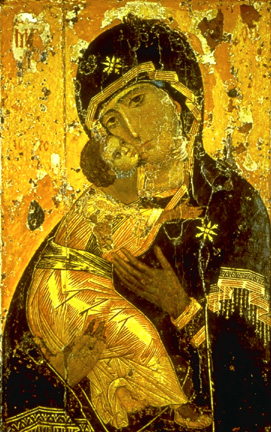
The Vladimir Mother of God (12th century)

Continuing the theme of traditional Russian culture, icons, even though they are part of other cultures too, are among the most recognizably Russian art works (although they’re not works of art at all…). They’re also possibly the most mysterious. For me the mystery lies in the idea that they access the spiritual world whilst being entirely impersonal. There’s nothing of the inspiration of the individual artist here – very few ancient icon painters are known by name. Rather than improvization and innovation, it’s the creators’ adherence to a very strict set of rules governing form that endows icons with a level of abstraction that gives access to their sublime meaning. It’s in icons that I can really see how the concept of sobornost’ (free spiritual communality) works in Russian culture, that absorbing one’s individuality into the collective enables participation in the divine. It’s perhaps the area of Russian tradition that is furthest from Western European thinking.

There don’t appear to be that many good websites devoted to Russian icons out there (even Russian sites, though the Moscow Icon Painting Centre has some good stuff, including some interesting icons of St George, and icons featuring Moscow), and a lot of gallery sites are basically on-line shops, which I didn’t want to include. But these four are worth exploring, despite some minor quibbles:

1. Old Russian Icons. This is a fairly small site, part of a larger on-line Russian art gallery, and the typo on the homepage is not particularly encouraging, but its contents are well chosen. The first section presents the Vladimir Mother of God (pictured here), the most venerated Russian icon, the second features Andrei Rublev, the most famous icon painter (and if you haven’t seen Tarkovsky’s film, you really should), and the final section includes a selection of the most typical and well known icons. The quality of the images is very good.

2. Windows into Heaven. This is a really interesting, if slightly incomplete, site, that has not only information on the history of icons and a gallery, but also a quite detailed section on the creation of icons – it’s written by a contemporary American icon painter, Bob Atchison, and it gives a very clear and comprehensible account of an ancient process that can otherwise seem quite mysterious to the non-spiritually inclined. The ‘Ikon Finder’ section is obviously still under construction.

3. Icon Painting. A fairly extensive site that is again part of a larger Russian painting site, this includes good outlines of the history and interpretation of icons, as well as sections on painters, schools and subjects. The main problem with this one is that the thumbnails are really low quality – when you click on them to see the large images, they’re okay, so I don’t really understand why the versions presented alongside the text are so bad.

4. Russian Icons: Index. Not the best presentation I’ve ever seen on a website, there isn’t a great deal of information about most of the pictures, and you either have to know what you’re looking for or take pot luck. Nevertheless, there is a good selection here, and the image quality is pretty decent.

Four short links: Russian folk art

Like many people who’ve spent time in Russia, I’ve picked up various bits of decorative art over the years. I’ve always liked the contrast between the really beautiful side of Russian folk art, such as Palekh boxes (the picture on this one is from Ruslan and Liudmila):

and its amusing and slightly vulgar side – I once had a Dymkovo whistle in the shape of a clay horse with its bum as the mouthpiece, and a Bogorodskoe wooden bear that a little man whacked on the bum when you pulled the lever (I assume this was supposed to represent being beaten with birch twigs at a banya but I’m not convinced that’s ever necessitated bending over like that). Both of them, sadly, seem to have been lost in one too many moves.

Anyway, following on from last week’s post on those amazing traditional wooden houses in rural Russia, some more websites on Russian folk culture.

1. Russian folk art. A good site covering many aspects of Russian folk art. It features fairytales, byliny (traditional epic narrative poems) and folk works by famous Russian writers such as Pushkin, lacquered boxes from Palekh, Gzhel ceramics, Khokhloma wooden decorative arts and Bogorodskoe sculpted wooden animals, all nicely illustrated and with informative texts.

2. Vyatka clay toys. Also known as Dymkovo toys, these were initially made as whistles for peasant rituals, then became toys after the magic had worn off. There are some lovely illustrations on this blog post, plus links to sites that have instructions on making your own Vyatka toy.

3. Russian Lubok. Lubki, or popular prints, represent a crossover point between folk culture and mass culture. They combine elements from traditional folk culture and icon painting with styles and subjects from European woodcuts. Some of them were for pure entertainment, and some were satirical, as with this very popular lubok ‘How The Mice Bury the Cat’, in which the cat represents Peter the Great and the mice the Russian people:

Others were definitely aimed at improving public morals, as with this one, ‘Wine is mankind’s greatest enemy’:

Lubki started in the 17th century and lasted until the revolution. This site has lots of information and examples.

4. Ivan Bilibin’s illustrations to Russian folktales. Whenever I’ve visited the Russian museum in St Petersburg and reached the early 20th-century and avant-garde paintings, I’ve always felt their proximity to the traditional decorative arts at the other end of the museum. Bilibin, who worked with the Mir Iskusstva group  and the Ballets Russes, shows the influence of Russian folklore and fairytales to an even greater extent than most of his colleagues. This illustrations and discussion in this post also give a good idea of his work.

Forest palaces

I recently discovered a great website by a Russian photographer, Andrei Kuzman, or Qzmn. He specializes in travel photography, the Russian wilderness, and its architecture. It’s really worth exploring the site, whether you’ve ever been to Russia and long for the birch forests (I’m a city girl but the Russian countryside definitely speaks to me), or just want an impression of what provincial and rural Russia are like. There’s a lot of stuff on the website, and I haven’t yet had time to go through much of it yet, but a couple of favourites so far are A New Year Trip to Arkhangel’sk Province, and a trip from Krasnoyarsk to the Mongolian border. His photos give an amazing sense of the space of Russia, and they’re not just picturesque.

But the pictures that really struck me are the ones of the ‘forest palaces’ near Chukhloma in Kostroma province, north east of Moscow.


They are the most extraordinary buildings. I’ve seen houses in this style before, obviously, but never quite so lavish or beautiful. They really made me appreciate, in a way that perhaps I hadn’t before, the ‘other’ Russia – its traditional, non-European side. I look at these houses and think of Russian fairytales, works featuring merchant life by Leskov and Ostrovsky, and Sergei Aksakov’s marvellous memoir, A Family Chronicle. It’s not a side of Russian literature I know terribly well, outside the most famous texts, such as Lady Macbeth of Mtensk and The Storm. I neglected Aksakov for a long time as I didn’t think it was my cup of tea, but then read it in an idle moment and discovered it’s really amazing – it’s out of print in English but you can pick up second hand copies (Oxford World’s Classics, translated as A Russian Gentleman), and I’d strongly recommend it. In other words, it’s a very rich seam of Russian literature that’s very different from the usual Dostoevsky-Tolstoy-Chekhov line (for all that I love it), and one that’s well worth exploring.

My thanks to the photographer for allowing reproduction of the pictures. To see more of the trip to Kostroma, click here.

Marriage in late imperial Russia

Today I went to a really great seminar given by Barbara Alpern Engel at SSEES on marriage breakdown in the reigns of Alexander III and Nicholas II. Engel is very well known as a specialist on women’s history who, among other things, has written the brilliant Mothers and Daughters: Women of the Intelligentsia in Nineteenth-Century Russia. Today she focused on the language of women’s petitions to the authorities to allow them to leave abusive husbands, and argued for the development – among educated women at least – of a discourse that counterposed the ‘despotism’ of the husband with assertions of the individual dignity and rights (lichnost’) of the woman. This is particularly interesting because it appropriates the political language of nineteenth-century Russian radicalism and shifts it to the personal sphere. It may well be for this reason, as Engel argued, that the authorities themselves, both in investigating marital petitions and discussing reforms to marital law, tended to adopt similar language – for them it divested radicalism of the terms it habitually employed to promote the idea of the integrity of the person and to critique the state’s relation to the individual.

One of my colleagues asked the question that came to my mind, which was whether a similar idea of ‘lichnost”, and its relation to women, was also apparent in ‘high’ literature (Engel discussed its use in prescriptive literature, such as manuals on domesticity and marriage) of the late imperial period. It would be fairly easy to establish the prevalence and context of uses of the term in Tolstoy, Chekhov etc with the aid of concordances, and I may well do that in an idle moment (probably around 2014). Of course, as Engel said, it would mostly be impossible to discover whether either the women writing the petitions or the officials reading them were familiar with any literary texts that dealt with the question of ‘lichnost”, but it would be interesting to see whether this discourse was developing in other spheres at the same time.

Barbara Engel’s new book, provisionally titled (according to her University of Colorado web page) Family Matters: Marriage, Its Discontents, and the State in Late Imperial Russia, from which her presentation was taken, is due out early next year. I’m certainly looking forward to it, and on the basis of today’s talk I would strongly recommend it.

Russkii vestnik: random volumes on archive.org

This is just a hotch-potch of five volumes ranging from 1871 to 1888 that are on archive.org. It includes a couple of instalments of Leskov’s At Daggers Drawn and Dostoevsky’s Demons and, tantalizingly, there’s a notice in volume 138 advertising Brothers Karamazov starting in the new year. Otherwise I’m mainly interested in a couple of Siberian texts, B. V. Struve’s memoirs and Cherkasov’s Notes of a Siberian Hunter. The supplements to the 1871 volume feature George Meredith’s The Adventures of Harry Richmond. The quality of the scans is unfortunately rather inconsistent in volume 188.

vol 91, Jan-Feb (1871)

January 1871

F. M. Dostoevskii, Besy. Chast’ 1, I-II
N. P. Koval’skii, Iz zapisok pokoinogo generala-maiora
Baron F. A. Biuler, Dva epizoda iz tsarstvovaniia Ekateriny II. Epizod vtoroi
F. A. Bredikhin, Padaiushchie zvezdy
N. S. Leskov (Stebnitskii), Na nozhakh. Roman. Konets vtoroi chasti
Kn. D. D-oi, Piat’ nedel’ v Kokane
Anderi Pecherskii, V lesakh (Prodolzhenie rasskaza ‘Za Volgoi’). I-IV
A. N. Maikov, Kak otdaril turetskii sultan moskovskogo tsaria. Iz sersbikh narodnykh pesniakh
P. K. Shchebal’skii, Nashi ‘Istinnye priiateli’ (1740-1744)

Supplement

Prikliucheniia Garri Richmonda. Perevod s angliiskogo. X-XV

February 1871

N. G. Zalesov, Posol’stvo v Khivu i Bukharu polkovnika Ignat’eva v 1858 godu
N. S. Leskov (Stebnitskii), Na nozhakh. Roman. Chast’ 3, I-V
Baron F. A. Biuler, Dva epizoda iz tsarstvovaniia Ekateriny II. Epizod vtoroi
Vozdukhoplavanie vo vremia osady Parizha
F. M. Dostoevskii, Besy. Chast’ 1, III-IV
N. S. Tikhonravov, Moskovskie vol’nodumtsy nachala XVIII veka i Stefan Iarovskii. III-IV
N. Boev, Neobychnyi sluchai. Rasskaz
G. P. Danilevskii, Leib kampanets
A. I. Lebedev, Neskol’ko slov o serbskom dukhovenstve
Nineviia i Vavilon. Iz chtenii Vattenbakha
D., Posmertnoe sochinenie Gertsena
P. Shch., Novye knigi

Supplement

Prikliucheniia Garri Richmonda. Perevod s angliiskogo. XVI-XIX

vol 138, Nov-Dec (1878)

November 1878

N. F. Dubrovin, Brat’ia Potemkini na Kavkaze. I-III
A. L. Zisserman, Otryki iz moikh vospominanii. LXIX-LXXII
V. F. Dukhovskaia, Iz dnevnika russkoi zhenshchiny v Erzerume v 1878 godu
, O drame. Otdel chevertyi. I-IV
B. M. Markevich, Chetvert’ veka nazad. Pravdivaia istoriia. Chast’ 2, LXIX-LXXXII
Ia. Ia. Veinverg, Noveishie otkrytie v oblasti fiziki. Telefon, fonograf i mikrofon
V. G. Avseenko, Skrezhet zubovnyi. Roman. Okonchanie
Andrei Pecherskii, Na gorakh. Rasskaz. LXXXIV-XCII
A. N. Maikov, Molitva. Stikhotvorenie
Novosti literatury
A. L. Zisserman, Politicheskoe obozrenie

December 1878

N. F. Dubrovin, Brat’ia Potemkini na Kavkaze
R., Maria Antuaneta i graf Ferzen
I. Pavlov, Zabyvaemyi poet-sovremennik
B. M. Markevich, Chetvert’ veka nazad. Pravdivaia istoriia
A. Satin, Na nizoviakh Dunaia
K. N. Shch., Igrushka sultana. Stikhotvorenie
A. Molchanov, Doezzhachii. Rasskaz
Portugal’skii teatr. P’esa de-Kastro v piati aktakh
Dezhurnaia bratchitsa. Iz perezhitogo vchera
P. Shch., Nyne i chetvert’ veka nazad
K. G-n, Germanskie partii i novyi zakon protiv sotsialistov
A. L. Zisserman, Politicheskoe obozrenie

vol 188, March-April (1887)

March 1887

V. (Avtor povesti ‘Otchego’), Deti solntsevykh. Iz dnevnika institutki dvadtsatykh godov. XI-XII
V. V. Krestovskii, V Dal’nikh vodakh i stranakh. XVIII
I. V. Tsvetaev, Pogrebal’nye obychai drevnykh rimlian. Okonchanie
A. A. Cherkasov, Iz zapisok sibirskogo okhotnika
V. A. Evrennov, Grazhdanskoe chinoproizvodstvo v Rossii. Istoricheskii ocherk
D. V., Khoziaistvennaia politika
D. M. Pozniak, Skvoz’ ogon’ strasti. Roman. Chast’ 2, I-IV
I. V., Novaia kniga o russkoi armii
N. A. Novosel’skii, O zolotopromyshlennosti v Rossii
K. R., Apollonu Nikolaevichu Maikovu. Stikhotvorenie
A. N. Maikov, Stikhotvoreniia
Bibliografiia
Sovremennaia letopis’
D. V. Tsvetaev, Andrei Ivanovich Fekhner

Supplement

Iulius Shtende, Bukh’goltsy v Italii. Perevod s nemetskogo

April 1887

K. F. Golovin, Krupnoe zemlevladenie v Zapadnoi Evrope i v Rossii. V-VIII
V., Deti solntsevykh. I-III
P. B., Vospominaniia ofitsera o voennykh deistviiakh na Dunae v 1853 i 1854 godakh. Iz dnevnika
D. V. Tsvetaev, Literaturnaia bor’ba s Protestantskom v Moskovskom gosudarstve. I-II
V. V. Krestovskii, V Dal’nikh vodakh i stranakh. XXIX
D. M. Pozniak, Skvoz’ ogon’ strasti. Roman. Chast’ 2, V-X
E. Belozerskii, Chto takoe Abissiniia i chego khotiat ot neia Italiantsy
A. N. Mailov, Stikhotvoreniia. I. A. A. Fetu. II. Ia. P. Polonskomu
Bibliografiia
Sovremennaia letopis’

Supplement

Iulius Shtende, Bukh’goltsy v Italii. Okonchanie

vol 189, May (1887)

May 1887

N. Ia. Danilevskii, Ekspressiia ili vyrazhenie chuvstva u cheloveka i zhivotnykh. I-II
V. V. Krestovskii, V Dal’nikh vodakh i stranakh. XXX-XXXI
K. F. Golovin, Krupnoe zemlevladenie v Zapadnoi Evrope i v Rossii. IX-XI
A. V., Pozdno. Povest’
P. B., Vospominaniia ofitsera o voennykh deistviiakh na Dunae v 1853 i 1854 godakh. Iz dnevnika
D. V. Tsvetaev, Literaturnaia bor’ba s Protestantskom v Moskovskom gosudarstve. III
V., Deti solntsevykh. IV-VI
P. S. Vasil’ev, Akhal-Tekinskii oazis. Ego proshloe i nastoiashchee. Ocherki
E. Bogdanov, Stikhotvoreniia. I. K prirode. II. Probuzhdenie
Bibliografiia
Sovremennaia letopis’

vol 196, May-June (1888)

May 1888

K. R., Sevastian-Muchenik, Stikhotvorenie
B. V. Struve, Vospominaniia o Sibiri. Prodolzhenie
N. E. Baratynskii, Nedelimye dvoriahnskie uchastkia
K. F. Orlovskii, Molodezh. Roman. Chast’ 2, II-III
A. N. Maikov, U groba Groznogo. Stikhotvorenie
K. F. Ordyn, Kak bylo delo? (Otvet g. Mekhelinu)
A. I. Roshtok, Zemstvo i statistika
A. E., Rasskazy Dzhemsa Pena (Glow worm tales). I. Vozmezdie. II. Khoroshen’kogo ponemnozhku. III. Sud’ia ne vpopad. IV. Zhertva stoikosti
K. N. Bestuzhev-Riumin, Teoriia kul’turno-istoricheskikh tipov
V. V. Krestovskii, T’ma egipetskaia. Roman. XVI-XVII
A. I. Maksimov, Nashi zadachi na krainem Vostoke. II. Rossiia i Iaponiia
I. P. Krushchov, I. V. Sugorskii, Kritika
Novosti literatury
Moskovskaia khronika
Vnutrennee obozrenie
Politicheskoe obozrenie

June 1888

A. N. Maikov, Bringil’da. Poema
Katkov i Belinskii. Po neizdannym pis’mam Belinskogo. 1837-1840
K. F. Orlovskii, Molodezh. Roman. Chast’ 2, IV-V. Prodolzhenie
B. V. Struve, Vospominaniia o Sibiri. Prodolzhenie
Gr. A. A. Golenyshchev-Kutuzov, Stikhotvorenie
A. M-skii, Nuzhdy mestnogo upravleniia. Okonchanie
A. -ov, Griadushchiia bedy Anglii
N. N. Strakhov, Nasha kul’tura i vsemirnoe edinstvo. I-IX
Novaia povest’ Bret Garta ‘Millioner’. I-IV
Iubilei A. N. Maikova
Novosti literatury
Moskovskaia khronika
Vnutrennee obozrenie
Politicheskoe obozrenie
Soobshcheniia i izvestiia

Four short links: Alexandra Kollontai

I’ve been interested in Alexandra Kollontai’s work for a while, and would like to do some research and write about her at some point. But at the moment I’ve got so many other projects on the go that I can’t see how I can possibly fit anything else in. So, as a statement of intent pending actually finding the time to get properly into her work, here are some links.

1. The Kollontai Archive. A large selection of Kollontai’s works in translation on the Marxists Internet Archive. Alas, no Love of Worker Bees, but plenty of other gems here.

2. Alexandra Kollontai. This interesting article by Helen Ward on the Permanent Revolution website covers Kollontai’s biography and work with working class women, and assesses her position as an opponent of ‘bourgeois feminism’.

3. Communism and the Family. A thoughtful review of one of Kollontai’s major works on Vulpes Libris, it examines her thinking about motherhood and the role of the community in raising children with a balance that is often absent from discussions of Kollontai. There’s also a link to a review of Red Love on Vulpes Libris.

4. Alexandra Kollontai and Red Love. This article by Teresa L. Ebert on the Solidarity website provides an in-depth examination of Kollontai’s theories of love and sexuality, comparing her ideas to contemporary gender theories and showing the continued relevance of her analysis of the class basis of sexuality.

Russkii vestnik 1856

1856 saw the first volumes of Russkii vestnik appear, and as Russian culture began to emerge from the stagnation that characterized the final years of Nicholas I’s rule, the journal began with a strong set of contributors, many of whom then continued to appear in the journal for many years. Literary works include Ostrovsky’s play A Hangover at a Stranger’s Feast, a sizeable selection from Shchedrin’s Provincial Sketches, Evgeniia Tur’s The Old Woman (Tur also contributes an essay on George Sand), and Narskaia’s Family Scenes. There is poetry by A. K. Tolstoy, Konstantin Aksakov, and, to my surprise, Nikolai Ogarev. I didn’t know he could be published openly in Russia at the time, and in any case assumed his political distance from Katkov would have precluded him appearing in Russkii vestnik. While there are articles with a historical focus, such as S. M. Solov’ev on ancient Russia, and on socio-economic subjects, including Boris Chicherin’s essay on village communes in Russia, there is overall a substantial bias towards biography and memoir, with extracts from Sergei Aksakov’s memoirs, Lazhechnikov’s memoirs of Pushkin (the latter also featuring in articles by Katkov), the autobiography of the recently deceased critic and ethnographer Nikolai Nadezhdin, with additions by P. S. Savel’ev, and D. A. Miliutin on Suvorov. The supplements that became such a feature in later years only appear intermittently with the first volumes, but here we have Charlotte M. Yonge’s Heartsease, Or the Brother’s Wife.

vol 1 (1856)

January-February 1856

Neizdannyi otryvok iz pervogo toma Mervykh Dush, naidennyi v rukopisiakh Gogolia
S. M. Solov’ev, Drevniaia Rossiia
Evgeniia Tur, Starushka. Povest’. I-II
S. T. Aksakov, Otryvok iz vospominanii (Gimnaziia – period vtoroi)
P. N. Kudriavtsev, Karl V. I
M. N. Katkov, Pushkin. I
Ob okeanii i ee zhiteliakh. Chtenie T. N. Granovskogo
A. N. Ostrovskii, V chuzhom piru pokhmel’e. Komediia v dvukh deistviiakh
Evgeniia Tur, Starushka. Povest’. III-IV
M. N. Katkov, Pushkin. II-III

Stikhotvorenie

M. A. Dmitriev
K. S. Aksakov
N. P. Ogarev

Voina za nasledstvo Ispanskogo Prestola. Stat’ia Tomasa Bebingtona Makoleia
B. N. Chicherin, Obzor istoricheskogo razvitiia Sel’skoi Obshchiny v Rossii. I
N. P. Ogarev, Zimnii put’. Iz dorozhnykh vospominanii. Stikhotvorenie
P. N. Kudriavtsev, Karl V. II
Trigorskii, V svete i doma. Povest’. I
Larets. Neizdannoe stikhotvorenie Del’viga
O. M. Bodianskii, Novye otkrytiia v oblasti Glagolitsy
S. D. Shestakov, Ody Goratsiia v perevode g. Feta
B. N. Chicherin, Obzor istoricheskogo razvitiia Sel’skoi Obshchiny v Rossii. II-III
I. I. Lazhechnikov, Znakomstvo moe s Pushkinym (iz moikh pamiatnykh zapisok)
Trigorskii, V svete i doma. Povest’. II
I. N. Berezin, Ramazan v Stambule
P. V. Annenkov, O raznykh vidakh gazoosveshcheniia i o prigodnosti ikh dlia Moskvy
Stikhotvorenie Mura. Perevod B.

Sovemennaia letopis’ [not included]

Supplement

Nevestka (Heartsease or The Brother’s Wife). Roman v trekh chastiakh. Perevod s angliiskogo. Chast’ pervaia i vtoroi chasti I-V

vol 2 (1856)

March-April 1856

P. K. Shch-i, Pravlenie Tsarevny Sofii
P. S. Savel’ev, N. I. Nadezhdin. Avtobiografiia s dopolneniem
Trigorskii, V svete i doma. Povest’
M. L. Mikhailov, Napraslina. Rasskaz
I. N. Berezin, Ramazan v sultanskom dvortse i beiram
A. S. Ershov, Noveishie uspekhi mehkaniki v oblasti sel’skogo khoziaistva

Stikhotvorenie

A. M. Zhemchuzhnikov, Skvorushka
Ia. P. Polonskii, Pesnia
F. B. Miller, Truzhenik
N. M. Pavlov, Sem’ stikhotvorenii
N. P. Ogarev, Afrika
K. K. Pavlova, ‘Ty, utselevshii v serdtse nishchem’
Gr. A. K. Tolstoi, Shest’ stikhotvorenii
N. P. Ogarev, Shest’ stikhotvorenii

D. A. Miliutin, Suvorov. Glava iz prigotovlennoi ko vtoromu izdaniiu ‘Istorii voiny 1799 goda’
E. Narskaia, Semeinye stseny
M. N. Katkov, Pushkin
V. P. Bezobrazov, O promyshlennykh predpriatiiakh
P. N. Kudriavtsev, Karl V
P. K. Shch-i, Pravlenie Tsarevny Sofii
E. Narskaia, Semeinye stseny
F. M. Dmitriev, Russkaia literatura (Semeinaia khronika i Vospominaniia S. T. Aksakova)
S. M. Solov’ev, Avgust Liudvig Shletser
P. K. Shch-i, Pravlenie Tsarevny Sofii
S. Vakhnovskii, Leto v Gapsale. Rasskaz
I. V. Vernadskii, O vneshnei torgovle
Kniagina Bel’dzhoiozo, Kurdskii kniaz’. Rasskaz

Sovemennaia letopis’ [not included]

vol 3 (1856)

May-June 1856

I. I. Lazechnikov, Belen’kie, cheren’kie i seren’kie
P. Shchebal’skii, Pravlenie Tsarevny Sofii
Evgeniia Tur, Zhizn’ Zhorzh-Sanda
I. K. Babst, Istoricheskii metod v politicheskoi ekonomii
M. Bibikov, Uzhin khudozhnikov v 162* godu
Kniagina Bel’dzhoiozo, Kurdskii kniaz’. Rasskaz
B. N. Chicherin, Nesvobodnye sostonaniia v drevnei Rossii
I. N. Berezin, Stseny v pustyne
M. S. Shchepkin, Iz moikh zapisok
Kn. G. V. Kugushev, Kornet Otletaev. Povest’
Vosem’ let stransvovaniia po Tseilonu
D. I. Kachenovskii, Zhizn’ i sochineniia Danielia Vebstera
D. I. Zhuravskii, O zheleznykh dorogakh v Rossii
I. I. Lazechnikov, Belen’kie, cheren’kie i seren’kie
Kn. G. V. Kugushev, Kornet Otletaev. Povest
E. M. Feoktistov, Ansel’m Kanterberiiskii
Evgeniia Tur, Zhizn’ Zhorzh-Sanda
B. N. Chicherin, Eshche o sel’skoi obshchine

Stikhotvorenie

N. P. Ogarev, Prokliast’ by mog svoiu sud’bu
Mikh. Mikhailov, Pesni Geine
N. Pavlov, Ne govori, chto serdtsu bol’no
N. P. Ogarev, K **
N. P. Ogarev, Piat’ stikhotvorenii

Sovremennaia letopis’ [not included]

vol 4 (1856)

[missing]

vol 5 (1856)

[missing]

vol 6 (1856)

November-December 1856

P. N. Kudriavtsev, Karl V. VI-IX (Okonchanie)
N. M. Goncharov, Ot Kronshtadta do mysa Lizarda. Iz putevykh zapisok
Dn. D. D-i, Vstrecha. Iz zapisok moego soseda
M. L. Mikhailov, Pesni Geine. XI-XX
M. S., Aleksei Vasil’evich Kol’tsov
M. N. Katkov, Neskol’ko dopolnitel’nykh slov ok kharakteristike Kol’tsova
N. V. Berg, V gorakh. Stikhotvorenie
P. N. Kudriavtsev, Karl V. VI-IX (Okonchanie)
Ser Robert Pil. Stat’ia Gizo (Okonchanie)
N. Shchedrin, Gubernskie ocherki. XI. Starets. XII. Eshche proshlie vremena. XIII. Chto takoe kommertsiia? XIV. Buerakin. XV. V ostroge. Poseshchenie vtoroe. XVI. Arinushka. XVII. Narodnye prazdniki I i II. XVIII. Priiatnoe semeistvo. XIX. Doroga (vmesto epiloga)
S. M. Solov’ev, Spor o sel’skoi obshchine
A. P-v, Stikhotvoreniia. I. Golos v lesu. II. Zakat’ (Iz Geine)
P. N. Kudriavtsev, Karl V. VI-IX (Okonchanie)
V. V. Stasov, Fotografiia i graviura
N. Shchedrin, Gubernskie ocherki
D. E. Min, Prikhodskie spiski. Poema Georga Krabba
A. S. Chuzhbinskii, Bezymennye tipy. I. Chinovnik. II. Provintsiial’nyi lev
N. V. Berg, Iz krymskikh zametok
Ser Robert Pil. Stat’ia Gizo (Okonchanie)
N. Shchedrin, Gubernskie ocherki
V. V. Stasov, Fotografiia i graviura
S. D. Shestakov, Eshche neskol’ko slov o russkom perevode Goratsievykh od g. Feta

Sovremennaia letopis’ [not included]

Mikhailov’s Pesni Geine, plus a couple of other poems, are available on wikitexts.

Russkii vestnik 1857

The 1857 volumes feature poetry by the usual suspects, Maikov, Fet, Tiutchev, and A. K. Tolstoy, all of whom obviously formed an early and lasting attachment to the journal. Prose is represented in works by Pechersky, Petrichenko and Evgeniia Tur, as well as a number of stories by Shchedrin. Tur also contributes an essay on Mme Bovary, and French literature features elsewhere in the translation of George Sand’s La Daniella in the supplement to volumes 9 and 10. Russian history and culture have a strong presence, including, looking into the distant past, Zabelin on ancient Russian literature, Lokhvitsky on church adminiatration in ancient Russia, and Popov on the rule of Tsar Fedor Alekseevich, and more recently, Annenkov on Stankevich, Stasov and Dobrovsky on Glinka, and Shestakov on Lermontov.

vol 7 (1857)

January 1857

Iu. A. Gagemeister, Vzgliad na promyshlennost’ i tovogliu Rossii
Pugachevshchina (Iz zapisko D. B. Mertvogo)
N. A. Popov, Koroleva Varvara. Istoricheskii rasskaz
N. Shchedrin, Gubernskie ocherki. I. Pervyi shag. II. Ozorniki. III. Nadorvannye
N. A. Osnovskii, Poroda khishchnikov

Stikhotvoreniia

Gr. A. K. Tolstoi, Chetryre stikhotvoreniia
F. B. Miller, Al’pukhara (Iz Mitskevicha)
Ia. P. Polonskii, ‘Ten angela proshla s velichiem tsaritsy’

A. V. Lokhvitskii, Ocherk tserkovnoi administratsii v drevnei Rossii
E. L., Sovremennoe polozhenie kreditnykh uchrezhdenii. I-III
Zhit’e-byt’e na Korege (zapiski Gul’ninskoi, Avdot’i Stepanovny)
A. K. Tulub’ev, Nezhnaia mat’. Povest’
Semero brodiag. (Rasskaz Gotorna)
V. P. Bezobrazov, Blagotvoritel’nost’ i obshchestvennaia ekonomiia

Stikhotvoreniia

A. M. Zhemchuzhnikov, I. Idealisty i praktiki (otryvok). II. Pochemu? III. Nishchaia
A. P-v, Podrazhanie pol’skomu
N. V. Berg, Sokolinye ochi (Serbskaia pesnia)

February 1857

P. V. Annenkov, Nikolai Vladimirovich Stankevich. Biograficheskii ocherk
E. L., Sovremennoe polozhenie kreditnykh uchrezhdenii
Ia. Prikhod’kov, Vstrechi i znakomstva. I. Evseev i Shtrikh
I. S-v, Volostnoi golova. Iz provintsial’nykh vospominanii chudaka
V. F. Sokolov, Neudachi. Povest’ v pis’makh
I. K. Babst, Geografiia i statistika Rossii i smezhnykh stran Azii

Stikhotvoreniia

A. M. Zhemchuzhnikov, Nadzor
S. T. Slavutinskii, I. Nochnoe kupan’e. II. ‘Ne speshi domoi, ia edu’. III. ‘Khodit tikho son po ulitse’
N. V. Berg, I. Sonet (S pol’skogo). II. Son Dima pered bitvoi (Novogrechnaia pesnia)

B. N. Chicherin, Dukhovnye i dogovornye gramoty velikykh i udel’nykh kniazei
P. V. Annenkov, Nikolai Vladimirovich Stankevich. Biograficheskii ocherk
N. M. Blagoveshchenskii, Sabinskoe pomest’e Goratsiia
Grafinia Ursula. Istoricheskaia nravoopisatel’naia povest’ Rilia
A. Pecherskii, Poriakov. Rasskaz

Stikhotvoreniia

A. N. Maikov, Niva
F. I. Tiutchev, N. F. Shcherbine
Iu. V. Zhadovskii, El’ (Iz Freiligrata)
B., Nezra. Bol’noi perevod iz Shen’e (Posviashchaesia baronesse Elisavete Antonovne Del’vig)

Vol 8 (1857)

March 1857

B. N. Chicherin, Dukhovnye i dogovornye gramoty velikykh i udel’nykh kniazei. II
V. Ch., O sel’skom khoziastve v Rossii
S. T. Aksakov, Vospominaniia o Dmitrii Mertvogo (Pis’mo k V. P. Bezobrazovu)

Stikhotvoreniia

D. E. Min, Prikhodskie spiski. Poema Krabba

A. N. Popov, Turetskaia voina v tsarstvovanie Feodora Alekseevicha
A. S. Ershov, O razvitii i sovremennom sostoianii parokhodstva v Evrope
N. F. Pavlov, Biograf-orientalist
Amfion (Povest Rilia)
K. D. Kavelin, Sluga (Sovremennyi fiziologicheskii ocherk)

Stikhotvoreniia

A. N. Maikov, Na smert’ N. I. Glinki
F. B. Miller, Voron

April 1857

A. N. Popov, Turetskaia voina v tsarstvovanie Feodora Alekseevicha
N. A. Okol’nichii, Vospominanie o Kutaise. I-VII
P. V. Annenkov, Nikolai Vladimirovich Stankevich. Biograficheskii ocherk. III. Period zhizni Stankevicha za granitsei i ego smert’
Ob otnoshenii gosudarstvennoi administratsii k narodnomu trudu v Anglii
Gr. A. K. Tolstoi, Chetyre stikhotvoreniia
S. M. Solov’ev, Shleitser i anti-istoricheskoe napravlenie
N. A. Okol’nichii, Vospominanie o Kutaise
N. Shchedrin, Matushka Mavra Kuz’movna
P. P. Dubrovskii, Vospominaniia o M. I. Glinke (Pis’mo k L. I. Shetakovoi)
A. M. Zhemchuzhnikov, Dva stikhotvoreniia

Sovremennaia letopis’, vol 7-8

vol 9 (1857)

May-June 1857

I. E. Zabelin, Drevniaia russkaia literatura (Zhenshchina po poniatiem starinnykh knizhnikov)
I. A. Goncharov, Plavanie v atlanticheskikh tropikakh (pis’mo k V. G. Benediktovu)
N. F. Khristianovich, Shopen. Pis’ma iz provintsii. I-IV
D. D. Neelov, Chto dolzhno razumet’ pod ratsional’nym sel’skim khoziaistvom

Stikhotvoreniia

A. P-v, Starie pesni na novyi lad
Iu. V. Zhadovskii, Grustnaia kartina

V. P. Vasilevskii, Vypiski iz dnevnika, vedennogo v Pekine
I. N. Berezin, Inoi Mir
S. D. Shestakov, Iunosheskie proizvedeniia Lermontova. I-III
A. Pecherskii, Dedushka Policarp. Rasskaz
V. P. Bezobrazov, Fiziologiia obshchestva
S. D. Shestakov, Iunosheskie proizvedeniia Lermontova
N. F. Khristianovich, Shopen. Pis’ma iz provintsii.
N. Shchedrin, Talantlivaia natura. Rasskaz
N. A. Osnovskii, Poroda khishchnikov. III-VII
K. N. Petrichenko, Rasskazy kaspiiskogo moriaka. I-II

Stikhotvoreniia

M. L. Mikhailov, Pesni Geine. I-VII
P. E., Vostochnaia kartina

A. N. Beketov, Severo-ural’skii krai
V. P. Vasilevskii, Vypiski iz dnevnika, vedennogo v Pekine
I. V. S-v, Iz vospominanii chudaka. I. Kamen’. II. Zamechatel’noe psikhologicheskoe iavlenie
K. N. Petrichenko, Rasskazy kaspiiskogo moriaka

Stikhotvoreniia

A. A. Fet, Smerti
M. L. Mikhailov, Rytsar’ Olaf (Iz Genie)

Supplement

Zhorzh Sand, Daniella. I-XVI

vol 10 (1857)

July 1857

D. I. Kachenovskii, Vzgliad na istorii politicheskikh nauk v Evrope
Andrei Pecherskii, Starye gody. Povest’
A. I. Artem’ev, O narodnykh perepisiakh
D. P. Lomachevskii, Novaia voennaia gruzinskaia doroga

Stikhotvoreniia

A. A. Fet, ‘Anruf an die Geliebte’ Betgovena
V. S. Kurochkin, Bednyi chudak (Iz Beranzhe)

A. I. Artem’ev, O narodnykh perepisiakh
S. I. Barshev, Ob ustosti i glasnosti ugolovnogo sudoproizvodstva
N. Shchedrin, Talantlivaia natura. I. Korepanov. II. Luzgin
Evgeniia Tur, Nravoopisatel’nyi roman vo Frantsii (M-me de Bovary par Flaubert)
A. I. Artem’ev, O narodnykh perepisiakh

Stikhotvoreniia

V. S. Kurochkin, I. Devochke-poetu (Iz Beranzhe). II. ‘Net, ty ne Lizeta’. III. Pesne bedniaka (Iz Bornsa)

August 1857

D. I. Kachenovskii, Vzgliad na istorii politicheskikh nauk v Evrope
F. I. Buslaev, O narodnosti v drevne-russkoi literature i iskusstve
N. Shchedrin, Bogomol’tsy, stranniki i proezzhie
A. I. Artem’ev, O narodnykh perepisiakh

Stikhotvoreniia

A. A. Fet, ‘Vse vokrug i pestro tak, i shumno’
A. P-v, Molitva

M. N. Kapustin, Turinskie palaty i graf Kavur
A. A. Afanas’ev, Cherty russkikh nravov XVIII stoletiia
Andrei Pecherskii, Medvezhii ugol
A. P-v, Nasledstvo
B. N. Chicherin, Kritika g. Krylova i sposob issledovaniia ‘Russkoi besedy’

Supplement

Zhorzh Sand, Daniella. I-XLIV (Okonchanie)

Sovremennaia letopis’, vol 9-10

vol 11 (1857)

[missing]

vol 12 (1857)

November-December 1857

D. I. Kachenovskii, Vzgliad na istorii politicheskikh nauk v Evrope. IV (Okonchanie)
Evgeniia Tur, Na rubezhe. Povest’
V. V. Stasov, Mikhail Ivanovich Glinka
M. P. Shchepkin, Sentiabr’skii Kongress v Brussele
S. V. Esevskii, Neskol’ko dopolnitel’nykh zamechanii k stat’e ‘Novikov i Shvarts’
K. K. Zedergol’m, Katon Starshii
V. V. Stasov, Mikhail Ivanovich Glinka
Evgeniia Tur, Na rubezhe. Povest’
I. V. S-v, Pochtovaia stantsiia (Iz vospominanii Chudaka)
Ot Del’gi do Kanpura. Dnevnik anglichanki. Stat’ia dr-a Menara
K. K. Zedergol’m, Katon Starshii
Baron Gakstgauzen, Ob otmenenii i vykupe pomeshchich’ikh gospodskikh prav v Prussii
V. P. Bezobrazov, Materialy dlia fiziologii obshchestva
Ot Del’gi do Kanpura. Dnevnik anglichanki. Stat’ia dr-a Menara
Baron Gakstgauzen, Ob otmenenii i vykupe pomeshchich’ikh gospodskikh prav v Avstrii
Andrei Pecherskii, Nepremennyi
Z. V. Ivanov, Zagoven’e (Stseny iz provintsiial’nogo byta)
M. N. Kapustin, Politicheskie ocherki Belgii
V. V. Stasov, Mikhail Ivanovich Glinka
M. I. Bogdanovich, Srazhenie pri Lubine
N. Shchedrin, Priezd revizora
Kn. Kostrov, Sorokovoi medved

Stikhotvoreniia

A. N. Maikov, Son v letniuiu noch’
I. Ia. Lebedev, Vospominanie o docheri (Iz Contemplations Viktora Giugo)
I. Ia. Lebedev, Iunosha (Iz Geine)
A. A. Fet, Eshche maiskaia noch’
A. A. Fet, ‘Na stoge sena noch’iu iuzhnoi’
Kn. G. V. Kugushev, Duniasha (Legenda davnishnikh vremen)
V. S. Kurochkin, Liza (Iz Beranzhe)
A. A. Fet, Bal
G. P. Danilevskii, Zhivoe ozero

Sovremennaia letopis’, vol 11-12