• New Post Alerts By Email

  • Syndication

    RSS
    Atom
  • Tags

  • Archives

Russian perspectives on the Great Exhibition (5)

This is the fifth report from Sovremennik on the Great Exhibition, and this time we get two sections. The first discussing aspects of London life, entertainment and commerce surrounding the Great Exhibition and commenting on the quality of reporting in European journals – criticizing them for their preoccupation with London life and entertainment and lack of emphasis on the products on show at the Exhibition. While the ironic feuilletonistic voice is dominant here, more straightforward reportage takes over for the second piece, which does address the exhibits, although the choice of porcelain, earthenware and crystal as the main focus seems slightly random. I can’t help feeling its main purpose was to segue into the final section on marble etc. and allow the report to finish with a reference to the magnificent Russian malachite exhibits. These had been mentioned in the previous report, but without reference to specific objects, and as raw materials they rather get lost amidst the enthusiasm for copper and iron ore.

The translation of this report offered a few challenges because of the prevalence of names – mainly French – in the description of the porcelain exhibits and elsewhere (one also gets the feeling that the author assumes readers will be more interested in French production than any other – this certainly matches a general preoccupation with French affairs one sees in the foreign news sections of Russian journals of this era generally). These were further complicated by rather blurred type that was difficult to decipher in places, and the vagaries of Russian spelling, not to mention the possibility of errors (there are several in this and the other reports). I ended up trawling through two catalogue volumes: Exposition universelle de 1851: Travaux de la Commission francaise sur l’industrie des nations, vol. 1 and the Official Catalogue of the Great Exhibition of the works of industry of all nations, 1851, and I think I’ve managed to track down all the correct names.

ВЕСТИ ИЗ ЛОНДОНА.

Современник, 29 (1851), Современные заметки, 57-61

Всемирная выставка промышленных произведений, как мы уже заметили в одной из прежних книжек “Современника”, привлекла в Лондон множество путешественников и между прочим заставила их обратить внимание на нравы и обичаи англичан. Оттого во всех журналах, французских, немецких, русских и проч., с мая нынешнего года начали появляться статьи о достопримечательностях Лондона, о праздниках, театрах и других увеселениях англичан, о нравах и обычах [sic] их и проч. Особенно много подобных статей во французских журналах. Редакторы почти всех парижских журналов нарочно отправили своих корреспондентов в Лондон, для оценки промышленных произведений, выставленных в Кристальной Палате, и для описания замечательных особенностей из жизни англичан. Но для того, чтобы представить полную и верную оценку огромной массы произведений, собранных со всех концов земного шара, надобно было бы употребить много трудов и усилий. Гораздо легче какой-нибудь праздник, увеселение, обычай и проч. Вот почему во французских журналах мы встречаем так много описаний нравов и обычаев англичан. Только надобно заметить, что очень немногие из этих описаний заслуживают внимания. Корреспонденты парижских журналов, как выражается один сотрудник “Revue Britannique”, наблюдали жизнь англичан большею частью из окна своей квартиры. Из всех парижских фельетонистов только один мог сделать самые верные наблюдения: это – Жоль Жанен. Он принят был с особенным почестями во всех лучших домах Лондона. В продолжение целого месяца он был львом Лондона и на всех публичных и частных зрелищах занимал самые первые места.

С другой стороны, Всемирная Выставка не могла остаться без последствий и для самых жителей Лондона. Особенно важны были последствия ее для купцов. Лондонские купцы сначала очень жаловались на свою судьбу, говорили, что Всемирная Выставка разорила их. Но эти жалобы оказались вовсе несправедливыми: сбыть товаров в продолжение нынешнего лета, как говорят, был гораздо значительнее прежних годов. По всей справедливости могут жаловаться только книгопродавцы. В Лондоне никогда еще не покупали так мало книг, как последние три месяца, хотя в это время вышло в свет очень много любопытных изданий. Зато лондонские театры постоянно был полны. Как велик был сбор их, об этом можно судить уже по тем огромным суммам, которые получены были певьцами, певицами, актерами, актрисами и танцовщицами, приглашенными в Лондон. Одна только французская актриса, г-жа Рашель, в продолжение двух месяцев получила от дирекции Лондонского театра более 100 тысяч франков; за каждое представление она получила по 125 фунт. стер. А между тем на лондонских театрах, в продолжение нескольких месяцев, давали все старые пьесы. Одни только оперные театры, как мы уже заметили в прежней книжке “Современнике”, старались блеснуть новизною. Впрочем, не было никакой надобности заботиться о приискании новых пьес. Публика каждый день была новая. Англичане, приезжая в Лондон из провинций, считают себя обязанными непременно побывать во всех театрах. Притом же недостаток новых пьес выкупался превосходною игрою знаменитых артистов.

Говоря о театрах, кстати сообщаем здесь известие об одном событии, случившемся в Лондоне 12 сентября. На Королевском театре давали “Отелло”. Роль Отелло поручено было г. Пардини, а роль Десдемоны выполнила г-жа Зонтаг. По какому-то недоразумению, г. Пардини дали настоящий кинжал, и этим кинжалом он с силою ударил г-жу Зонтаг. Кровь брызнула из раны и полилась на сцену. К счастью, удар пришелся по руке, и потому не был опасен.

Скоро уже наступить день (15 Октября), назначенный для закрытия выставки, и жители Лондона очень заняты теперь будущего судьбою Кристальной Палаты. Во всех лондонских журналах очень много писали о том, чтобы великолепное здание и после закрытия Всемирной Выставки осталось на прежнем месте и обращено было в зимний сад. К концу августа за вход в это здание всего собрано было более 10 миллионов франков; а к концу выставки весь сбор, вероятно, будет постираться до 15 миллионов, так что чистого барыша останется около 10 миллионов франков. Сумма эта более, нежели достаточна для покупки места, занимаемого Кристальной Палатой. Но есть одно очень важное препятстие [sic]: это – право соседних домовладельцев. Если Кристальная Палата останется на своем месте, от этого все соседние с ней дома лишены будут света и чистого воздуха.

Англичане, как видно, очень дорожить зданием Всемирной Выставки. Пакстон, архитектор, строивший это здание, пользуется у них необыкновенным уважением. Портреты его красуются на окнах всех эстампных магазинов, и счастлив тот, кто, проходя мимо, может сказать, “Какое удивительное сходство!” Толпа любопытных тотчас же окружает этого счастливица и осыпает его вопросами: “Ах, так вы знаете его? – Вы знали этого великого Пакстона? – Вы находите, что портрет похож на него?” и т. д.

Обратимся теперь к самим произведениям, выставленным в Кристальной Палате.

Лондонская выставка.
Фарфоровые и фаянсовые изделия. Севский, гоблинский и бовесский фарфор из Франции, как известно, расходится по всем странам и находить себе немного соперников. Недавно один из французских фабрикантов изобрел новый, более дешевый способ обжигания фарфора. Это изобретение, говорят, еще более усилить французскую торговлю, если оно принято будет и на других фабриках Вталь-Ру в 1849 году, по определению присяжных, получил за это изобретение золотую медаль.

Самые лучшие из французских фарфоровых изделий, выставленных в Кристальной Палате, принадлежат г.г. Аллюо, Жугано и Дюбуа, Мейеру, Гоноре, Лягошь-Буану, Бойие, Бетиньи, Ляшасенью и Баптросу. Фарфор г. Аллюо, одного из богатейших лимузеиских фабрикантов, отличается удивительною белизною, так что для него вовсе ненужно никаких украшений; а самые лучшие рисунки на фарфор принадлежат г. Мейеру. Г. Баптрос занимается только приготовлением одних пуговок. Но эта, по видимому ничтожная, фабрикация его приняла страшные размеры. На фабрике его с 1849 года ежедневно производится более 1,500 тысяч пуговок. Одним только укладыванием этих ничтожных вещиц занимаются около 500 человек рабочих.

Фаянсовые французские изделия уже далеко не так хороши, как фарфоровые, и во многом уступают произведениям английских и немецких фабрикантов. С особенною похвалою отзываются только о фаянсовых изделиях г. Трамблея, Лекока и Рейдера и Ависсо.

Англия выставила в Кристальной Палате множество богатейших фарфоровых изделий. Но многие из них имеют очень важный недостаток: на них слишком много украшений и рисунки выполнены не совсем отчетливо. Фарфор сам по себе так красив, что на нем заметны самые малейшие недостатки рисунков. На Всемирной Выставке самые лучшие фарфоровые изделия принадлежат гг. Минтону, Капеланду, Мезону и Шамберлину.

Фаянсовые изделия английских фабрикантов отличаются не только своим изяществом, но и дешевизною, и занимают одно из самых почетных мест на выставке.

Саксония выставила в Кристальной Палате немного фарфоровых изделий; но в этом немногом, как говорят, слишком много достоинств.

С похвалою отзываются также об изделиях Венской Императорской фабрик и богемских фабрикантов Гардингера и Эльбогена.

Хрусталь. Между хрустальными вещами, красующимися на Всемирной Выставке, самые лучше, по оригинальности и изяществу форм и по искусной отделке из, принадлежат богемским фабрикантам. Но хрусталь Соединенных-Штатов, по своей чистоте, занимает самое первое место на выставке.

Англия в этом отношении далеко отстала от Богемии. Впрочем, огромный хрустальный фонтан г. Ослера привлекает всеобщее внимание публики. С особенною похвалою отзываются также о хрустальных вещах и других английских фабрикантов.

Между французскими хрустальными вещами отличают только произведения г. Маеса.

Мрамор, гранит и малахит. Франция, Англия и Италия выставили в Кристальной Палате богатейшие коллекции гранитных и мраморных вещей, но все это, как говорят, становится ничтожным перед великолепными малахитовыми дверями, каминами и вазами, красующимися в Русском Отделении выставке.

News from London

The Contemporary, 29 (1851), Contemporary Notes, 57-61

The World Exhibition of industrial production, as we have already noted in a previous issue of “The Contemporary”, has attracted many travellers to London, and incidentally forced them to pay attention to the manners and customs of the British. Because of this since May of this year articles have started to appear in all the journals – French, German, Russian, etc. – about the sights of London, holidays, theatres and other amusements of the British, and their manners and customs, and so on. There are particularly large numbers of such articles in French journals. The editors of nearly all the Parisian journals deliberately sent their correspondents in London to assess the industrial products on display in the Crystal Palace, and to describe remarkable features of British life. But in order to provide a full and correct evaluation of the great mass of works collected from all over the globe, a great deal of work and effort would have had to be expended. Much easier to write about some holiday, entertainment, custom, and so on. That is why we encounter so many descriptions of British manners and customs in French journals. It is necessary only to note that very few of these descriptions are worthy of attention. The correspondents of Parisian journals, as one staff writer from “Revue Britannique” expressed it, observed the lives of Englishmen for the most part from their apartment windows. Of all the Parisian columnists only one could make the most faithful observations, and that is Jules Janin. He was received with special honours in all the best houses in London. For a whole month he was London’s lion and held the very first place in every private and public spectacle.

On the other hand, the World Exhibition could not but have consequences for most Londoners. Especially important were the consequences for its merchants. London merchants at first complained bitterly about their fate, saying that the World Exhibition ruined them. But these complaints were completely unfair: sales of goods over the course of this summer, they say, have been much more significant than in previous years. In all fairness only the booksellers can complain. Never have so few books been sold in London as the last three months, although during this time interesting publications appeared. But then London theatres have been consistently full. How big the takings have been can be judged by the enormous sums that have been obtained by the singers, actors, actresses and dancers who have been invited to London. Just one French actress, Mme. Rachel, in the course of two months has received from the management of London Theatre over 100,000 francs; for every performance she received 125 pounds sterling. Meanwhile, in London’s theatres for several months all the old plays have been staged. Only the opera houses, as we noted in a previous issue of “The Contemporary”, tried to show off new work. However, there was no need to worry about finding new plays. The audience was new every day. Englishmen arriving in London from the provinces feel obliged to visit all the theatres. And also the lack of new plays was redeemed by the superior performances of famous artists.

Speaking of the theatre, we can incidentally report news of one event that happened in London on 12 September. “Otello” was being performed at the Royal Opera. The role of Otello was entrusted to Mr. Pardini, and the role of Desdemona was undertaken by Ms. Sontag. As a result of some misunderstanding, Mr. Pardini was given a real dagger, and with this dagger he violently struck Ms. Sontag. Blood spurted from the wound and showered over the stage. Fortunately, the blow hit her arm, and therefore was not dangerous.

Soon the day will arrive (15 October) when the exhibition will close, and residents of London are now very preoccupied with the future fate of the Crystal Palace. In all the London journals a great deal is written about the fact that this magnificent building, after the World Exhibition has closed, will remain in the same place and be turned into a winter garden. By the end of August entrance fees for the building had already amounted to more than 10 million francs, and by the end of the exhibition overall receipts are likely to have reached 15 million, so that the net profit will be around 10 million francs. This sum is more than enough to buy the plot occupied by the Crystal Palace. But there is one very important obstacle: the rights of the neighboring homeowners. If the Crystal Palace remains on that spot, all the neighboring houses will be deprived of light and fresh air.

The British, apparently, greatly cherish the building of the World Exhibition. Paxton, the architect who constructed this building, enjoys extraordinary respect amongst them. Portraits of him adorn the windows of all the engravings shops, and happy is he who, passing by, can say, “What a remarkable likeness!” A crowd of curious people will immediately surround the lucky fellow and inundate him with questions: “Oh, so you know him?” “You know the great Paxton?” “Do you think this picture looks like him?” etc.

We now turn to the work itself exhibited in the Crystal Palace.

The London exhibition.

Porcelain and earthenware. Sevres, Gobelin and Beauvais porcelain from France, as we know, has appeared in every country, and has few rivals. Recently one of the French manufacturers invented a new, cheaper way of firing porcelain. This invention, they say, will further strengthen the French trade, if it is taken up by the other factories. Vital-Roux in 1849, by the decision of the jury, was given a gold medal for this invention.

The best of the French porcelain on display in the Crystal Palace belongs to Messers Alluaud, Jouchanneaud et Dubois, Meier, Honore, La Hoche-Boigny, Boyer, Bettignies, Lachassagne and Bapterosse. Porcelain by Alluaud, one of the richest Limoges manufacturers, stands out for its remarkably whiteness, so that it does not need any decoration; while the best designs for porcelain are by Meier. M. Bapterosse makes only buttons. But this apparently insignificant manufacturing has taken on terrible proportions. At his factory since 1849 more than 1,500 thousand buttons have been produced every day. Around 500 workers are employed just for packing these insignificant little items.

French earthenware is not as good as its porcelain, and in many ways is inferior to the works of British and German manufacturers. We can speak with special praise only of earthenware made by Tremblay, Lecoq et Rieder, and Avisseau.

England exhibited at the Crystal Palace an array of the richest porcelain products. But many of them have very significant deficiency: there is too much decoration on them, and the designs are done not quite precisely. The porcelain itself is so beautiful that even the most minor flaws in the design are apparent. At the World Exhibition the best porcelain was by Minton, Copeland, Mason, and Chamberlain.

Earthenware by British manufacturers stands out not only for its elegance, but also because it is so inexpensive, and it occupies one of the most honorable places at the exhibition.

Saxony exhibited very little porcelain at the Crystal Palace, but in this little, as they say, there is much merit.

Praise also resounds for the products of the Vienna Imperial factory and the Bohemian manufacturers the Haidinger Brothers of Elbogen.

Crystal. Among the crystal objects shown off at the World Exhibition, the best, in its originality and elegance of form and skillful workmanship, belongs to the Bohemian manufacturers. But the crystal from the United States, in its purity, occupies first place in the exhibition.

England, in this respect, is far behind Bohemia. However, Osler’s huge crystal fountain attracted the widespread attention of the public. The crystal objects of other British manufacturers also received particular praise.

Of the French crystal, only the works of M. Maes stand out.

Marble, granite and malachite. France, Britain and Italy exhibited at the Crystal Palace the richest collections of granite and marble items; but all this, they say, pales into insignificance before the magnificent malachite doors, fireplaces and vases, shown in the Russian Department of the exhibition.

Creative Commons License
This translation by Sarah J. Young is licensed under a Creative Commons Attribution-ShareAlike 3.0 Unported License.

Chaucer, Chernyshevsky and the Crystal Palace

Or, Russian perspectives on the Great Exhibition (4).

The late arrival of much of the Russian exhibit probably explains why we have to wait until the August issue of Sovremennik to read any details about what one assumes would have been of some significance to many Russian readers. The majority of the report is taken, if not word-for-word, then in broad detail, from The Morning Post, 16 June 1851, p. 6. This newspaper is one of the sources for some of the other reports as well, but one has to say that the description here is much less lively than the others we have already seen, and it has an air of duty rather than genuine interest or entertainment about it.

Much more notable is the reference to the ‘English poet’ in the opening paragraph. The writer in question is Chaucer – one imagines his name is omitted version because he was so little known in Russia – and the source of this part of the report is the 10 May, 1851 issue of Notes and Queries, which suggests that the dream of a temple made of glass in Chaucer’s 1380 poem The House of Fame was a prophecy of the Great Exhibition. The Notes and Queries version goes like this:

… But, as I slept, me mette I was
Within a temple ymade of glas,
In which there were mo images
Of gold, standing in sundry stages,
Sette in mo rich tabernacles,
And with perrie mo pinnacles,
And mo curious portraitures,
And queint manner of figures
Of gold worke, than I saw ever.
But all the men that been on live
Ne han the conning to descrive
The beaute of that ilke place,
Ne couden casten no compace
Soch another for to make,
That might of beauty be his make;
Ne so wonderly ywrought,
That it astonieth yet my thought,
And maketh all my witte to swinke
On this castel for to thinke,
So that the wondir great beautie
Caste, crafte, and curiositie,
Ne can I not to you devise,
My witte ne may not me suffise;
But nathelesse all the substaunce
I have yet in my remembraunce …

The poem is semi-translated (compare it to the texts on eChaucer and Wikisource – the quotation begins at l. 119), but it seems unlikely that our not-so-intrepid Sovremennik reporter went as far as digging out the original, so it was evidently this bastardized version that acted the source for the (rather loose) translation in his article.

Aside from contemporary accounts, I’ve read a good deal of later writing on the Crystal Palace – both literary evocations and critical/historical studies – and do not recall coming across any reference to either the Notes and Queries article or the Chaucer poem, so this is a significant discovery. I’m not making any claims, of course, for Chaucer’s prophetic status, but would suggest that the vision in the poem – and the fact that it was compared to the exhibition so soon after the opening – may modify our idea of what the Crystal Palace means. Its great resonance as an iconic structure and an idea is apparent in the amount of literature it has generated and, I can testify, in its hold on the imagination in the area where it was reconstructed, still going strong 75 years after it burned down. It’s generally assumed that its status as a symbol of modernity was fundamental to this, and I’m not denying the importance of that. But the Chaucer poem also suggests that the building appealed to something deeper – the mystical palace of wonders as the ideal of human life. What is significant here is that the dream is of a human construction, not a natural environment. A similar conception is apparent – including an echo of the role of glass and light – in Coleridge’s Kubla Khan, where the ‘decreed’ building betters nature: ‘A sunny pleasure-dome with caves of ice!’ This suggests that the brilliance of Paxton’s design and the achievement of the modern age was that it actualized this long-held dream.

And it’s the dream form – the workings of the unconscious – that is particularly significant when we bring Chernyshevsky into the equation, as the famous utopian image of the Crystal Palace occurs in ‘Vera Pavlovna’s Fourth Dream’ (part 4, chapter XVI of Chto delat?; bowdlerized English translation here, with the relevant chapter, differently numbered because of the cuts, beginning on p. 367). Dreams are quite significant in the novel – as the chapter title suggests, Vera has others – but to my knowledge no-one has adequately explained the manifest inconsistency of Chernyshevsky, who denied the existence of anything beyond the physiological, introducing the irrational and the unconscious specifically to depict his conception of the materialist, rationally organized future (the criticism voiced by Dostoevsky’s underground man is precisely that the irrational has no place in this world).

One could suggest that Chernyshevsky’s appeal to this dream was a coincidence, but it is far from outlandish to suppose that he actually read the article in Sovremennik touching on the idea. His career as a writer had not quite begun, and he was not yet working for the journal – following his graduation from St Petersburg university he was employed as a teacher in Saratov – but his radical beliefs were already in place, and it is inconceivable (and not in the News International sense) that he did not keep up with developments through regular reading of the most significant radical organ of the era. It’s clear from his later writings, such as the 1854 piece from Otechestvennye zapiski I discussed in a previous post, that by this stage he saw the Crystal Palace as the epitome of progress and modernity; it is unlikely that his interest was not sparked three years previously by the Great Exhibition itself. Even if he missed the article at the time, it is quite possible he revisited reports when writing his later works on the subject and editing Sovremennik. The fact that the Chaucer poem is presented alongside the description of the Russian contribution to the exhibition makes it all the more probable that it would have attracted attention.

The inclusion of Chaucer’s other-worldly vision may have been the result of the Sovremennik writer trying to add a bit of colour to an otherwise dull but necessary piece – raw materials are hardly the stuff of feuilletonistic irony and wordplay, after all. But the juxtaposition of the earthly and the ethereal, combining the different dimensions of the Crystal Palace, also seems to suggest a brighter future beyond the material reality of Russian life. So it seems we may have this humble report to thank for sparking off one of the most significant debates of nineteenth-century Russian literature.

О лондонской выставке

Современник, 28 (1851). Современные заметки. Август, 29-30.

Знаменитый английский поэт, родившийся в 1328 и скончавшийся в 1400 году, некоторым образом предсказал открытие всемирной выставки в Кристальной Палате. В предисловие к поэме “The House of Fame” (Дом славы), написанной им в 1380 году, он говорит: “Я спал и во сне видел себя перенесенным в палату, выстроенную из стекла. В этой палате расставлены были в различных местах бесчисленные золотые изображения, богатые шатры, множество было полок, наполненных драгоценными вещами, множество чудных скульптурных произведений и огромное количество золотых вещей, каких я никогда еще не видывал. Потом я видел, что по обеим сторонам с низу до верху возвышались бесчисленные колонны, блиставшие светом. Вокруг меня толпились люди различных стран, всех сословий, какие существуют в подлунному мире, богатые, точно так же, как и бедные. Я никогда не видывал и вероятно никогда не увижу такого множества людей, которые входили в палату и толпились по всем по всем направлениям ее.”

Сообщим нашим читателям некоторые известия о русских произведениях, красующихся на всемирной выставке. Вот что напечатано об этом в “Morning-Post”:

“Из всех предметов, помещенных в русском отделении Кристальной Палаты, особенного внимания заслуживают произведения минерального царства, и преимущественно произведения, выставленные гг. Демидовым. Так, например, мы рассматривали в большим удовольствием отличные сорты железа, которые известны под названием “старого соболя”, и которым шефильдские фабриканты отдают особенное предпочтение. Это железо, впервые привезенное в Англию в начале прошлого столетия, очень много содействовало к упрочению славы шефильдских фабрик. Усилившееся с тех пор потребление железа внутри России и сношения англичан с Швецией уменьшили ввоз русского железа в Англию, нисколько, впрочем, не повредив славе, которой оно пользуется на наших фабриках.

“Русская медь отличается такой же добротой и чистотой, как и железо, и особенно пригодна к тонкой работе. Но для этого требуется особенное искусство в отделке, к которой не всегда удобно даже самая лучшая английская медь, употребляемая на свансийских заводах, между тем как в числе образцов, доставленных из России в Лондон, есть такие сорта необделанной меди, которые вполне соответствовали бы всем требованиям этой отрасли английской промышленности.

“Между образцами драгоценных металлов выставлены: два золотых самородка, из которых один весит 5 фунтов, 4 лота, и три платиновых самородка, между которыми один весит 21 фунт, 12 лотов.

“Но первое место между всеми русскими предметами, как по богатству, так и по красоте, бесспорно, принадлежит малахитовым изделиям. Громадность, чудная отделка и вкус, которыми они отличаются, составляют небывалое до сих пор явление в истории искусства. На одном из рудников гг. Демидовых несколько лет тому назад найдена была глыба, объемом и красотой превосходившая все прежние. Из нее приготовлены были превосходные колонны для Исакиевской церкви и те чудные вещи, которые красуются теперь на всемирной выставке. Эти произведения составляют важное событие в истории искусства, потому что до сих пор никогда еще не употреблялись такие дорогие материалы для украшения частных домов. Нельзя также не заметить, что отделка их требовала очень значительного капитала, и следовательно мы должны смотреть на эту присылку как на одобрение, которым Россия почтила исполинскую мысль о всемирной выставке. Истощение приисков а трудность сбыта таких дорогих предметов, вероятно, надолго остановит приготовление других малахитовых произведений, и потому образцы, выставленные теперь в Кристальной Палате, бесспорно, составляют одно из самых достопамятных и необыкновенных явлений в истории промышленности.

“Мы заметили также с удовольствием прекрасную медь с завода г. Пашкова в Оренбургской губернии, отличнейшее листовое железо с завода г-жи Пономаревой в Вятской губернии. Но особенного внимания заслуживают превосходные произведения с завода г-жи Яковлевой в Рязанской губернии; они доказывают, что Россия начинает с успехом употреблять в дело собственно для себя то превосходное железо, которое прежде обрабатывалось только на английских фабриках.

“Русское правительство доставило также из своих рудников несколько произведений, добытых большей частью русскими горными офицерами в казенных рудниках. Преимущество, бесспорно, принадлежит железу и чугуну с заводов Олонецких, Златоустовских, Каменского и Камско-воткинского; по ним уже можно судить о совершенстве, до которого достигли русские заводы и фабрики. Не менее заслуживают внимания отличные образчики меди с плавильных заводов Пермских и Богословских, — дамаскированная сталь, приготовление которой введено в Уральских и Алтайских горных заводах, и наконец косы, присланный с Артинского завода.

On the London exhibition
The Contemporary, 28 (1851). Contemporary Notes. August, pp. 29-30.

A famous English poet who was born in 1328 and died in 1400, in a sense predicted the opening of the world exhibition in the Crystal Palace. In the preface to his poem “The House of Fame,” written in 1380, he says, “I was asleep and in my dream saw myself transported into a chamber made of glass. In this chamber there were placed in various places countless gold images, rich pavilions, many shelves filled with precious things, many wonderful sculptures and a huge number of gold objects that I had never seen before. Then I saw that on both sides from top to bottom rose the countless columns, sparkling with light. Around me crowded people from different countries, of all classes that exist in the sublunary world, the rich as well as the poor. I’ve never seen before and will probably never see again that number of people who entered the chamber and crowded in every direction”.

We will acquaint our readers with some news about the Russian works presented at the World Exhibition. That is what was printed on the subject in the “Morning Post”:

“Of all the items found in the Russian department of the Crystal Palace, special attention should be paid to products from the mineral kingdom, and especially the works by Messrs. Demidov. For example, we have scrutinized with great pleasure the different varieties of iron known by the name of “Old Sable,” to which the Sheffield manufacturers give special preference. This iron, first brought to England at the beginning of last century, has contributed a great deal to the consolidation of the Sheffield factories’ fame. The increase since that time in demand for iron in Russia and relations between the British and Sweden have reduced the importation of Russian iron to England, but without, however, damaging the fame it enjoys in our factories.

“Russian copper is notable for the same goodness and purity as the iron, and is particularly suitable for fine work. But this requires special artistry in the workmanship, for which even the best English copper used in the Swansea factories is not suited, whereas among the samples brought from Russia to London, there are varieties of raw copper that fully correspond to the requirements of this sector of British industry.

“Among the samples precious metals exhibited there are two gold nuggets, one of which weighs 5 pounds 4 ounces, and three platinum nuggets, among which one weighs 21 pounds 12 ounces.

“But the first place among all the Russian objects, in both their richness and beauty, belongs without a doubt to the malachite products. In their huge size, and their wonderful taste and workmanship, they stand out, and are an unheard-of phenomenon in the history of art. At one of the Demidovs’ mines a few years ago a block was found, the volume and beauty of which surpassed all other. It was made into the superlative columns in St. Isaac’s Church and the wonderful items that now adorn the world exhibition. These works constitute an important event in the history of art because before now such expensive materials have never been used to decorate private homes. Nor can one ignore the fact that working on them they require very significant capital, and consequently we should look upon it being sent as a token of approval by which Russia recognized the scale of the idea of the world exhibition.​​ Depletion of the mines and the difficulty of selling such expensive items is likely to permanently stop work on other malachite products, and therefore the samples now being exhibited in the Crystal Palace undoubtedly constitute one of the most memorable and unusual phenomena in the history of industry.

“We also noticed with pleasure the excellent copper from Pashkov’s factory in Orenburg province, and the most splendid sheet metal from Mrs Ponomareva’s factory in the Vyatka province. But especially noteworthy are the excellent products from Mrs Yakovleva’s factory in Ryazan province; they prove that Russia is beginning to successfully make properly for itself the excellent iron the was previously processed only in British factories.

“The Russian government also supplied from its mines several products extracted in large part by officers from the Russian mountain corps in state mines. The advantage undoubtedly belongs to the iron and pig iron from the Olonets, Zlatoust, Kamensky and Kama-Votkinsk plants; through them it is already possible to judge the perfection that Russian plants and factories have reached. No less noteworthy are the excellent examples from the Perm and Bogoslov copper smelting plants – damask steel, production of which was introduced in the Ural and Altai mountain plants, and finally scythes sent from the Artinsk plant.

Creative Commons License
This translation by Sarah J. Young is licensed under a Creative Commons Attribution-ShareAlike 3.0 Unported License.

Russian perspectives on the Great Exhibition (3)

Actually, this is the second, not the third report, from Sovremennik, taken from the June Miscellany of volume 27 (May-June 1851). I failed to spot it first time round. For those of you who aren’t familiar with 19th century Russian journals, they can be pretty confusing – they’re generally 800-900 pages long, and in several sections that are usually numbered separately. Quite often the contents pages are either missing or incomplete, sections don’t always appear in the order you would expect, and formats aren’t particularly consistent. When you’re dealing with small reports rather than the big literary or learned works that were the journals’ prime fare, there is seldom any indication of their presence in the contents page even if they are there, so the only really reliable method is to browse through the whole thing. I thought I had done so pretty thoroughly, but still somehow managed to miss the second item.

The presence of two reports on the Great Exhibition in every volume of Sovremennik is, I think, telling. At the moment I’m only going off journals that are available online, and annoying, the 1851 volumes are missing from the digitizations of two of the big serial publications of that time, Otechestvennye zapiski (Fatherland Notes) and Biblioteka dlia chteniia (Library for Reading) – so at some point I’m actually going to have to visit a library to check what they had to say on the subject! But a comparison shows that Sovremennik’s coverage was far more extensive than that of Moskvitianin (The Muscovite). The latter does also report on the exhibition (in volumes 3, 4 and 5), but two of these articles are barely more than a page long and the last one in particular (pp. 164-5) is presented as something of an afterthought. The tone of the reports is also somewhat dry in comparison with the lively, ironical style of Sovremennik. One might suggest that the Slavophile perspective of Moskvitianin would preclude much consideration of such events, but in fact the journal has an foreign news section just as extensive as that of Sovremennik, and the focus of both, moreover, tends to be more on France than Britain. It would seem rather that the progressive outlook of Sovremennik meant that its editor and contributors were quick to perceive the significance of the Crystal Palace, and its relevance to Russia’s European capital.

That said, this report, like many of the others, exhibits a strong tendency to wander off topic at the least opportunity, generally to insert anecdotes that provide evidence of English eccentricity (here on the subject of May Day festivities and the English abroad) – this is obviously very much in the feuilletonistic style. The observation I made in my previous post – on the July report – about the name Kristal’naia Palata acquiring capital letters, is true here too. In fact, in this regard, Sovremennik at least is ahead of the British press; I’ve also been searching through articles published in The Morning Post and suchlike during the same period, and there seems to be very little consistency about the name being used at this stage.

Again, my translation is not entirely polished. In particular, I’ve not yet managed to confirm the name of the restaurateur mentioned in the penultimate paragraph (‘Werry’).

О лондонской выставке.
Современник, 27 (1851). Смесь. Июнь 1851. Современные заметки, 169-172

После торжественного открытия всемирной выставки, о котором мы извещали в прежней книжке “Современника”, в тот же день, т. е. 1-го мая, начался народный праздник весны. На всех улицах и площадях, дети, с зелеными ветвями на головах, потешалиcь пляскою и в то же время выпрашивали пенса у прохожих. Пляски прекращены были появлением Полишинеля, который у англичан называется милордом Пуншом (Рunch) и пользуется большим уважением.

На другой день, начало весны праздновалось жителями Лондона за шесть миль от столицы, в так называемом Кеw-Gardens, в огромных оранжереях, наполненных дорогими растениями Индии, Китая, Японии и других стран. Эти оранжереи в мае представляют чудный вид; здесь собраны цветы всех-возможных видов и сортов. Англичане, как известно, питают особенную любовь к цветам. В Лондоне каждый аристократический дом сверху до низу наполнен цветами: в первом этаже померанцы, гортензии и тропические растения; на всех балконах герани; цветы в зале, цветы в столовой, гостиной, в сенях; цветы везде, самые лучшие и самые дорогие. Тоже самое заметно и в небольших домиках среднего класса народа.

Но обратимся к самому важному событию, которое занимает теперь всех, о котором печатают множество статей во всех европейских журналах, и для которого появилось несколько новых журналов, книг, брошюр, путеводителей и проч. Всемирная выставка породила множество малых выставок: выставку художественных произведении, всех паровых машин, которые в микроскопических моделях действуют с удивительною быстротою и точностьо, и проч. Англичане очень любят выставки. Каждый день открываются в Лондоне все новые выставки, которые привлекают огромную толпу посетителей. Но, разумеется, более всего занимает теперь всемирная выставка. Англичане с такою тщательностью осматривают все произведения, помещенные в огромной Кристальной Палате, что шести месяцев, кажется, для них будет недостаточно.

— Что вы думаете о выставке? спросили у одного джентльмена.

— Я не могу сказать ничего решительного, отвечал он,— я пробежал еще только половину Китая.

Когда два приятеля назначают друг другу свидание в Кристальной Палате, то условливаются, в какой стране они должны встретиться. — «Ожидайте меня в Австрии», говорит один другому; или: «Я целый день пробуду в России», и проч. Но никогда не говорят: «Ожидайте меня в Англии, потому что Англия одна занимает более половины Кристальной Палаты.

Впрочем, выставка очень неполна: многие народы еще не успели представить всего, что назначено ими для этой выставки. Даже из Франции многие произведения еще не прибыли в Лондон. Но и в этом неполном виде, как говорят, резко выказываются блистательные успехи науки и искусства. Особенно это заметно в английских произведениях, которые теперь все красуются на выставке и — главное — расположены с удивительным искусством: на самых видных местах поставлены более интересные, артистические вещи, между тем как сырые материалы, металлы и машины помещены в боковых галлереях. Замечают также, что некоторые произведения Востока, как, например, ковры, шали и т. п., отличаются удивительным изяществом и далеко превосходят европейские произведения этого рода. Но во всяком случае теперь еще нельзя сделать полной сравнительной оценки всех произведений промышленности.

Несмотря на то, со всех сторон начинают уже возникать споры о превосходстве произведений того или другого народа. Только в маленьком уголку Кристальной Палаты стоят люди, которых нисколько не беспокоит этот вопрос. Это — китайцы. С ног до головы покрытые чудным атласом различных цветов, они насмешливо посматривают на черную одежду и на все произведения европейцев и как будто говорят: «Что нам за дело до ваших машин, пароходов, сукон, журналов, статуй и проч. Пекин обширнее Лондона; наша Фарфоровая башня блистательнее всех ваших городских башен; один наш мандарин знает более всех ваших ученых, и т. д. Мы, как старшие братья, пришли посмотреть, что умеют делать наши младшие братья, и видим, что нечему у вас поучиться.» В этом уголку обращает на себя всеобщее внимание один представитель Небесной империи, мандарин Гаи Синг. Эта почтенная особа, говорят, имеет такое поразительное сходство с известными всем статуетками, что кажется, как будто сейчас она сошла с этажерки и остановилась в великолепной Кристальной Палате, для того, чтобы придать ей лишнее украшение. Такое же пергаментное лицо, те же желтые зубы, тот же улыбающийся глаз, такая же остроконечная шапка, длинная одежда и проч. Говорят, удивительное сходство.

Лондон принял теперь необыкновенный внд. Теперь уже нельзя повторить о нем то, что сказал какой-то остряк прошлого века. На вопрос: «каков Лондон?», он отвечал: «это город, в котором очень много англичан.» В настоящее время, напротив того, на улицах, на публичных гуляньях, в ресторациях и проч. встречается более иностранцев, нежели англичан. Стечение иностранцев необыкновенное. Англичане, разумеется, извлекают из этого огромный выгоды. Говорят даже, многие богачи оставили свои великолепные палаты, для отдачи их в наем иностранцам, а сами отправились за границу. Кстати, надобно же съездить за границу. Известно, что англичане особенно считают путешествие необходимым для образования. У них каждый молодой человек из хорошей фамилии непременно должен совершить путешествие за границу.

Рассказывают, что один почтенный баронет до тридцатилетного возраста никогда не выезжал из своих девонширских владений далее Лондона. Большой любитель орнитологии, он приготовил образцы пернатых всех видов и этим сделался известным в целой Великобритании. Но эта известность нисколько не спасла его от порицания за то, что он не совершил ни одного путешествия за границу. Даже друзья решительно восстали против него. Делать было нечего: почтенный баронет заказал огромный дорожный экипаж, в котором велел поместить постель, стол, все свои инструменты, ученые книги и трупы пернатых животных, и даже приказал устроить кухню в задней части экипажа, — сел в этот экипаж и приказал камердинеру проехать по всем самым живописным и известнейшим странам Европы. Через год баронет, исполнивший таким образом обязанности настоящего джентльмена, возвратился в Лондон и привез с собой несколько сот птичьих трупов. Во все время путешествия он спал, ел, пил, занимался своей наукой в экипаже и ни разу подумал посмотреть на местность; но экипаж его проехал по Европы, и честь его была спасена.

Лондонская выставка, без всякого сомнения, будет иметь сильное влияние на развитие промышленности. Но, с другой стороны, огромное стечение иностранцев в Лондоне не останется без последствий для жизни англичан. Даже теперь уже замечают некоторые перемены. Так, напр., на публичных танцовальных вечерах англичане, увлеченные примером иностранцев, начинают уже плясать не с такою важностью, как бывало прежде. Встречаются также некоторые нововведения, как, напр., цирки, общие обеденные столы на французский манер и проч. Конечно, многие предприятия и не удаются. Всемирная выставка одним принесет огромную выгоду, а других разорить.

Парижский фельетонист К. Тексье рассказывает довольно забавный случай касательно одного обеденного стола. В «Times» 5-го мая напечатано было, что знаменитый ресторатор Веррей (в Лондоне рестораторы все знаменитые, по крайней мере по объявлениям) имеет честь объявить об открытии общего обеденного стола на 250 персон, имеющем быть 6-го мая. Г. Тексье с одним из своих приятелей отправился к знаменитому ресторатору в пять часов. Действительно, на столе было 250 приборов, но за столом не было ни одной персоны. Г. Тексье хотел уже уйти, но хозяин умолял подождать. В 6 часов начали угощать обедом, только не 250, а двоих посетителей. По окончании обеда хозяин пришел благодарить из просил, чтобы они продолжали увеличивать число его посетителей.

По этому поводу рассказывают подобное же событие, случившееся с одним из известных французских актеров. Этот актер намерен был представлять Цинну в каком-то провинциальном театре. Перед самым открытием занавеса режиссёр вдруг объявил ему, что в театре только один зритель. Он приказал поднять занавес и вышел на сцену. – «Милостивый государь – сказал он единственному зрителю – если вам угодно, я буду играть Цинну; но не лучше ли будет сыграть нам в домино?» Предложение было принято.

On the London exhibition.
The Contemporary, 27 (1851). Miscellany. June 1851. Contemporary Notes, pp. 169-72.

After the opening ceremony of the World exhibition, which we announced in the last issue of “The Contemporary”, on the very same day, ie on 1 May, the national spring festival began. On all streets and squares, children with green wreathes on their heads, amused themselves with dances and at the same time begging for pennies from passers-by. Dances halted upon the appearance of Punchinello, whom the British call Milord Punch and who enjoys great respect.

The next day, residents of London celebrated the beginning of spring six miles from the capital, at the so-called Kew-Gardens, in enormous greenhouses filled with expensive plants from India, China, Japan and other countries. These greenhouses in May create a marvellous sight, here flowers are collected of all possible kinds and varieties. The British are known for their particular love of flowers. In London, every aristocratic house is filled with flowers from top to bottom: on the ground floor Seville oranges, hydrangeas, and tropical plants, geraniums on all the balconies, flowers in the hall, flowers in the dining room, the living room, the lobby, flowers everywhere, the best and the most expensive. The same thing noticeable in the small houses belonging to middle class people.

But let us turn to the most important event, which is now occupying everyone, on which numerous articles have been published in all the European journals, and for which several new journals, books, brochures, guidebooks, and so on have appeared. The world exhibition has spawned many small exhibitions: an exhibition of works of art, of all steam engines, which in microscopic models operate with amazing speed and accuracy, and so on. The British are very fond of exhibitions. Every day a new exhibition will open in London that will attract a huge crowd of visitors. But, of course, most of all the world exhibition is now engrossing everyone. Englishmen examine all the products placed in the huge Crystal Palace with such care that six months, it seems, will not long be enough.

– What do you think about the exhibition? one gentleman was asked.

– I can not say anything decisive, he replied, – I’ve only rushed through half of China.

When two friends arrange to see each other in the Crystal Palace, they decide in which country they should meet. – “Wait for me in Austria,” one says to another, or: “I’ll be in Russia all day,” and so on. But they never say: “Wait for me in England” because England occupies more than half of the Crystal Palace.

However, the exhibition is very incomplete: many nations have not yet managed to provide everything that was planned for the exhibition. Even many works from France have not yet arrived in London. But even in its incomplete form, as they say, it sharply evinces the brilliant successes of science and art. This is especially noticeable in the English works, which are now cutting a swath at the exhibition and – most importantly – are arranged with extraordinary artistry: in the most prominent spots are placed the more interesting, artistic objects, whereas raw materials, metals and machines are placed in the side galleries. It is also noted that some works from the East, such as carpets, shawls, etc., are distinguised by their astonishing elegance and are far superior to European works of the same kind. But in any case it is still impossible to make a full comparative assessment of all the products of industry.

In spite of this, on all sides disputes are already beginning to arise about the superiority of the works of one or another nation. Only in a small corner of the Crystal Palace are there people who do not worry about this question. These are the Chinese. From head to toe covered with marvellous satin in different colours, they look mockingly at the black clothes and all the works of the Europeans, as if to say: “What do we care about your machines, steamers, cloth, journals, statues and so on. Beijing is more extensive in London, our Porcelain Tower is more brilliant than all your urban towers, one of our mandarins knows more than all your scientists, etc. We, as older brothers, came to see what our little brothers can do, and we see that there is nothing to learn from you.” In this corner universal attention was drawn to one representative of the Heavenly Empire, the mandarin Hai Sing. This venerable personage, so they say, bears such a striking resemblance to a well known statuette that it seems as though he has stepped down from his display case and stayed in the magnificent Crystal Palace in order to give it additional decoration. The same parchment face, the same yellow teeth, the same smiling eye, the same pointed hat, long clothing, and so on. They say the resemblance is extraordinary.

London has now taken on an unusual appearance. Now one can no longer repeat what was said by some wag in the last century. To the question: “what is London?”, he replied: “it is a city in which there are many Englishmen.” Currently, on the contrary, in the streets, at public festivities, in the restaurants and so on, you encounter more foreigners than Englishmen. The confluence of foreigners is extraordinary. The British, of course, have extracted huge benefit from this. They even say that many rich people have left their magnificent chambers in order to let them to foreigners, and have gone abroad. Incidentally, one must indeed go abroad. It is known that the British in particular consider travel a necessary part of education. Every one of their young men from good families indispensibly has to make a trip abroad.

They say that one honourable baronet before the age of thirty never went further from his Devonshire estate than London. A great lover of ornithology, he made patterns of bird feathers of all kinds and because of this became known throughout the whole of Great Britain. But this fame did not save him from condemnation for the fact that he had never once travelled abroad. Even his friends turned firmly against him. There was nothing to be done: the honourable baronet ordered a huge and expensive carriage, in which he ordered to be placed a bed, table, all his instruments, learned books and carcasses of fowl, and even ordered a kitchen to be built in the rear part of the carriage – then he got into this carriage, and ordered his valet to go through all the most picturesque and best known countries in Europe. A year later, the baronet, having performed in this manner the duties of a true gentleman, returned to London and brought with him several hundred bird carcasses. Throughout the whole journey, he had slept, ate, drank, and worked at his science in the carriage, and had never once thought to look at the environment, but his carriage had traveled around Europe, and his honour was saved.

The London exhibition will, without doubt, have a strong influence on the development of industry. But, on the other hand, the vast confluence of foreigners in London will not be without consequences for the life of the British. Even now some changes are already noticeable. Thus, for example, at public dances the British, captivated by the example of foreigners, are already beginning to dance without the same gravity they used to have. There are also certain innovations, such as, for example, circuses, communal dining tables in the French manner, and so on. Of course, many businesses will not succeed. The world exhibition will bring huge benefit to some, and devastate others.

The Paris columnist K. Texier tells a rather funny story about a certain dining table. In the “Times” on 5 May 5 was printed, the famous restaurateur Werry (London restaurateurs are all famous, at least according to the ads) was pleased to announce the opening of a communal dining table for 250 persons, from 6 May. M. Texier headed with one of his acquaintances to the famous restaurateur at five o’clock. The table did indeed have 250 places, but there was not a single person sat at the table. M. Texier was about to leave, but the owner begged to wait. At 6 o’clock not 250, but two visitors began to wine and dine. At the end of dinner, the owner came out to thank them and asked that they continue to increase the number of visitors.

A propos of this, a story is being told about a similar occurrence that happened to one famous French actor. The actor was slated to play Cinna in some provincial theatre. Just before the curtains were raised the director suddenly notified him that there was only one spectator in the theatre. He ordered the curtain to be raised and went out onto the stage. – “My dear sir – he said to the sole viewer – If you want me to, I will play Cinna, but wouldn’t it be better for us to play dominoes?” His proposal was accepted.

Creative Commons License
This translation by Sarah J. Young is licensed under a Creative Commons Attribution-ShareAlike 3.0 Unported License.

Housekeeping

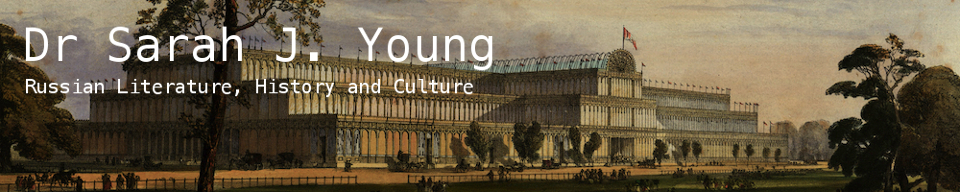
I’m very pleased with my new banner (the picture’s taken from Dickinsons’ comprehensive pictures of the Great Exhibition of 1851). If you’re wondering why I’ve got a picture of the Crystal Palace up there rather than St Basil’s or an illustration from a Russian fairy tale, you may wish to catch up by reading a couple of my posts from last year on the Crystal Palace in Russian literature (part 1 and part 2). My thanks to John for sorting that out.

The eagle-eyed amongst you may also have noticed the ‘follow me on Twitter’ button that has appeared in my ‘syndication’ panel. After months of prevarication, I have finally decided to take the plunge (@russianist). So what can I say? You can follow me on Twitter, or not, as you wish. Someone asked recently why I don’t have facebook thingies on my website, but I don’t do facebook.

Top ten food in Russian literature: part 2

I shall keep you in suspense no longer.

5. Shalamov, ‘Condensed Milk’. As in the case of Solzhenitsyn, hunger is ubiquitous in Shalamov’s stories, so food also plays a significant role. ‘Condensed Milk’ is unusual in depicting a moment of triumph and satiation: the narrator, offered a place on an escape, asks the ringleader Shestaskov for some cans of condensed milk to help build him up for the journey. He polishes them off with enormous relish and then tells Shestakov that he isn’t going with them after all – he knew it was a trap all along. Russian text

4. Dostoevky, The Double. Although the vocabulary of devouring and cannibalism plays a significant role in Dostoevsky’s writing, and there are significant scenes that revolve around meals, such as Marmeladov’s funeral feast, and the underground man’s dinner with school friends, food itself is not as important to him as it is to some writers (this is one indication that his characters are generally not, in fact, embodied). It’s telling that his most memorable food scene is in his most Gogolian work. In chapter 9 of The Double Mr Goliadkin goes into a restaurant on Nevskii Prospekt and eats a pie. He goes up to the till to pay his ten kopecks, only to be told his bill is one ruble ten kopeks, for eleven pies. It’s one of the many moments of uncertainty about the status of the double – Mr Goliadkin is in the middle of rationalizing the consumption of eleven pies, when he suddenly on the other side of the counter, where he thought he had been looking in a mirror, he catches sight of his dastardly double making off, smacking his lips in pleasure. It’s a beautifully constructed scene, also remarkable for the narrator’s entanglement in trying to prove he knows the difference between the two Goliadkins. Russian text | English text

3. Kharms, ‘What they sell in shops nowadays’. Food actually appears less in Incidences than I expected, though there is this very memorable murder by cucumber:

ЧТО ТЕПЕРЬ ПРОДАЮТ В МАГАЗИНАХ
Коратыгин пришел к Тикакееву и не застал его дома.
А Тикакеев в это время был в магазине и покупал там сахар, мясо и огурцы.
Коратыгин потолкался возле дверей Тикакеева и собрался уже писать записку, вдруг смотрит, идет сам Тикакеев и несет в руках клеенчатую кошелку.
Коратыгин увидел Тикакеева и кричит ему:
– А я вас уже целый час жду!
– Неправда, – говорит Тикакеев, – я всего двадцать пять минут, как из дома.
– Ну, уж этого я не знаю, – сказал Коратыгин, – а только я тут уже целый час.
– Не врите! – сказал Тикакеев. – Стыдно врать.
– Милостивейший государь! – сказал Коратыгин. – Потрудитесь выбирать выражения.
– Я считаю… – начал было Тикакеев, но его перебил Коратыгин.
– Если вы считаете… – сказал он, но тут Коратыгина перебил Тикакеев и сказал:
– Сам-то ты хорош!
Эти слова так взбесили Коратыгина, что он зажал пальцем одну ноздрю, а другой сморкнулся в Тикакеева.
Тогда Тикакеев выхватил из кошелки самый большой огурец и ударил им Коратыгина по голове.
Коратыгин схватился руками за голову, упал и умер.
Вот какие большие огурцы продаются теперь в магазинах!

WHAT THEY SELL IN SHOPS NOWADAYS
Koratygin came to see Tikakeev and did not catch him at home.
Tikakeev at the time was in the shop and there he bought sugar, meat and cucumbers.
Koratygin hung around Tikakeev’s door and was about to write a note, when suddenly, look, here comes Tikakeev carrying an oilcloth bag in his arms.
Koratygin saw Tikakeev and shouts at him:
‘I’ve been waiting a whole hour!’
‘That’s not true’, says Tikakeev, ‘I’ve only been out twenty-five minutes’.
‘Well, I don’t know about that’, said Koratygin, ‘but I’ve been here for a whole hour’.
‘Don’t tell lies!’ Tikakeev said. ‘Lying’s shameful’.
‘Dear Sir’, Koratygin said. ‘Watch your expression’.
‘I think…’ Tikakeev began, but Koratygin interrupted him.
‘If you think…’ he said, but here Tikakeev interrupted Koratygin and said:
‘You’re a good one!’
These words so infuriated Koratygin that he closed one nostril with his finger and blew the other one at Tikakeev.
Then Tikakeev whipped out the biggest cucumber from his bag and struck Koratygin on the head on the head with it.
Koratygin clutched his head in his hands, fell down and died.
That’s the size of cucumbers they sell in shops nowadays!

This came to mind in the recent e-coli outbreak and the dramatic headlines it generated (now sadly removed from the BBC website) about killer cucumbers, before the real culprit was uncovered. Incidences: Russian text | English text

2. Gogol, ‘The Nose’. If you’re in any doubt about the importance of food to Gogol, read Nabokov’s biography of him. There are various scenes I could have chosen, in particular from Dead Souls, but my favourite is in fact the opening of ‘The Nose’, when the barber Ivan Iakovlevich, breakfasting on bread and onion (a combination that perplexes some but is actually fairly normal in the context), but eschewing coffee in order to avoid the wrath of his wife, cuts open a bread roll and finds a nose in it. It’s a good metaphor for Gogol’s work as a whole, and I have particular affection for it because it was when I first read this scene as a teenager that I realized how amazing Russian literature was. Russian text | English text

1. Tolstoy, Anna Karenina. This is not just to prove that I’m not prejudiced – whatever my reservations about Tolstoy, and this novel in particular, I genuinely believe it belongs at the top of this list. I’m thinking of two connected scenes in part 6. The first is in chapter 2, when Kitty, Dolly and their mother are making jam and upsetting the old servant Agafia Mikhailovna by using a new-fangled method. What makes it really special is the way that discussion of the technical aspects of jam making are intertwined with the women’s recollections of their marriage proposals. The second scene, in chapter 5, is connected in both style and theme, as Levin’s brother Sergei Ivanovich fails to propose to Varenka whilst explaining the finer points of mushroom hunting. The mirroring of the two scenes apart, I don’t think there’s any great symbolism at work here; they work because they’re so natural and life-like, and they remind you that Tolstoy could do this better than anyone else. This is the main reason I get so annoyed with him – he could be so perfect, yet spent half his life trying to be something else. Russian text

So what else should have been in there? Many would say Nabokov’s description of mushroom picking in Speak, Memory should have been included, but unfortunately it strikes me as a prime example of precisely what I dislike about him: an overwritten parade of knowledge and cleverness for its own sake. Bunin does food well, but no particular text really sticks out, and on the whole I’m not convinced by him, apart from ‘The Gentleman of San Francisco’. When I was teaching Bunin on a short story course, I kept coming across articles on him that started by insisting that he was a great writer, which came across as strangely defensive. It’s hard to imagine anyone finding it necessary to say that about Chekhov.

There are  other brilliant scenes that I did want to include. The first is from the second volume (I think – my copy is in the office) of Evgeniia Ginzburg’s memoir, Krutoi marshrut, translated as Within the Whirlwind, when Ginzburg, working in a camp canteen, realizes she’s serving one of her former interrogators. The second, from Vladimir Dal’s ‘The Petersburg Yardkeeper‘ (from Nekrasov’s Petersburg Physiology), is a lovely description of two yardkeepers, Grigorii and Ivan, eating peas and gooseberries. Food is also very significant in Goncharov’s Oblomov, in particular Oblomov’s dream of of his childhood in Oblomovka, while his Vyborg Side landlady’s pies are essentially what allow him to return to that state of childhood bliss. Finally, on the symbolic use of food, the references to bread in Zamyatin’s ‘The Flood‘ are also worth a mention.

Top ten food in Russian literature

Food is a tricky subject, as there are a lot of viable candidates for inclusion – so many that I toyed with the idea of doing a top twenty, but that’s a cop out, so I’ve had to whittle it down, and some exceptional works have missed the cut. I’ll say a bit more about the ones that didn’t make it at the end of the list. Before we start, a recommendation: Lesley Chamberlain’s The Food and Cooking of Russia (London, 1982), which is both an excellent source of recipes and information on Russian food, and offers an interesting perspective on Russian culture whether you’re into cooking or not.

The emphasis here is specifically on food, rather than eating, and I’ve excluded drinking, which will probably be the subject of a future top ten. But for now, my food list:

10. Pushkin, Evgenii Onegin. The description of Onegin’s meal in a Petersburg restaurant (chapter 1, verse XVI), which features roast beef, truffles, Limburger cheese, a Strasbourg pie, and pineapple, leaves us in no doubt he is a deeply Europeanized character:

Пред ним roast-beef окровавленный,
И трюфли, роскошь юных лет,
Французской кухни лучший цвет,
И Страсбурга пирог нетленный
Меж сыром лимбургским живым
И ананасом золотым.

The contrast with the Russian food on offer at the Larins could not be greater. A special mention also for the fabulous scene where Onegin lets Tatiana down after her declaration of love, whilst walking through the vegetable patch. Russian text

9. Olesha, Envy. Much of Olesha’s 1927 novel revolves around food, though not in an entirely good way. The central figure of Andrei Babichev, the sausage maker and champion of communal eating projects, cuts a fairly repulsive figure with his enormous, healthy groin, as we see his toilette through the eyes of Kavalerov in the opening scene, and he and his sausages never really recover from this grotesque depiction. Even more disgusting is the description of the widow Prokopovich, also a communal food provider – she cooks for a hairdressers’ collective, but what we actually witness is her feeding offal to the cats and the floor being covered in spittle. Russian text

8. Solzhenitsyn, The Gulag Archipelago. As you might expect, Gulag narratives are a great, if depressing, source of food scenes, but few are as memorable or remarkable in their symbolic resonance than the preface of The Gulag Archipelago:

Году в тысяча девятьсот сорок девятом напали мы с друзьями на примечательную заметку в журнале “Природа” Академии Наук. Писалось там мелкими буквами, что на реке Колыме во время раскопок была как-то обнаружена подземная линза льда – замерзший древний поток, и в нем – замерзшие же представители ископаемой (несколько десятков тысячелетий назад) фауны. Рыбы ли, тритоны ли эти сохранились настолько свежими, свидельствовал ученый корреспондент, что присутствующие, расколов лед, тут же ОХОТНО съели их.
Немногочисленных своих читателей журнал, должно быть, немало подивил, как долго может рыбье мясо сохраняться во льду. Но мало кто из них мог внять истинному богатырскому смыслу неосторожной заметки.
Мы – сразу поняли. Мы увидели всю сцену ярко до мелочей: как присутствующие с ожесточенной поспешностью кололи лед; как, попирая высокие интересы ихтиологии и отталкивая друг друга локтями, они отбивали куски тысячелетнего мяса, волокли его к костру, оттаивали и насыщались.
Мы поняли потому, что сами были из тех ПРИСУТСТВУЮЩИХ, из того единственного на земле могучего племени зэков, которое только и могло ОХОТНО съесть тритона.

In 1949 some friends and I came upon a noteworthy news item in Nature, a magazine of the Academy of Sciences. It reported in tiny type that in the course of excavations on the Kolyma River a subterranean ice lens had been discovered which was actually a frozen stream – and in it were found frozen specimens of prehistoric fauna some tens of thousands of years old. Whether fish or salamander, these were preserved in so fresh a state, the scientific correspondent reported, that those present immediately broke open the ice encasing the specimens and devoured them with relish on the spot.
The magazine no doubt astonished its small audience with the news of how successfully the flesh of fish could be kept fresh in a frozen state. But few, indeed, among its readers were able to decipher the genuine and heroic meaning of this incautious report.
As for us, however – we understood instantly. We could picture the entire scene right down to the smallest details: how those present broke up the ice in frenzied haste; how, flouting the higher claims of ichthyology and elbowing each other to be first, they tore off chunks of the prehistoric flesh and hauled them over to the bonfire to thaw them out and bolt them down.
We understood because we ourselves were the same kind of people as those present at that event. We, too, were from that powerful tribe of zeks, unique on the face of the earth, the only people who could devour prehistoric salamander with relish. (The Gulag Archipelago, trans. Thomas P. Whitney, vol 1, ix)

This also gives me an excuse to provide links to the translation, all three volumes of which are available for download on archive.org. The original is on lib.ru and undoubtedly elsewhere as well, but the OCR is a bit of a shocker. Russian text: vol. 1 | vol. 2 | vol. 3 | English text vol. 1 | vol. 2 | vol. 3

7. Bulgakov, Master and Margarita. Bulgakov’s diaries and letters, edited by Julie Curtis as Manuscripts Don’t Burn (London, 1992), give a very clear impression of how dire the food situation was in Russia in the 1920s, so it’s possibly no surprise that it plays such an important role in The Master and Margarita. The scenes at the restaurant of Griboedov House and at the hard currency store make very plain the abundance available to those in the right position and denied to the rest of the population. But my favourite moment is the conversation with the Variety Theatre buffet manager about the quality of his fare in part 1, chapter 18:

– Я извиняюсь, – заговорил ошеломленный этим внезапным нападением Андрей Фокич, – я не по этому делу, и осетрина здесь ни при чем.
– То есть как это ни при чем, если она испорчена!
– Осетрину прислали второй свежести, – сообщил буфетчик.
– Голубчик, это вздор!
– Чего вздор?
– Вторая свежесть – вот что вздор! Свежесть бывает только одна – первая, она же и последняя. А если осетрина второй свежести, то это означает, что она тухлая!
– Я извиняюсь, – начал было опять буфетчик, не зная, как отделаться от придирающегося к нему артиста.
– Извинить не могу, – твердо сказал тот.

‘I’m sorry,’ said Andrei Fokich, appalled by this sudden attack, ‘but I came about something else, the sturgeon has nothing to do with it…’
‘How do you mean, nothing to do with it, when it was spoiled!’
‘The sturgeon they sent was second-grade fresh’, said the barman.
‘Really, what nonsense!’
‘Why nonsense?’
‘”Second-grade fresh” – that’s what I call nonsense! There’s only one degree of freshness – the first, and that’s the last as well. If your sturgeon is “second-grade fresh” that means it’s spoiled.’
‘I’m sorry . . .’ began the barman, at a loss as to how to parry this insistent critic.
‘No, it’s unforgivable,’ said the professor.

A superb commentary on Soviet language, bureaucracy and supply chains. Russian text | English text

6. Chekhov, ‘Gooseberries’. I love Chekhov’s ‘Little Trilogy’ – it’s the stories-within-stories thing that awakens the narrative nerd in me – and Ivan Ivanovich’s story of his brother Nikolai dreaming of buying an estate with gooseberry bushes is an absolute gem. Nikolai finally achieves his dream, and when his brother visits, tucks into a bowl of hard, unripe, practically inedible gooseberries in a state of bliss, convinced they are utterly delicious. It crystallizes the meaning of dreams and self-delusion, and makes me crave (ripe) gooseberry fool. Russian text | English text

And at this point I’m going to take a break. Tune in next time to find out who makes the top five.

Russian perspectives on the Great Exhibition (2)

The second article on the Great Exhibition in Sovremennik [The Contemporary] appeared in the foreign news round-up of the July-August issue. While the first report was somewhat unclear in its origins, this one was evidently cobbled together from reports in the European press. A further development is apparent regarding the naming of the building; the words used remains the same (Kristal’naia Palata), but now they are in upper case throughout, i.e. this is no longer merely a description, it has become a proper name (Russian is very sparing in its use of capitals). For that reason, this time I’ve chosen to translate it as the Crystal Palace.

О лондонской выстваке.
Современник, 28 (1851). Смесь. Иностранные известия, с. 74-6

Около двух месяцев уже английские и французские журналы разносят по Европе известия о всемирной выставке; но в этих рассуждениях до сих пор нет еще ничего положительного. Сначала во всех журналах рассуждали о последствиях выставки, — об идее мира, о развитии промышленности, о цивилизации, о влиянии иностранцев на нравы и обычаи англичан. Потом, когда эта тема уже рассмотрена была со всех сторон, начались длинные рассуждения и споры о превосходстве английской и французской промышленности. Парижские фельетонисты превозносят произведение французской промышленности и стараются унизить англичан; а лондонские восхваляют свою отечественную промышленность. О произведениях же других народов почти ничего не говорят. Поэтому мы до сих пор еще не имееем сравнительной оценки различных родов промышленности. Мы можем указать только на замечательные произведения, которые обращают на себя всеобщее внимание посетителей Кристальной Палаты, и о которых поэтому журналы не могли умолчать.

В первые дни после открытия выставки в Кристальной Палате всеобщее внимание обращено было на брильянт, известный под названием: «ко-и-нурь (гора света). Эта редкая драгоценность, конечно, не даст никакого понятия ни о чьей промышленности; но она стоит два миллиона фунтов стерлингов, и этого уже достаточно было для того, чтобы англичане обратили на нее особенное свое внимание. Англичане, как говорят, даже и в произведениях искусства главное внимание обращают на цену, а не на внутреннее достоинство предмета. Большая часть джентльменов, осматривая различные произведения на выставке, прежде всего спрашивают: «Сколько золота или серебра пошло на такой-то предмет?» или: «Что стоит такая то вещь?» Что же касается до искусства, отделки, это очень мало занимает их.

В лондонских газетах долго и много писали о знаменитой горе света. Главное опасались, чтобы кто нибудь не унес из Кристальной Палаты этого драгоценного камня, хотя приняты уже все предосторожности против подобного покушения. Знаменитый брильянт помещен на выставке в особенной маленькой комнате, под стеклянным колпаком, в позолоченной клетке. Кроме того в клетке устроен особенный механизм, при посредстве которого брильянт, при малейшем прикосновении к нему чьей либо руки, мгновенно скрывается под землю на несколько метров, и вместо его на поверхности является железная дверь. Впрочем, какой то господин придумал особенный план для похищения его и, неизвестно, с какою целью, напечатал его в одной из лондонских газет. Весь этот план состоит в том, чтобы нанять квартиру поблизости к Кристальной Палате и прокопать подземный ход к тому месту, где находится ко-и-нурь.

После ко-и-нура в последнее время более всего занимала публику машина, приготовляющая конверты для писем. Посредством этой машины лист бумаги складывается и склеивается в одну секунду, так что в продолжении дня приготовляется на ней около 100,000 конвертов. Фабрикант каждому посетителю предлагает приготовленный таким образом конверт.

Впрочем, машины вообще, и особенно английские, привлекают всеобщее внимание посетителей Кристальной Палаты. Даже французы, которые, обыкновенно, стараются унизить все английское, сознаются, что англичане, по устройству машин, превосходят все другие народы. Но, замечательно, что машины производят неодинаковое впечатление на посетителей выставки. Одни смотрят на них с любопытством, с удовольствием, многие даже с восторгом, другие же с грустью, с сожалением и иногда даже со слезами. Однажды публика особенно поражена была слезами молодой девушки. Бедная девушка содержит себя и старушку-мать единственно своими трудами, занимаясь приготовлением конвертов. Заметив, с какою невероятною быстротой машина приготовляет конверты, она не могла удержаться от слез.

Между музыкальными инструментами на выставке особенно замечательно, говорят, дубовое фортепьяно. Оно замечательно не столько по своему устройству, сколько по дешевизне: оно продается за 100 франков. Многие предполагают, что этот инструмент удостоен будет первой премии; и это предположение породило уже множество огромных пари.

Впрочем, выставка все еще не достигла окончательной полноты и с каждым днем, говорят, более и более наполняется. Русские произведения, остановленные льдами, не могли поспеть на выставку ранее июня, и потому они не могли быть оценены посетителями Кристальной Палаты. Только наши шелковые материи возбудили всеобщее внимание знатоков. Даже лионские фабриканты отзываются о них, говорят, с особенною похвалой.

Число посетителей Кристальной Палаты с каждым днем все увеличивается, особенно после того, как билеты для входа в Палату продаются по одному шиллингу. Сначала эти билеты продавались чрезвычайно дорого; только в последних числах мая цена их понизилась до одного шиллинга. Весь сбор за билеты к половине июня простирался до 228 тысяч фунтов стерлингов (5,757 тысяч франков).

С июня между посетителями Кристальной Палаты особенно много было сельских жителей и рабочих. Но число иностранцев до сих пор вовсе не так велико, как надеялись жители Лондона. До открытия выставки расчетливые англичане предполагали, что большая часть Европы двинется в Лондон, оставляли свои дома для отдачи в наем, сами же удалялись в другие города или помещались в подвалах и кухнях. Расчет оказался не совсем верным. Счастливы те, которые могли отдать свои квартиры за несколько шиллингов, между тем как прежде предполагали взять за них большие суммы.

В конце мая и в первых числах июня жители Лондона постоянно отвлекаемы были от Кристальной Палаты различными праздниками и увеселениями, между которыми особенно замечателен был бал, данный в пользу бедных литераторов. Надобно заметить, что в Лондоне, по идее известного нашим читателям Диккенса, составилось общество для поощрения молодых литераторов и для пособия бедным литераторам. Члены этого общества решились дать несколько домашних представлений, для усиления своего общественного капитала. Сэр Э. Бульвер по этому случаю написал новую комедию, а герцог девонширский предложил обществу залу. Новая пьеса разыграна была литераторами, в присутствии королевы и принца Альберта, и заслужила всеобщее одобрение. Общество собрало за это представление 2 тысячи фунтов стерлингов.

On the London Exhibition.
The Contemporary, 28 (1851). Miscellany. Foreign News, pp. 74-6

For around two months already British and French journals have been peddling news around Europe of the world’s fair, but so far there has been nothing positive in these reflections. At first all the talk in the journals was about about the impact of the exhibition – the idea of ​​peace, the development of industry, of civilization, the influence of foreigners on the manners and customs of the British. Then, when this topic has already been considered from all sides, there commenced long arguments and debates about the superiority of British and French industry. Parisian columnists praised the products of French manufacturing and try to disparage the British, while London columnists and praised their own domestic industry. About the products of other nations they say almost nothing. Therefore at this point we still have no comparative assessment of the various types of industry. We can point only to remarkable works, which attract the universal attention of visitors to the Crystal Palace, and on which for that reason the journals could not remain silent.

In the first days after the opening of the exhibition in the Crystal Palace universal attention was paid to the diamond known as the “koh-i-nor” (Mountain of Light). This rare jewel, of course, will provide no understanding of anybody’s industry, but it’s worth two million pounds sterling, and that has been enough to ensure that the British paid it special attention. The British, as they say, even when it comes to works of art pay most attention to the price, not the intrinsic value of the object. Most of the gentlemen looking at the various works in the exhibition ask first of all: “How much gold or silver went to such an object?” Or: “How much does such a thing cost?” As for art and decoration, it very little occupies them.

London newspapers have written endlessly and at great length about the celebrated Mountain of Light. In the main they feared that somebody would take this precious stone from the Crystal Palace, although all precautions have already been taken against such an attempt. The celebrated diamond is placed in the exhibition in a special small room under a glass dome, in a gilded cage. In addition a special mechanism is arranged in the cage by means of which the diamond, at the slightest touch from any hand, instantly disappears some metres under the ground, and in its place on the surface there appears a metal door. However, some gentleman or other thought up a special plan to abduct it and, it is unclear to what purpose, published it in one of the London newspapers. The entire plan consisted of renting a flat close to the Crystal Palace and digging a tunnel to the spot where the Koh-i-nor was placed.

After the Koh-i-Nor in recent times the public has been most of all been occupied by a machine that prepare envelopes for letters. By means of this machine a sheet of paper folded and glued in a single second, so that in the course of the day around 100,000 envelopes are made on it. The manufacturer offers each visitor offers an envelope thus made.

However, machines in general, and especially the British ones, attract the universal attention of visitors to the Crystal Palace. Even the French, who usually try to denegrate everything British, acknowledge that the British are superior to all other peoples in the design of machinery. However, it is remarkable that the machines produce different impressions on visitors to the exhibition. Some look at them with curiosity, with pleasure, many even with delight, but others with sadness, regret, and at times even with tears. One day the audience was particularly struck by the tears of a young girl. The poor girl supported herself and her mother solely by her work making envelopes. Seeing the incredible speed with which the machine made the envelopes, she could not refrain from tears.

Among the musical instruments at the exhibition particularly remarkable, they say, is a piano made of oak. It is remarkable not so much not so much in its design as in its cheapness: it sells for 100 francs. Many suggest that this instrument will be awarded the first prize, and this suggestion has already led to many enormous bets.

However, the exhibition has not yet reached its full capacity, and with every day, they say, it is filling up more and more. The Russian products, stopped by the ice, did not make it to the exhibition until June, and for that reason they could not be assessed by visitors to the Crystal Palace. Only our silk fabrics aroused the widespread attention of connoisseurs. Even the manufacturers of Lyons speak about them, they say, with special praise.

The number of visitors to the Crystal Palace is increasing every day, especially since tickets for entry to the Palace have been sold for one shilling. A first these tickets were extremely expensive; only in the final days of May did their price drop to one shilling. The entire takings for tickets up to the middle of June, reached 228 thousand pounds sterling (5,757 thousand francs).

Since June amongst visitors to the Crystal Palace there have been particularly large numbers of rural inhabitants and workers. But the number of foreigners has so far has been nothing like as great as residents of London had hoped. Before the opening of the exhibition thrifty British people assumed that a great part of Europe would move to London, gave up their homes to rent out, and themselves moved away to other cities or found places in cellars and kitchens. The calculation turned out not to be quite correct. Those who can rent out their apartments for a few shillings are fortunate, whereas previously they had assumed they would earn large sums.

In late May and early June the residents of London were constantly distracted from the Crystal Palace by various holidays and entertainments, among which especially remarkable was the ball given in aid of poor writers. It must be noted that in London, on the idea of Dickens, who our readers know well, a society was formed to encourage young writers and for the benefit of poor writers. The members of this society have decided to put on a number of domestic performances, to increase the society’s capital. Sir E. Bulwer wrote a new comedy for the occasion, and the Duke of Devonshire offered the society a hall. The new play was performed by writers, in the presence of the Queen and Prince Albert, and earned universal approval. The company has collected 2 thousand pounds for this production.

Creative Commons License
This translation by Sarah J. Young is licensed under a Creative Commons Attribution-ShareAlike 3.0 Unported License.

Repetition, Repetition, Repetition

My article, ‘Recalling the Dead: Repetition, Identity, and the Witness in Varlam Shalamov’s Kolymskie rasskazy,’ has been published in the latest issue of Slavic Review (vol. 70. 2, 2011, pp. 353-72).

In this article, I examine different types of repetition in Shalamov’s Kolyma Tales, from the repeated narration of the same incident in different tales, to the appearance of recurring characters, the formation of doubles, and the narrator’s alter egos, as expressions of the tensions created by the destruction of identity in the labour camp. Placing this question within the context of the problem of memory facing the Gulag survivor/narrator, I show how repetition becomes central to the depiction of the traumatized consciousness in the act of writing. With reference to Giorgio Agamben’s theorization of the non-survivor as the true witness to Auschwitz, and his identification of two forms of witnessing, I argue that the reader, through their response to repetition, is drawn into the text to become one of those witnesses, so that Shalamov’s stories bear witness to the trauma of Kolyma, and those who did not survive it, through a reciprocity of text and reader, rather than through a transformation or recovery of the writer.

Mapping St Petersburg: Literature as data?

Cross-posted with Mapping St Petersburg.

We’ve added a map of Dostoevsky’s addresses to Mapping St Petersburg, and this seems like a good opportunity to discuss the question of data. In comparison with our work on the Crime and Punishment maps, mapping addresses was easy: information on where Dostoevsky lived is well established and available from various sources, most significantly E. Sarukhanian, Dostoevskii v Peterburge (Leningrad: Lenizdat, 1970). There’s also a Russian Wikipedia page, and Wikimapia was helpful in places as well. But essentially there were no real complications beyond a brief discussion about whether Dostoevsky’s cell in the Alekseev Ravelin should be marked. I decided that it should; clearly he did not choose it as a residence, but reside there he did, during a very significant period of his life.

This was in marked contrast to the experience of mapping the literary text, a process that was full of ambiguity and complication, and is worth reflecting on. How does one turn literature into data, and in doing so, is it inevitable that one will lose all the richness that makes it a work of art?

From one perspective, compiling data for this type of project is no different, at least in its initial stages, from any other type of literary analysis. Reading for place, as I did (twice) with Crime and Punishment, resembles any close reading undertaken with a specific object in mind. It’s not simply a matter of skimming for place names – the Russian habit of abbreviating to initial or final letters prevents that, and in any case we are frequently dealing with descriptions rather than names (therefore bulk analysis using concordances or suchlike is out of the question). Instead, this is a pain-staking process of extracting every reference to place, with its context and consideration of questions such as what type of place it is, and whether it is being mentioned or is an actual setting; such questions are essential to moving beyond using a map as an illustration (the old woman lived here; Sonia lived there etc), because it is only through considering different aspects of the use of place that one can begin to analyse its significance.

Examining aspects of the novel that have an existence beyond the text, it was necessary to refer to various extra-textual sources to establish precise details of place. In particular, I made extensive use of Boris Tikhomirov’s excellent commentary, ‘Lazar! Griadi von’: Roman F. M. Dostoevskogo ‘Prestuplenie i nakazanie’ v sovremennom prochtenii. Kniga-kommentarii (St Petersburg: Serebriannyi vek, 2005) [‘Lazarus, come forth!’: a contemporary reading of F. M. Dostoevsky’s novel Crime and Punishment], which has provided extensive detail beyond that supplied in the Academy Edition Complete Works, F. M. Dostoevskii, Polnoe sobranie sochinenii v tridtsati tomakh (Moscow-Leningrad: Nauka, 1972-90), 7: 363-412, and S. V. Belov, Roman F. M. Dostoevskogo ‘Prestuplenie i nakazanie’: Komentarii (3rd edition; Moscow: KomKniga, 2009) [F. M. Dostoevsky’s Crime and Punishment: a commentary]. Also useful was the little guidebook by K. S. Gorbachevich and E. Khablo, Pochemu tak nazvany?: o proiskhozhdenii nazvanii ulits, ploshchadei, ostrovov, rek i mostov Sankt-Peterburga (5th edition; St Petersburg: Norint, 2002). In addition, I made constant reference to the Google map of St Petersburg, to make sense of the geography and possible routes taken, and to clarify possible locations where they are not specified. Three further websites were invaluable in identifying and locating prototypes: Wikimapia, Photographs of Old St Petersburg, and the Encyclopedia of St Petersburg.

For the next stage, turning these places into data, the essential site was Find Latitude and Longitude – a great tool, although some easier way of recording coordinates beyond copying and pasting the two figures separately would be nice.

The first thing to note is that this process helped establish with some degree of certainty some locations that have previously eluded identification. In particular, there is no information in the commentaries on the tavern where Raskolnikov meets Marmeladov (part 1, chapter 2), while Julian Connolly’s map illustrating key locations in the novel places this scene on Brinko Lane (formerly Tairov Lane), just off the Haymarket – a street Raskolnikov does walk down later in the novel, encountering prostitutes here on his round-about way to the Crystal Palace tavern (part 2, chapter 6). But in fact this can’t possibly be the location of Marmeladov’s tavern; Raskolnikov stops outside it when he reaches ‘the next street’ after leaving the pawnbroker’s following his ‘rehearsal’, and when the two leave at the end of the scene, it is only 200-300 yards to Marmeladov’s lodgings – later confirmed (also by reference to proximity to the pawnbroker’s house) as being on Bolshaia Podiacheskaia (part 2, chapters 6-7). Therefore the tavern must logically be located on prospekt Rimskogo-Korsakova (formerly Ekateringoffskii prospekt), near the junction with Bolshaia Podiacheskaia (markers 9 and 12 on Mapping Ambiguity shows this arrangement). The fact that in the scenes with Marmeladov, location, insofar as it is specified, is related to the pawnbroker’s house, is, I think, significant, and this indicates the potential of reading for place; it is not simply a matter of finding the places and plotting them on a map, but through that process, of coming to an understanding of how place is used and what the relationships between the places and the characters signify.

If certain locations can be established by this process, confirming the remarkable degree of locatedness exhibited by Crime and Punishment, is it possible for every scene? Not quite. My reading revealed one location about which too little information is given to attempt to map it: Porfiry’s flat, where Raskolnikov first encounters the examining magistrate and his article on crime and the rights of great men is discussed (part 3, chapter 5). The brevity of the conversations en route to and from Porfiry’s suggest he lives reasonably near to both Raskolnikov’s lodgings on Stoliarnyi Lane and those of his mother and sister on Voznesenskii Prospekt, but the only remark that is made is Razumikhin’s comment ‘It’s this grey building’ (part 3, chapter 4). In comparison with the specificity seen elsewhere, this seems deliberately evasive; ‘grey’ as a synonym for ‘anonymous’. Why is this one – highly significant – scene dis-located in this way? A further ambiguity about location is apparent in the second interview (part 4, chapters 5-6), which takes place at one of two police stations (see Mapping Ambiguity markers 74 and 75). So while most of the other characters are connected to particular locations, Porfiry is treated differently, and I think this should give us some new insight into this character.

I suspect some traditional literary researchers will dismiss this sort of project as reductive and bypassing all that is essential in Dostoevsky’s novel – its philosophical, spiritual and emotional intensity. And there is, on a literal level, a reduction – of a setting to a set of coordinates – but only as part of a wider process, and one that, I think, opens up a new dimension of the text, which goes beyond the consideration of the Petersburg setting as a primarily symbolic part of the text and enables analysis of other aspects of the role of place. Literature is not data, and Dostoevsky wrote a novel rather than providing us with a set of data, but the process of converting a literary text into data in this way, far from being reductive, resulted in perhaps the most revealing reading I have undertaken.


The opening of the Great Exhibition: a view from Russia

The level of interest from around the world in the Great Exhibition was really quite remarkable, and Russia was no different. I’ve been digging out articles from Russian journals and present here what must be one of the very first, from the May-June issue of Sovremennik for 1851, which deals with the build-up to the opening, and reads as though it was dispatched just as the opening ceremony got underway (there is no information about the author or whether it was an original piece or taken from another source, although one generally finds that when articles are copied from European journals, it tends to say so).

Aside from the shambles of the ticketing arrangements, which reminded me somewhat of the Millenium Dome fiasco, the most interesting thing from my perspective is the naming of the building. It’s well known that the name the Crystal Palace was originally an ironic term coined by Punch before the exhibition even opened, but I was quite surprised to see that the nickname was already so well established that a Russian journal was approximating it at this stage. The name given several times (without any suggestion it is an unofficial coinage) is kristal’naia palata (crystal chamber) – not quite there, but close enough to show how fast ideas could travel even before the days of mass communication. The resemblance in sound of the Russian ‘palata’ to ‘palace’ may have influenced the choice as well. In any case, the translation of Crystal Palace into Russian never established a definitive form, even at the height of its significance for Russian letters, in the 1860s: you see Kristal’nyi dvorets, but also Khristal’nyi and Khrustal’nyi, and while dvorets is the most common word used for ‘palace’, you also come across palas and palats. So, is this the first reference in Russian letters not so much of the building, but of the name by which it became known?

Here is the article, followed by a (slightly rough-and-ready) translation. More like this to follow in due course.

Открытие всемирной выставки.
Современник, 27 (1851), Смесь. Май 1851. Иностранные известия, с. 86-88

Из Лондона сообщают краткое известие о важном торжестве, совершенном 1 мая, по случаю открытия всемирной выставки, и мы спешим передать это известие нашим читателям. Около двух дней Лондон дышал и жил только для 1 мая, для этого дня, который всегда был праздником для Англии, — праздником весны и цветов. Бедные цветы! печальная весна! Но на этот раз в Лондоне был всемирный праздник, большая церемония, в которой приняли участие королева, двор, посланники, комиссары всех промышленных народов и вся знаменитость Великобритании. Это был праздник беспримерный, на который стеклись народы со всех концов земли. Это было торжество открытия гигантской палаты со всеми чудесами ее; это было торжество промышленности и мира. Поэтому неудивительно, что в аристократических салонах, в Сити, между народом, — повсюду говорили только о церемонии открытия.

Вчера вечером комиссия уже не раздавала билетов для входа. Те, которые прежде дали себе слово не присутствовать при открытии кристальной палаты, в последние минуты, увлеченные общим стремлением, делали невероятные усилия, чтобы приобрести билеты для входа. Можно себе представить, как это выгодно было для спекулянтов. В среду вечером в Пикадилли был настоящей рынок. Что стоит билет? — Ливр. Через минуту этот билет продавался уже за 1 1/2 ливра, и так дальше до полуночи. Один книгопродавец купил билетов на 2,000 фунтов стерлингов (50,000 франков) и потом перепродал их с огромным комиссия

В среду утром выставляющие свои товары не знали еще, будут ли они иметь свободный вход. Королевская комиссия по этому случаю получила бесчисленное множество просьб, на которые она, обыкновенно, отвечала, что при церемонии открытия будут присутствовать только те, которые заблаговременно запаслись билетами. После этого формального ответа французы решились закутать все свои произведения в полотняные покрывала. Примеру этому последовали и многие другие иностранцы, прибывшие на выставку с своими произведениями. Комиссия не предвидела этой хитрости, о которой в самом деле ничего не было сказано в программе, иностранцы, несмотря ни на какие убеждения, твердо решились выполнить свою угрозу. Что делать? Не могли, как следовало, открыть всемирной выставки, которой уже не было. Согласились, наконец, чтобы известное число билетов передано было в распоряжение выставляющих произведения каждого народа. Французы получили на свою долю пятьсот билетов. Таким образом дело было улажено. Но жители Лондона в продолжении двух дней очень опасались, чтобы иностранцы не выполнили своей угрозы.

Накануне, праздника вид кристальной палаты совершенно изменился. В галлереях уже не видно было тюков, и не было прежнего беспорядка. Сквозь очищенные аллеи можно было видеть самые отдаленные части огромного здания. В залах повсюду красовались великолепные обои и материи.

В этот день кристальная палата представляла трогательное зрелище. Эмигранты, прибывшие из Корнваллийского графства и отправляющиеся в Австралию, получили дозволение посмотреть на эти промышленные богатства, о которых они не имели и понятия. Оставляя свое отечество, они пришли бросить взгляд на эти громадные богатства, который они видели в первый раз и которых уже никогда не увидят. Печальный контраст, который в Лондоне можно видеть каждый день, и который был еще поразительнее в такую торжественную минуту!

В самый день торжества, 1 мая, с семи часов утра, Нуde-Раrк, этот огромный сад, уже наполнен был народом; во всех аллеях видны были толпы народа, но толпы спокойные и молчаливые, которые ожидали проезда экипажей. В девять часов начали проезжать экипажи. Пикадилли уже перестала быть улицей: она похожа была на реку, по которой катились экипажи и омнибусы. При таком страшном собрании людей, экипажей и лошадей, в Париже непременно произошло бы множество несчастных случаев, а в Лондоне не было ни малейшего несчастья. Никто не теснился, никто не забегал вперед; каждый следовал за тем, кто шел впереди его.

Гигантское здание, со всеми чудесами промышленности, представляло великолепный вид. Здесь колоссальные статуи; там широкие фонтаны, или гигантские телескопы и огромнейшие машины, которые в перспективе казались допотопными животными. В этих великолепно украшенных футлярах и на этих эстрадах, обремененных драгоценными предметами, собраны образцы всех родов промышленности, с целого земного шара; точно также, как в этой толпе были представители всех народов, начиная с флегматического голландца до улыбающегося китайца. Здесь развевались флаги всех народов, знамена всех нации: и трехцветное знамя Франции и нидерландский лев, и британский единорог, и ирландская лира, в двуглавый орел Австрии, и черный орел Пруссии, в белый орел России. Все эти знамена, которые до сих пор встречались только на поле сражения, теперь вместе развевались мирно в промышленной базилике. Под сводами этого здания люди говорили на всех диалектах, как во времена вавилонского столпотворения.

Среди палаты возвышалась обширная платформа, на которой поставлен был трон с британским гербом. Северная часть, прямо против трона, украшена была цветами и зеленью. Это не простой цветник, а сад: пальмы, лимонные деревья и тропические растения во всех направления раскидываются под этим высоким сводом.

The Opening of the Great Exhibition
The Contemporary, 27 (1851). Miscellany. May 1851. Foreign news, pp. 86-88

From London, a short news report about an important ceremony held on 1 May, on the occasion of the opening of the World Exhibition, and we rush to pass this news onto our readers. For around two days London breathed and lived only for 1 May, for this day which was always a holiday for England – the festival of spring and flowers. Poor flowers! sad spring! But this time London held a worldwide festival, a large ceremony attended by the queen, court, ambassadors, commissioners of all industrial nations and the great and good of the whole of the UK. It was an unprecedented festival, to which people flocked from all corners of the earth. It was a celebration of the opening of a giant chamber with all its marvels, it was a celebration of industry and peace. Therefore it is not surprising that in the aristocratic salons, in the City, and among the people – everywhere the opening ceremony was the only topic of conversation.

Last night, the commission had still not distributed entrance tickets. Those who earlier gave their word not to attend the opening of crystal chamber at the last minute, enthused by the general aspiration, went to incredible lengths to acquire entrance tickets. You can imagine how beneficial this was for speculators. On Wednesday evening in Piccadilly there was a veritable market. How much did a ticket cost? – one livre. A minute later the ticket was already being sold for  1 1/2 livres, and so on until midnight. One bookseller bought tickets for 2,000 pounds sterling (50,000 francs), and then resold them at a huge profit.

On Wednesday morning, those exhibiting their products still did not know whether they would have free entry. The Royal Commission on this occasion received countless requests, to which it usually replied that when the opening ceremony would be attended only by those who had acquired tickets in  advance. After this formal response, the French decided to wrap all their works in linen covers. This example was followed by many other foreigners who had come to the exhibition with their works. The Commission did not foresee this trick, of which in fact nothing has been said in the programme. Foreigners, regardless of conviction, took a firm decision to carry out their threat. What should be done? The world exhibition, as it was not there, could not be opened as it should have been. It was agreed, finally, that a certain number of tickets should be put at the disposal of exhibitors of the products of each nation. The French received their share of five hundred tickets. In this manner the case was settled. But the inhabitants of London in the course of two days were very much afraid that the foreigners would carry out their threat.

The day before the festival, the appearance of the crystal chamber has completely changed. In the galleries packaging was no longer visible, and the previous disorder had gone. Down the cleared walkways it was possible to see the most distant parts of the huge building. The halls throughout were adorned with beautiful wallpaper and materials.

On this day, the crystal chamber presented a stirring spectacle. The emigrants who had arrived from the Duchy of Cornwall and were departing for Australia received permission to look at this industrial wealth, of which they had no concept. Leaving their homeland, they came to cast an eye over this enormous wealth, which they were seeing for the first time and which they will never see again. A sad contrast, which in London you can see every day, and that was more striking at such a festive moment!

In the very day of the festival, 1 May, from seven o’clock in the morning, Hyde Park, that huge garden, was already filled with people, down all the avenues crowds of people were visible, but the crowds were calm and quiet as they waited for the carriage procession. With such a terrible gathering of people, carriages and horses, in Paris, there would certainly have been an abundance of injuries, but in London there was not the slightest disaster. No one was crushed, no one tried to rush ahead, everyone followed the person who was walking in front of them.

The giant building, with all the wonders of industry, presented a magnificent view. Here, there are colossal statues; there, there are wide fountains or giant telescopes and the most gigantic machines, which from a distance looked like prehistoric animals. In these beautifully decorated cases and on these platforms, weighed down with precious objects, are gathered together samples from all branches of industry, from all over the globe; just as in the crowds there were representatives of all nations, from the phlegmatic Dutchman to the smiling Chinese. Here there were waving flags of all peoples, banners of every nation: the French Tricolore and the Dutch lion, the British unicorn and Irish harp, the two-headed eagle of Austria, the black eagle of Prussia, and the white eagle of Russia. All these banners, which until now had only been found on the battlefield, are now flying together peacefully in the industrial basilica. Under the arches of this building, people were speaking in every dialect, as in the time of Babel.

In the middle of the chamber an extensive platform rose up, on which was placed a throne with the British coat of arms. The northern part, directly opposite the throne, was decorated with flowers and greenery. Not a simple flowerbed, but gardens: palms, lemon trees and tropical plants are spread in all directions under these high arches.

Creative Commons License
This translation by Sarah J. Young is licensed under a Creative Commons Attribution-ShareAlike 3.0 Unported License.