• New Post Alerts By Email

  • Syndication

    RSS
    Atom
  • Tags

  • Archives

Live from Naples

I’m currently at the 14th International Dostoevsky Symposium in Naples, which started this morning. I missed the opening sessions so don’t have a great deal to report yet except to say that the surroundings in the Palazzo Du Mesnil are really rather sumptuous, and they provided us with a very fine lunch, for which I arrived just in time. Apparently the highlight of the morning was Robert Louis Jackson’s presentation, which returned to a much-discussed subject, but one which is very dear to my heart, the role of Holbein’s painting ‘Christ in the Tomb’ in The Idiot, so I’m slightly annoyed to have missed that.

In the afternoon Robert Belknap gave a really interesting talk on Crime and Punishment. It started out in a fairly mundane way discussing the different plots, Raskolnikov’s doubles, and the way that the different plots and characters comment on the main ones, and it took a while to get going, to the extent that at one point I wondered whether he would get round to saying anything different at all. Then in the last five minutes or so it really came to life when he started discussing Porfiry.

The most thought-provoking point for me was that the novel doesn’t provide us access to Porfiry’s mind – obviously, for most of the novel we’re with Raskolnikov, but there are significant passages where we have access to the thoughts of Svidrigailov, Razumihkin, and Dunia — in other words, the characters who function as the counterparts of Raskolnikov in the subplots that mirror the main one. Belknap suggested that this placed Porfiry in a unique position.

But the character he didn’t mention at all was Sonia, and we don’t see inside her mind either.  I’ve been quite surprised while I’ve been re-reading it recently quite how often we leave Raskolnikov and follow Razumikhin and Dunia in particular — much more than I remembered. But the closest we get to seeing her on her own is the end of part 3, chapter 4, when Svidrigailov follows her home, and that all comes from his point of view. For Belknap it was the fact that Porfiry is a detective that was of significance, but for me there is something very important in Dostoevsky’s work as a whole relating to which characters we are given inner access to, and which we see from the outside. In Crime and Punishment I don’t think it’s half as simple as a dichotomy of characters who reflect aspects of Raskolnikov’s thoughts and actions and those who don’t.

Soviet jokes

The book I’ve been reading for fun over the last few days could, for once, actually be described as fun: Ben Lewis, Hammer and Tickle: A History of Communism Told Through Communist Jokes (2008). Actually, it isn’t that funny, partly because analyses of humour never are (the worst research seminar I’ve ever been to was about Soviet humour, but that’s another story), partly because most Russian and Soviet anecdotes seem to be in the wry smile rather than the laugh-out-loud category. But it did make me nostalgic for some of the Brezhnev and KGB gags that were still doing the rounds in the USSR at the beginning of the nineties.

Lewis’s attempt to construct a theory of communist jokes (essentially, did jokes contribute towards the collapse of communism?) is a bit feeble, and the first third of the book leaves something to be desired — I’m really not convinced that narrating the history of Stalinism through the humour of the time really does anything more that make it a bit less grim, while not really telling us much about the humour either. It works best when he just relates the history straight and intersperses it with apposite anecdotes, but often he prefers to tell the story through the role of jokes, which is not always successful. It picks up in the chapter on Nazi vs communist jokes, when the comparison of the two is quite illuminating on the differences between the ideologies and the attitudes of the German and Soviet populations to them.

Perhaps it’s because I learned something new, but I though the second half (post-Stalin) was much more better, even if the jokes were on average weaker. When he’s dealing with the Soviet bloc, he interviews some interesting witnesses, including stand-up comedians and satirists, who give fascinating perspectives on the vicissitudes of dissidence and accommodation within the party and government. While they pretty much rescue the book, it’s still nearly sunk by Lewis’s preoccupation with his girlfriend from the former GDR. Obviously the gradual demise of their relationship is there to dramatize the clash of ideologies, but frankly, it just makes him look like an idiot. He does sort of admit that at the end, but by that time he’d long since lost my sympathy. And speaking of the end, giving a summary of the preceding 300 pages is not, in my book, a conclusion.

There were a couple of omissions. Firstly, although he gives a brief survey of satirical writers in the twenties and thirties (pp. 33-40), including Bulgakov and Zoshchenko, there’s no reference to Kharms, who, as regular readers will know, is one of my favourites. Obviously Kharms was barely published in his lifetime, but much of Bulgakov’s satirical work also remained unpublished until long after his death, so that’s not why he’s ignored here. And Kharms is important because his humour, more akin to slapstick, is so different from the sort of classic Soviet satire represented by Zoshchenko. Where does Kharms’s brand of absurdism come from, and what does that say about communism?

Second, Vovochka doesn’t make an appearance. For those of you who haven’t had the pleasure, Vovochka, a foul-mouthed kid with distinctly adult drinking, smoking and sexual habits, is a stock character of Russian jokes — you can see some examples here, though I warn you, some of them are remarkably crude. Nowadays Vovochka jokes are definitely considered political because they refer to Putin (Vovochka being a diminutive of Vladimir), but as Lewis eventually has to admit, there are no new jokes, only new contexts, and in the fag-end of the Soviet era, at least among the circles I moved in, Vovochka was Lenin, often only implicitly, but sometimes overtly, as in the following example:

Vovochka puts his hand up in class and says ‘Please miss, I don’t feel right, I need to go home’. His teacher gives him permission to leave. On his way out of the school gates he bumps into a friend who’s got a packet of cigarettes.

‘Hi Vovochka’, he says, ‘fancy a smoke?’

‘Nah’, says Vovochka, ‘I’ve got to get home. Something’s wrong.’

He heads home and round the corner sees another friend, this time with a bottle of vodka.

‘Vovochka, fancy a drink?’ he says.

‘I can’t today’, says Vovochka. ‘I’m going home. I don’t know what’s wrong, but…’

He carries on and meets his girlfriend.

‘Hey Vovochka’, she says, ‘fancy a quick shag?’

‘Not today’, he says, waving her away, ‘I need to get home.’

As his friends gather to discuss what on earth’s wrong with Vovochka, he finally arrives home. As he opens the door, his mum blurts out:

‘Vovochka, thank God you’ve come home! Terrible news! Your brother tried to kill the tsar!’

Well, I didn’t guarantee it was going to be funny, did I?

The Crocodile and the Crystal Palace: a whimsy

Some of the best ideas are destined never to make it into print. They’re usually the ‘wouldn’t it be great if…’ ideas, that you know probably aren’t true, and even if they are, there’s no way you’re ever going to prove them. At the same time you don’t want to let them go altogether. And this is where a blog is good.

While I’ve been thinking and writing about the Crystal Palace recently, and reading and re-reading various things, of particular interest have been two articles by Ekaterina Dianina. The first, ‘Dostoevskii v khrustal’nom dvortse’, Novoe literaturnoe obozrenie, 57 (2002), 107-25 (‘Dostoevsky in the Crystal Palace’, New Literary Review) claims that Dostoevsky didn’t visit Sydenham during his trip to London in 1862, but instead went to the world exhibition in South Kensington. Some of Dianina’s textual analysis is convincing (although I think her explanation of Dostoevsky visiting the wrong exhibition by error is very weak and unlikely), but in the end I was only persuaded that he conflated the 1862 exhibition with the Crystal Palace, not whether he visited one or the other. But in any case it set me thinking about how one might prove what he did in London.

Dianina’s second article, ‘Passage to Europe: Dostoevsky in the St Petersburg Arcade’, Slavic Review, 62.2 (2003), 237-57, examines the setting of his 1865 satirical story The Crocodile (Russian here) in the St Petersburg arcade, Passazh (The Passage).

The article to a great extent follows the Benjaminian path one would predict, but it also reminds us of the links between such early shopping/entertainment arcades and the design of the Crystal Palace. I have to admit, I don’t think I’d read ‘The Crocodile’ since I was an undergraduate, so I went hurrying back to it. Rediscovering it was a treat. It’s the story of a Ivan Matveich, who visits the Passazh to see the latest curiosity being exhibited there, a crocodile, gets a bit close, and is swallowed whole, but is still alive inside the crocodile, and can talk and take part in discussions about what to do with him, and how it will affect the Russian economy, which then turns into a discussion of political economy — in other words, the man inside the crocodile becomes the new sensation.

As Dianina points out, the crocodile is clearly linked to Europe and progress — it has a German owner, is described as a native inhabitant of Europe, and Ivan Matveich wanted to see it in the first place because he was about to depart on a trip to Europe. And there are also lots of references to the progressive ideas of the day — they are even being discussed in the next room while Ivan Matveich is being swallowed. So there is evidently a connection between the Passazh setting and the satire on contemporary ideas and Western influences.

And then last time I was in Crystal Palace park I went to see Waterhouse Hawkins’s dinosaur models, and I thought…
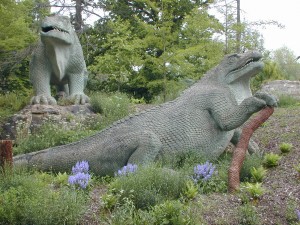
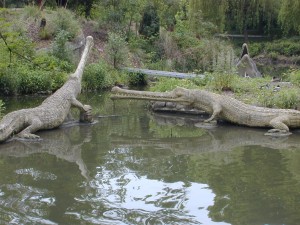
… wouldn’t it be great if Dostoevsky was thinking of the Crystal Palace dinosaurs when he wrote ‘The Crocodile’. Pretty far-fetched, I’ll admit, but bear with me. The big question (which Dianina’s article doesn’t really address) is: why a crocodile? Is it merely satirizing the fashion for the exotic, or is it a parodic counterpoint to the modernity of the Passazh? Surely the fact that the story involves a prehistoric creature is significant, especially as the story makes direct reference to this:

I hope to live at least a thousand years, if it is true that crocodiles live so long, which, by the way — good thing I thought of it — you had better look up in some natural history to-morrow and tell me, for I may have been mistaken and have mixed it up with some other fossil [ископаемый]. (ch 3)

And as my second picture shows, the Telesoaurs in the park, among the most accurate of Hawkins’s dinosaurs, don’t look that different from crocodiles today. In the mid-nineteenth century, as knowledge of the prehistoric world and understanding of evolutionary theory developed, dinosaurs represented a curious amalgam of the ancient and the contemporary, and as a depiction of the latest knowledge, Hawkins’s models played a very important role in the Crystal Palace’s vision of the present day. This relates to one way I’ve been considering the Crystal Palace recently — its capacity to incorporate or signify opposites simultaneously. But it also makes sense in the context of Dostoevsky’s story; the crocodile, as a form of dinosaur, is both part of the modernity of the Passazh, and its antithesis. When Ivan Matveich, from within the crocodile, starts pronouncing on progressive ideas, the ancient becomes the mouthpiece for the contemporary, just as the Crystal Palace dinosaurs provide a commentary on science and progress by representing the prehistoric world.

Then there’s the fact that Ivan Matveich is swallowed whole by the crocodile, discovers that its insides are empty and ‘exceedingly roomy’ and, once they have solved the conundrum of how to feed him, is quite happy to stay there. Aficionados of the Crystal Palace dinosaurs will know exactly where I’m heading: the dinner party that Hawkins held in his studio on 31 December 1853 in the body of the iguanodon model.
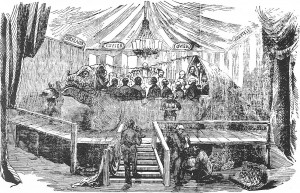
Is there any evidence that Dostoevsky knew about this event, which has become part of the Crystal Palace legend? Absolutely not, but I’m not going to let that get the in way of a nice idea.

But he almost certainly would have read about the dinosaurs, even if he didn’t see them himself, because they were discussed in the Russian press as part of the phenomenon of the Crystal Palace. This is what Chernyshevsky has to say about them in his 1854 article in Fatherland Notes (Otechestvennye zapiski):

It’s unnecessary to talk say that [the gardens] are full of grottos, waterfalls, fountains, lakes, statues, etc. Let us just say a few words about the collection of antedeluvian animals that are situated in the gardens. These gigantic figures were made life size by Hawkins under the direction of one of the great English geologists and an honourary member of our Academy of Sciences, Owen, from drawings by Cuvier and Mantell, who  reconstructed the forms of the monsters of the ancient world from skeletons. The creatures are placed in natural surroundings that reproduce the natural world in which they lived. To give a sense of the terrible size of these monsters we can say that many of the models weight more than 2,000 puds [1 pud = 36 pounds] and the body of the iguanadon is supported by the iron pillars 4 arshins thick [1 arshin = 28 inches] that constitute the bones of its four legs. And there are many monsters whose size outdoes that of the iguanadon. In the  Sydenham park there stand an icthyosaurus — a fish-like lizard which combines the form of reptile, bird, mammal and fish — a labyrinthodon, a mastodon, dozens of other antedeluvian giants and the biggest of all their contemporaries — the megalosaurus, before which an elephant today would be like a sheep before a crocodile. (Section 7, pp. 94-5)

… and there’s our crocodile. Dostoevsky was not long out of prison when this was published, and, having been isolated from literary life for so long, was devouring every journal he could get his hands on. Fatherland Notes was one of the most important literary journals at that time, so it’s likely to have been pretty high up Dostoevsky’s reading list.

So, in 1854, the rising star of the new radical generation describes the dinosaurs and compares one to a crocodile. A decade later Dostoevsky, in the middle of his dispute with the nihilsts, in which the meaning of the Crystal Palace is of huge symbolic importance, writes a story that features a crocodile in an arcade spouting radical ideas. Coincidence? I’d like to think not.
Dickens and anti-Semitism

Now I’ve finished reading Oliver Twist, I can say for certain that the depiction of Fagin is undoubtedly the most problematic aspect of the novel. It is widely known to be a graphic example of anti-Semitism, but even so, it’s quite shocking. I say this as someone who’s used to reading Dostoevsky, but I would suggest that the way Fagin is described is worse than anything we see in Dostoevsky’s fiction (his journalistic work is another matter).

I have to admit I find Dickens’s attitude towards Fagin rather puzzling. Stephen Gill’s introduction to the Oxford World’s Classics edition (1999) suggests that it was somehow accidental, citing the author’s surprise at later charges of anti-Semitism and his revisions to the text for the 1867 edition, which removed numerous references to Fagin’s Jewishness.

Fagin, complete with trident

Although I’m very far from being a specialist on Dickens, I’m not convinced. It’s not just the associations with the devil, which begin from the moment he is introduced (and are evident in Cruikshank’s illustration), but the persistence with which Fagin is described as repulsive, ugly, dirty, disgusting, treacherous and evil — it’s pretty much every time he appears. Yes, as Gill states, the stereotype of the Jew as scapegoat was very strong, but Fagin isn’t just scapegoated by society, he’s scapegoated by the text as well. It’s not a commentary on that process, it participates in the process wholeheartedly — not even Bill Sikes, brutal as he is, has anything like the opprobrium heaped on him that Fagin gets. I can’t see any escape from that, and I can’t see that removing a few references to ‘the Jew’ would make that much difference either.

It doesn’t fit with Dickens’s usual sympathy for the marginalized — particularly in a novel which is primarily concerned with denunciation of the poor laws and marginalization/criminalization through poverty. So why is it there? To pander to popular prejudices? To me that seems unlikely; although he was, like Dostoevsky, anxious to maintain his popularity, the social concerns which dominate his novels suggest that his aim was more to undermine, not buttress, the received opinions of the day. In any case, the fact that he takes every opportunity to attack Fagin strikes me as bordering on the obsessive — it feels more fundamental than something intended just to entertain the audience.

Perhaps this is something that cannot be interpreted away, and perhaps we’re all the better for that. It’s often too easy to avoid confronting the most problematic aspects of literature, and the unpleasant attitudes and beliefs of writers whose works we love and (otherwise) respect, but a character like Fagin reminds us that we have to keep on questioning them. Which means I will tackle the complex and extremely unpalatable question of Dostoevsky’s anti-Semitism, and in particular its relationship to his religious faith, very soon.

Summer reading

The exam season is more or less over, my marking marathon is finished, and one of the things I always look forward to at this time of year is being able to read intelligent books for fun. First up is my annual Dickens fix, and this time I’m reading Oliver Twist. This was the book that turned me against Dickens as a kid, and even though it must now be nearly 20 years since I realized how wonderful he really is, I’ve kept putting off my return to Oliver Twist. But living in London has finally spurred me on, and I’m now racing through it.

It is, as many people have noted, an uneven book, certainly not as consistently brilliant as my favourites, Bleak House and Dombey and Son, but beyond the standard gripes about poor characterization and inconsistent narrative voice, two things in particular bother me, in part because they both play such a problematic role in Dostoevsky’s writing: its anti-Semitism, and the portrayal of epilepsy, both of which are connected firmly in the novel with evil.

Monks’s epilepsy is a minor element in the novel, but it becomes his chief characteristic because he is barely fleshed out in other respects, and there is a definite assumption that there is a link between criminality and epilepsy, even if the causality remains unclear. Essentially, the role of epilepsy here is to make the character more repulsive and frightening, and even though in the end Monks is not treated particularly harshly, the fact that the character is given this illness to make him seem less sympathetic is troublesome.

It’s perhaps unfair to compare Dickens’s treatment of epilepsy to Dostoevsky’s, given that the latter suffered from the disease and was capable of depicting it from within, as he does, of course, in The Idiot. But it is always a source of ambiguity in Dostoevsky, making us question Prince Myshkin’s goodness — which seems to derive from his illness — but moving in the opposite direction with Smerdyakov in The Brother Karamazov, who initially appears to be wholly negative but is ultimately shown to be far more complex. But the comparison made me think about other portrayals of epilepsy and related illnesses in literature, in particular Silas Marner’s trances in George Eliot’s novel, because they are, as Wolf states (see references below) related to religious questions, as Myshkin’s fits are in The Idiot, and are responsible for Marner being considered by the other characters as both saintly and satanic. I’m pretty certain Dostoevsky wasn’t aware of Silas Marner when he was working on The Idiot (according to Harper and Booth, the publication of the Russian translation of Silas Marner was delayed, so that it didn’t appear until some years after Dostoevsky’s death — all her other novels were translated straight away), and while Eliot’s use of a medical diagnosis makes sense because of her humanism, Dostoevsky’s religious beliefs make his incorporation of epilepsy more complicated, particularly when considering his supposed attempt at portraying a ‘positively beautiful man’.

But the context of Prince Myshkin’s first fit, which saves him from Rogozhin’s knife, does raise the of possibility that Dostoevsky was drawing on both Oliver Twist and Othello (both of which he certainly did know). He cites the latter in his notebooks for the novel, specifically referring to the relationship between Myshkin and Rogozhin, but I never felt the comparison really worked, and somehow it didn’t register when I was studying The Idiot that Iago mentions witnessing Othello having an epileptic fit (Act 4, scene 1). Then in Oliver Twist, when Oliver first encounters with Monks (chapter 33), he is saved from attack by the onset of Monks’s epileptic seizure. In both these texts, therefore, a connection is established between epilepsy and murder or violence. Dostoevsky’s scene (The Idiot, pt 2, ch 5) clearly echoes Dickens’s, not least because Myshkin and Rogozhin have just become ‘spiritual brothers’ by exchanging crosses, while Oliver and Monks are half-brothers, but Dostoevsky reverses the roles; the ‘healthy’ character is the murderous one, and the fit saves the epileptic himself. Epilepsy thus emerges as a positive, even as the horror of witnessing the fit is described in graphic detail.

This obviously doesn’t account for everything related to epilepsy in Dostoevsky’s novel, but while the build-up to Myshkin’s fit has been much analysed (including by me, in both my book Dostoevsky’s ‘The Idiot’ and the Ethical Foundations of Narrative and, taking a different perspective, in an article, ‘Dostoevsky and Buddhism’, in my edited collection Dostoevsky: On the Threshold of Other Worlds — I am planning to post that article on my website some time soon), that encounter between Myshkin and Rogozhin has been somewhat passed over in comparison (except in Elizabeth Dalton’s Freudian study), but on this reading the intertext makes it a more significant moment. What it means, precisely, I’m not yet sure, beyond emphasizing his rejection of physiological explanations for crime and violence. Perhaps it is also an indication that one ought not to make easy assumptions about the guilt and innocence of Dostoevsky’s two main characters. However it is interpreted, it seems quite strange that this echo of Oliver Twist appears in the novel which to some extent marks Dostoevsky’s shift away from his preoccupation with the ‘insulted and injured’, and it shows that even when that is not the main focus of his writing, it is never in fact far away from his attention.

In my next post, I’ll discuss the question of anti-Semitism in Dickens and Dostoevsky.

References:

Elizabeth Dalton, Unconscious Structure in ‘The Idiot: A Study in Literature and Psychoanalysis (Princeton University Press, 1979)

Kenneth E. Harper and Bradford A. Booth, ‘Russian Translations of Nineteenth-Century English Fiction’, Nineteenth-Century Fiction, 8.3 (1953), 188-197

Wolf, Peter, ‘Epilepsy in Literature’, Epilepsia, 36, suppl. 1 (1995), S12-S17

See also:

Irina Gredina and Philip V. Allingham,  Dickens’s Influence on Dostoevsky on The Victorian Web.

Andrew Larner, Dostoevsky and Epilepsy in ACNR, 6.1 (March/April 2006).

Grossman events

Three events in June:

Monday 7 June, 6.30pm, Free Word Centre: Robert Chandler talking about Vasily Grossman.

Tuesday 15 June, 7.3opm, Pushkin House: Robert Chandler reading from his translation of Everything Flows, and discussing Grossman with Yekaterina Korotkova-Grossman (the author’s daughter).

Sunday 20 June, 2pm, British Museum, Stevenson Room: Yekaterina Korotkova-Grossman talks to Robert Chandler about her father, and her memoir Ukraine: On the Edge of an Empire. The talk is part of LRB’s World Literature Weekend.

And a couple of links to recent articles on Grossman in The Guardian (how often does a Russian writer get an editorial in a British newspaper?):

In Praise of Vasily Grossman

Guardian review of Everything Flows


Imagining St Petersburg

I’ve finally got round to reading Solomon Volkov’s St Petersburg: A Cultural History (Simon & Schuster, 1995). I’ve felt a bit ashamed that I haven’t managed to read it before, but since I reached the half-way point I’ve changed my mind about how important it is, for me at least. It mainly deals with twentieth-century Petersburg culture, and while it’s obviously wrong to criticize someone on the grounds that they haven’t written the book you wanted them to write, I do feel on this occasion the book is a bit skewed. The first two chapters (140 pp.) deal with everything up to the early twentieth century, including Pushkin’s, Gogol’s and Dostoevsky’s Petersburg, plus Tchaikovsky, Mussorgsky, Rimsky-Korsakov (Volkov, being a musicologist, is often stronger on that side than on written culture) … And then the remaining 400 pages cover the period from 1908 to 1991. Of course, twentieth-century Russian culture was extremely rich, varied, and subject to all sorts of changes, pressures and reversals, and is worthy of very detailed examination, but the treatment of the nineteenth century, particularly on the literary side, is very thin indeed, and this does not seem warranted.

But I think the main problem is that this book, even though it comes nearly up to the present day, epitomizes the tendency to view St Petersburg as a cultural museum. At one point Volkov cites disapprovingly a critical review of Nikolai Antsiferov’s 1922 book The Soul of St Petersburg:

The book draws the city’s ‘face’, the face and soul of Petersburg. But it draws it exclusively from the point of view of the representative of the former ruling class. It presents (rather vividly) the image of the central part of the city — its palaces, gardens, churches, and monuments — but does not present at all, does not even mention, the large area where there were factories, poverty, and slavery, as if there existed only the center, full of interest, life, movement, and uninqueness, while the rest was just deserted, dead, mute, and unneeded. This creates an incorrect, anti-proletarian perspective. (Voprosy literatury, 9 (1974), p. 175, cited in Volkov, St Petersburg, p. 418).

Now, I love Antsiferov’s book (yet another thing I need to re-read…), and am very rarely inclined to agree Soviet critics, but the writer here, Alexander Serafimovich, does have a point, and it applies to Volkov’s book as well. In fact, no book on Petersburg culture seems to be able to get away from it. Helena Goscilo and Stephen M. Norris’s edited collection Preserving Petersburg: History, Memory, Nostalgia (Indiana University Press, 2008) starts out with a critique of the ‘museumization’ of the city, but I can’t see that the essays, even if some of them are very interesting, are doing anything other than perpetuating that idea.

Far more interesting for me recently, because it does look beyond the cultural story we all know (and love) is James H. Bater, St Petersburg: Industrialization and Change (London, 1976), which examines the process of urbanization and the very ordinary lived life of the city. One of Bater’s main foci for analysis is the year 1869, which handily coincides with Dostoevsky’s Petersburg novels, and as Spasskaya ward, where Sennaya ploshchad (the Haymarket) is located, was the most densely populated and poorest part of the city, the setting for Crime and Punishment features quite prominently.

I do believe that the Petersburg mythos is interesting and important, but after my recent reading I’m no longer convinced that expressing it in terms of a string of cultural figures, events or texts is particularly relevant for my work. Dostoevsky’s characters may on one level be fantastic creations, idea-heroes, as Bakhtin put it, but the city they inhabit is a very real one where poverty, drunkenness and prostitution crowd into the spaces between the grand façades of the designed city. And for all Dostoevsky’s centrality in creating the Petersburg text, the city he actually depicted seems to have been forgotten.

Dostoevsky and Holbein

I have a new publication, but unfortunately I fear that most of my readers will be as incapable of reading it as I am:

Gendai Shiso (Contemporary Thought)

‘“Hakuchi” to Holbein “Hakano nakano Kirisuto”,’ Gendai Shiso, 38.4 (2010), 298-307. That’s ‘Holbein’s Christ inthe Tomb in The Idiot‘, translated by Kyohei Norimatsu (to whom many thanks) in a special Dostoevsky issue of the journal Contemporary Thought, edited by Ikuo Kameyama and Tetsuo Mochizuki.

In the article I look at the role of Holbein’s painting Christ in the Tomb as a structuring device in The Idiot. The painting, I think, still has the power to shock, and as is well known, it is central in the novel to questions about the nature of the hero, Prince Myshkin and his relationship to the figure of Christ. A great deal has already been written about that, but my interest when I was working on The Idiot was in the interactions of the characters and how that affected the narrative form, which everybody agrees is rather strange, with part 1 taking place over a single day and parts 2-4 covering a two or three week period six months later.  I argue that the two appearances of the painting, close to the beginning of part 2 and towards the end of part 3, frame the central section, where the novel seems quite literally to lose the plot, because of the impact it has on the hero.

It’s a bit more complicated than that, but if you do want to read it, fortunately it’s available in English: ‘Holbein’s Christ in the Tomb in the Structure of The Idiot,’ Russian Studies in Literature, 44.1 (2007-8), 90-102; and in Russian: ‘Kartina Gol’beina “Khristos v mogile” v strukture romana “Idiot”, trans. Tat’iana Kasatkina, in T.A. Kasatkina, ed., Roman Dostoevskogo ‘Idiot’: Sovremennoe sostoianie izucheniia (Moscow: Nasledie, 2001), 28-39. I’m taking bets on what language it’ll be translated into next.

Dostoevsky studies is, as ever, thriving in Japan, and the journal as a whole looks good, with a big selection of essays by Japanese and international scholars. I just wish I could read it.

Four short links: Russian avant-garde

Not exactly my speciality, but it will keep a certain someone happy.

1. Architecture and the Russian Avant-Garde: a decent collection of videos on YouTube on the Russian avant-garde of the 1910s and 20s, mainly covering visual arts — Malevich, Tatlin and Rodchenko are particularly well represented.

2. Tango with Cows: really interesting site connected with a 2009 Getty Center Exhibition on Russian Avant-Garde book art. You can download digitized versions of some of the books, and there are page-though options, with translations and recordings of readings of some of the poems. My favourite is Goncharova’s A Game in Hell.

3. Ubuweb sound: Russian Futurists: recordings of poetry by Burlyuk, Kamensky, Khlebnikov and Mayakovsky, among others. I’m a bit of a sucker for Mayakovsky, I have to admit — on the fence about his writing, but I can’t resist his image, and his readings of his poetry are mesmerizing.

4. Daniil Kharms. He had to feature here. It’s not a huge selection, but gives a good flavour, and if you don’t know Kharms’s work, you’re in for a great treat. If you’re after a more comprehensive site of his writing (in Russian), Daniil Kharms is the place to go — some of his brilliant illustrations as well as stories, incidences, plays and poems — but don’t be fooled by the suggestion of English translations in the banner, as it only translates the titles.

Merthyr Tydfil: the cradle of civilization

Merthyr Tydfil is one of my other interests, because of family connections and most importantly a great-great-uncle, D.B. Davies, who played rugby league for Merthyr and Wales in the early 1900s.

D. B. Davies, front row, first on the left

(D.B. stands for Dai ‘Brecon Road’ Davies, to distinguish him from the other Dai Davies on the Merthyr team; here are some old photos of Brecon Road, Merthyr Tydfil.) Merthyr is a place with an extraordinary history — one of the centres of the industrial revolution, site of the biggest iron works in the world, the first workers’ uprising in Britain, early trade unionism, and one of the first two constituencies to elect a Labour MP (Keir Hardie), it was an important place in the development of both the workers’ movement and industrial capital. It’s also famous for producing Wales’s two best-known historians, Gwyn Alf Williams (of whom more later), and Glanmor Williams, as well as Bill Roberts, builder of the first Daleks. There’s a UCL connection, in the form of Richard Trevithick, who built a high-pressure steam engine and turned it into a locomotive at the Penydarren Ironworks in 1802, and in 1808 opened to the public (to limited interest, by all accounts) a circular steam locomotive, Catch Me Who Can, on the site of the present Chadwick Building, by Gower Street.

Richard Trevithick's Stream Circus

Trevithick plaque, UCL


But even though Merthyr was once the most cosmopolitan place in Wales, I didn’t really anticipate finding a Russian connection, until I picked up a rather interesting little book in Church Street bookshop, Stoke Newington: Colin Thomas, Dreaming a City: From Wales to Ukraine (Ceredigion: Y Lolfa, 2009). This is the story of John Hughes, who started out as an apprentice at the Cyfarthfa Ironworks in Merthyr.

Cyfarthfa Ironworks, by Penry James (1825)

He became an factory owner and armaments manufacturer, and in 1870 moved to Russia and set up the New Russia Company, opening an ironworks in the Donbas. The town that grew around the works was called Yuzovka (Hughesovka), and the Hughes family made their home there, as did many Welsh workers who moved out to the Ukraine with their families to work at the plant.

Yuzovka works, with John Hughes' house in the background (1888)

Yuzovka works, with John Hughes' house in the background (1888)

Iron and steel production, and coal mines to supply them, grew steadily, and by 1905 Yuzovka had 50,000 inhabitants, one fifth of whom worked for the New Russia Company. The Soviet author Konstantin Paustovsky worked at the steel works during World War I, and Khrushchev was a member of the Yuzovka soviet after the February revolution, although according to Thomas’s account Bolsheviks were few on the ground even after the end of the civil war. In 1924, Yuzovka was renamed Stalino (not after Stalin, but meaning ‘town of Steel’). Vassily Grossman also started his work life in the town, as a mines inspector and chemistry teacher, before he became a writer. In many ways it seems to have become a very average town. In the Stalin era, it saw its share of the horrors inflicted on the country, by both the Soviet state — collectivization famine and terror — and Nazi occupation — 3,000 died in the Jewish ghetto, and over 90,000 were killed in the concentration camp there. In 1961 it was renamed Donetsk and went through the Thaw, stagnation, glasnost’ and post-Soviet deterioration like everywhere else. The population is now around 1.1 million, and it remains a major centre of heavy industry and coal mining. I don’t know why one should imagine that somewhere that has unusual origins should somehow remain exceptional, but it does seem slightly strange that it’s so normal.

The other thing that’s interesting about the book is that it also becomes a kind of biography of the (Merthyr-born) Marxist historian Gwyn Alf Williams, as the author worked with him on the production of various documentaries, including a short BBC2 series on Yuzovka in 1991 (which comes on DVD with the book). Williams was radicalized at a very early age, volunteering to fight in the Spanish Civil War for the International Brigade before he was in his teens (he was turned away) and, as many on the left did, revered the Soviet Union. Dreaming a City charts his gradual disillusionment, and as it shifts away from its initial focus on one side of Welsh-Russian/Ukrainian relations — the Hughes family and the development of the town of Yuzovka — it then turns into another, becoming a story about attitudes towards the USSR, in which the figure of Gwyn Alf Williams individualizes the problem of the European Left in a very moving way.