Russian literature is featuring more than usual in The Guardian this week. First, sadly, the obituary of the poet Elena Shvarts, one of the great heirs to the Petersburg tradition of Russian literature. Second, an article about Vasily Grossman to mark the British publication of Robert Chandler’s translation of Everything Flows (read it — it’s extraordinary!). Neither is particularly well known in the English-speaking world, even though both had works that were not acceptable in the USSR published in the West. In the case of Grossman at least, his profile is rising, largely due to Chandler’s efforts, and next year’s Radio 4 dramatization of Life and Fate should certainly put him on the map. Whether it will do much for his reputation in Russia, where he still seems to be viewed with a great deal of scepticism, is another matter.
Two articles
https://sarahjyoung.com/site/2010/05/07/two-articles/
Crystal Palace Literature
Now I’ve recovered from the unbearable strain of watching Crystal Palace’s game against Sheffield Wednesday and can breathe a sigh of relief as we’ve avoided relegation, I can get back to the Crystal Palace itself and continue my musings on some of its representations in literature.
The Crystal Palace first appeared in fiction in the year it opened, in Henry Mayhew’s novel 1851: Or, The Adventures of Mr and Mrs Sandboys, the supposedly comic tale of a family which initially refuses to be taken in by the hype of the Great Exhibition, and then when they finally decide they should go after all are thwarted by a series of misadventures. I’m not going to pay it any attention now, partly because I’m more interested in the palace’s permanent home in South London, but mostly because it’s absolute trash and I haven’t managed to get through it yet. If you’re interested, here’s an article by Karen Chase and Michael Levenson.
George Gissing’s The Nether World, published in 1889, is one of the most depressing novels I’ve ever read (and I say that as someone who works on Dostoevsky and Shalamov). Amidst the unremitting misery of poverty, alcohol abuse, violence and exploitation of people who are completely unable to escape their fate, one might imagine that a bank holiday trip to the Crystal Palace by some of the characters to celebrate Bob and Pennyloaf’s wedding would provide some light relief from the grim reality of Clerkenwell, but no such luck. It’s depicted as a philistine place of mindless amusement whose sole object is to relieve the poor of their hard-earned cash. As the trip degenerates into drunken violence — thereby setting the tone for the Hewetts’ abject marriage — we are left in no doubt that the palace represents the worst of civilization.
The Crystal Palace appears in a couple of works by the children’s writer E Nesbit. The fireworks at the palace act as a backdrop to the 1900 short story The Ice Dragon, or Do As You Are Told, but for me The Enchanted Castle (1907) is more interesting. The only concrete (no pun intended) reference to the palace is to Waterhouse Hawkins’ dinosaur sculptures coming to life.

But the whole image of the enchanted castle also seems to spring from the atmosphere of the palace and park. Elsewhere in children’s literature, the Crystal Palace features in Daisy Ashford’s The Young Visiters (written 1890, published 1919).
Lawrence Durrell’s The Black Book (1938) is set at the Queen’s Hotel (in the novel called the Regina) on Church Road, Crystal Palace. Personally I think it’s a pretty awful, self-indulgent book, but the setting does interest me — the local area is quite strongly evoked (some great comments about ladies from Penge), but the Crystal Palace, which burnt down while Durrell was writing the book in 1935-6, is much more of an absence than a presence; I think it’s only mentioned once. It’s also significant for me because of a number of references to Russians and to obviously Dostoevskian themes, which in particular echo Notes from Underground.
There are also direct Dostoevskian references in Peter Carey’s wonderful novel Oscar and Lucinda (1988), in addition to the central theme of gambling. As Lucinda’s obsession with the Crystal Palace leads to her buying a glassworks and designing a glass church — ‘a Crystal Palace but not a Crystal Palace’ (p. 366) — a similar conception of the palace as an absence seems to arise. These are the sorts of connections I like exploring. There are other recurring themes in these texts, but I’ll leave those for another time.
https://sarahjyoung.com/site/2010/05/02/crystal-palace-literature/
Four short links: Russian dictionaries
1. Multitran: an excellent resource, Multitran has dictionaries for French, German, Spanish, Italian, Dutch, Estonian, Latvian, Japanese and, oddly, Afrikaans, Esperanto and Kalmyk. You very occasionally get a duff translation, usually of an idiom, but the only real problem is the absence of stress marks, which my students find a bit annoying.
2. Slovopedia: with links to Dal’s Etymological Dictionary, dictionary of Russian synonyms, Brockhaus-Efron Encyclopedia, and a number of specialist dictionaries, what more could you want?
3. Russian Slang: a guide to the weird, wonderful and complex world of Russian slang, with some good explanations and examples.
4. Russian Word of the Day: not a dictionary, I know, but a brilliant site for word-nerds, dealing with all sorts of peculiarities and problems of the Russian language, and with an added bonus: pictures of kittens.
https://sarahjyoung.com/site/2010/04/28/four-short-links-russian-dictionaries/
I love Orlando
For some reason I feel a sudden urge to declare my undying love for Orlando the Marmalade Cat.

Okay, so this isn’t the real Orlando, because I can’t find any images that are out of copyright, but I hereby declare Orlando to be the king of fictional felines.

Continuing the ‘cat in plant pot’ theme.
My thanks to 3268zauber and Gravitophoton respectively for providing these lovely pictures, filed under Red tabby cats on Wikimedia Commons, the first via a Creative Commons Attribution Share-Alike 3.0 Unported license, the second in the public domain.
https://sarahjyoung.com/site/2010/04/26/i-love-orlando/
Anagram
It’s puzzle time, folks, and today I have an anagram for you:
I GOOF SLANDER
Can you guess what the answer is? If you can’t work it out, here are a few clues:
from the BBC,
the Guardian,
and, though it pains me to even to write these words, let alone provide a link, the Mail on Sunday.
https://sarahjyoung.com/site/2010/04/25/anagram/
The Crystal Palace in Russian Literature (2)
I think the general assumption is that Chernyshevsky’s use of the Crystal Palace as the basis for his utopian vision riled Dostoevsky so much that he then included in the polemic against rational egoism in Notes from Underground (Russian text here). But by the time What is to be Done? was published, Dostoevsky had already visited Sydenham himself, and written about the Palace in his travelogue Winter Notes on Summer Impressions (publ. Feb. 1863), so his negative response to it was already documented:
Сити с своими миллионами и всемирной торговлей, кристальный дворец, всемирная выставка… Да, выставка поразительна. Вы чувствуете страшную силу, которая соединила тут всех этих бесчисленных людей, пришедших со всего мира, в едино стадо; вы сознаете исполинскую мысль; вы чувствуете, что тут что-то уже достигнуто, что тут победа, торжество. Вы даже как будто начинаете бояться чего-то. Как бы вы ни были независимы, но вам отчего-то становится страшно. Уж не это ли, в самом деле, достигнутый идеал? – думаете вы; – не конец ли тут? не это ли уж и в самом деле,”едино стадо”. Не придется ли принять это, и в самом деле, за полную правду и занеметь окончательно? Все это так торжественно, победно и гордо, что вам начинает дух теснить. Вы смотрите на эти сотни тысяч, на эти миллионы людей, покорно текущих сюда со всего земного шара, – людей, пришедших с одною мыслью, тихо, упорно и молча толпящихся в этом колоссальном дворце, и вы чувствуете, что тут что-то окончательное совершилось, совершилось и закончилось. Это какая-то библейская картина, что-то о Вавилоне, какое-то пророчество из Апокалипсиса, в очию совершающееся. Вы чувствуете, что много надо вековечного духовного отпора и отрицания, чтоб не поддаться, не подчиниться впечатлению, не поклониться факту и не обоготворить Ваала, то есть не принять существующего за свой идеал… (гл. 5)
A city with its millions and its world-wide trade, the Crystal Palace, the world Exhibition… Yes, the Exhibition is astounding. You feel a terrible force which has united all these numberless people here, from all over the world, into a single herd; you become aware of a colossal idea; you feel that something has already been achieved here, that there is victory, triumph here. It’s even as if you begin to feel afraid of something. No matter how independent you are, for some reason you feel terrified. ‘Hasn’t the ideal already been achieved?’ you think, ‘isn’t this the end? isn’t this already in fact “a single herd.” Aren’t you forced, in fact, to accept this as the full truth and grown numb once and for all? It’s all so solemn, triumphant and proud that you begin to gasp for breath. You look at these hundreds of thousands, these millions of people obediently streaming here from all over the earth — people coming with a single thought, peacefully, insistently and silently crowding into this colossal palace and you feel that something final has been accomplished, accomplished and brought to a close. It’s a kind of biblical scene, something from Babylon, some kind of prophecy from the Apocalypse being fulfilled before your very eyes. You feel it would require a great deal of eternal spiritual resistance and repudiation not to surrender, not to succumb to the impression, not to bow down to fact and not to idolize Baal, that is, not to accept what exists as your ideal… (Winter Notes, Chapter 5)
It’s pretty clear from this that the problem, as far as Dostoevsky’s concerned, is exactly what Chernyshevky celebrated: the universalism the Crystal Palace represents. Not only is Dostoevsky prepared to be (or create) the ‘single voice’ raised against the idea of the Palace, but the thing he suggests that is most terrible about it is the possibility that no-one might raise a voice against it. But what’s curious about his description is the way Dostoevsky lumps the Crystal Palace in with the other memorable sights he sees in London: alcohol abuse in Whitechapel and prostitution in the Haymarket. He sees them all as manifestations of the worship of Baal, but the way he conflates apparently different things here is interesting. It’s not that he views the Crystal Palace as a place of debauchery, as, for example, George Gissing does in The Nether World — in fact it seems to be quite the opposite, and yet there a connection between them that I think goes beyond the overt one of the loss of religious faith.
A little over a year after Winter Notes appeared, and with Chernyshevsky’s novel firmly fixed in the public imagination, Dostoevsky published part 1 of Notes from Underground, and here he is evidently responding to Chernyshevsky’s image:
Тогда-то, – это все вы говорите, – настанут новые экономические отношения, совсем уж готовые и тоже вычисленные с математическою точностью, так что в один миг исчезнут всевозможные вопросы, собственно потому, что на них получатся всевозможные ответы. Тогда выстроится хрустальный дворец. Тогда… Ну, одним словом, тогда прилетит птица Каган. Конечно, никак нельзя гарантировать (это уж я теперь говорю), что тогда не будет, например, ужасно скучно (потому что что ж и делать-то, когда все будет расчислено по табличке), зато все будет чрезвычайно благоразумно. (ч. 1, гл. 7)
And then – it’s still you speaking – new economic relations will come into being, all ready-made and also calculated with mathematical precision, so that in a single instant all possible questions will disappear, precisely because all possible answers to them will have been provided. Then the crystal palace will be constructed. Then… well, in a word, those will be our halcyon days. Of course, there can be no way of guaranteeing (and this is me speaking now) that it won’t be, for example, terribly boring (because what will there be left to do when everything has been calculated by tables), but then everything will be extremely rational. (Notes from Underground, pt. 1, ch. 7)
He uses the image to make apparent connections that are not openly stated in What is to be Done? The idea of everything being ‘calculated with mathematical precision’ relates more to Chernyshevsky’s 1860 essay The Anthropological Principle in Philosophy than to his novel — although to be sure his superhero Rakhmetov is a pure embodiment (insofar as one can say such a cardboard cut-out can be an embodiment of anything) of the theory of rational egoism — but in Chernyshevsky’s work the Crystal Palace appears to have little to do with this, being, as I said, an expression of sexual equality. Dostoevsky’s novella throws that aspect out of the window — though the position of women in society remains a preoccupation in Notes from Underground and throughout his career — and in doing so demonstrates the potential of the Crystal Palace as a symbol of the rationalist utopia which is largely untapped in What is to be Done?
Clearly, the underground man is not Dostoevsky, and neither, perhaps, is the narrator of Winter Notes, but there is a different emphasis in the two texts (despite Marshall Berman’s tendency to treat them as though they are a single work — he even quotes Winter Notes when he is talking about the underground man). They may coincide in their horror at the finality and universalism of the Crystal Palace — and therefore its inhumanity:
В хрустальном дворце оно [страдание] и немыслимо: страдание есть сомнение, есть отрицание, а что за хрустальный дворец, в котором можно усомниться? А между тем я уверен, что человек от настоящего страдания, то есть от разрушения и хаоса, никогда не откажется. (ч. 1, гл. 9)
In the crystal palace it [suffering] is inconceivable: suffering is doubt, negation, and what sort of crystal palace would it be where doubt was allowed? But I’m convinced that man will never renounce real suffering, that is, destruction and chaos. (pt. 1, ch. 9)
but the suggestion in Winter Notes of a connection between the Crystal Palace and depravity and vice seems absent here, even if the underground man himself is no stranger to debauchery, as part 2 shows. In Crime and Punishment, the direct connection reappears, in the form of a seedy tavern called the Crystal Palace, but the moral questions surrounding alcohol and prostitution in that novel are far from straightforward. Overall, I think this suggests there is more to Dostoevsky’s references to the Crystal Palace than just his argument with the nihilists. My plan is to compare his Dostoevsky’s treatment to representations of the Crystal Palace in English literature to get to the bottom of this. But that, as they say, is for another day.
https://sarahjyoung.com/site/2010/04/22/the-crystal-palace-in-russian-literature-2/
The Crystal Palace in Russian Literature (1)
At my next conference, the 14th International Dostoevsky Symposium, in Napoli this June (volcanic ash cloud permitting), I’ll be presenting a paper on Dostoevsky and the Crystal Palace. It’s a subject that has obviously been examined before, usually in relation to the narrator’s comments in Notes from Underground, but I’ve decided to tackle it partly because my reading has uncovered some features that haven’t really been commented on before, but also because I live in Crystal Palace and have been reading up on the palace itself and the area, exploring the ruins and generally gaining a new perspective. This is a good excuse for me to introduce Crystal Palace as a new theme to my blog, and from now on I will occasionally be writing on that topic, both in its Russian connections and more generally.
The Crystal Palace was a hugely important image in Russian literature of the mid-nineteenth century, and as part of the process of gathering my thoughts to write my conference paper, I want to start by retracing some of the discussion it provoked, starting with Chernyshevsky’s response. In the July 1854 issue of Fatherland Notes (Otechestevsnnye zapiski) Chernyshevsky wrote a 40-page article, ‘News on literature, art, science and industry’ (compiled from a number of European journals, including The Edinburgh Review, The Illustrated London News, and The Atheneum), half of which is devoted to the opening of the re-built Crystal Palace at Sydenham (the rest, dealing with advances in industry and communications leaves you in little doubt that the author considers the Crystal Palace to be the vanguard of progress and modernity).

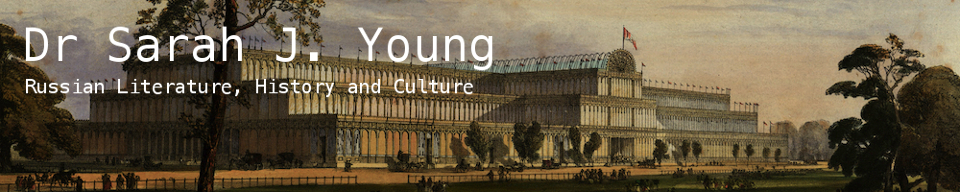
The Crystal Palace at Sydenham
The review contains lots of detail about the Palace and its construction, is full of facts and figures on its dimensions and cost, and gives a virtual tour of the interior, and a brief description of the grounds. There’s no mistaking the author’s enthusiasm, as he describes the Palace as a ‘miracle of art, beauty and splendour’ (section 7, p. 82). The historic courts particularly capture his imagination to the extent that he sees them as better than the real thing; the Egyptian Court is praised for bringing together different periods of Egyptian culture, so that one gets a view of the whole inaccessible to visitors to Egypt (p. 87), while the Alhambra Court is ‘a true copy of the beautiful original,’ which ‘shines with brightness and clarity of colour; it is a part of the Alhambra of the 15th century of which only a faded shadow survives in Granada’ (p. 88). Leaving aside the fact that this rather contradicts Chernyshevsky’s argument only a year later in The Aesthetic Relation of Art to Reality for the inherent superiority of life over art, it’s hard not to be caught up by his rhetoric as he describes the crowds flocking to the Palace and gardens and emphasizes the unanimity of positive opinion about it (evidently he hadn’t heard what John Ruskin had to say) to posit it as a universal idea: ‘there has not been a single voice that would be raised against the Palace itself, against its idea and its execution’ (p. 94).
At the time of writing, Chernyshevsky hadn’t visited the Crystal Palace, and it’s not entirely clear whether he ever did. He visited London for 5 days in 1859, to meet Herzen, and while it’s hard to imagine he wouldn’t have made the trip down to Sydenham — surely he would have wanted to see the structure on which he’d lavished so much praise — there doesn’t seem to be much evidence of anything he did in London. Most biographers simply tell us that little is known about his visit. Marshall Berman, in All That Is Sold Melts Into Air, has Chernyshevsky glimpsing the Crystal Palace from afar (p. 220), but this looks a bit like artistic licence and there’s no source to back it up. I need to look at Chernyshevsky’s correspondence to see if there’s anything conclusive.
Whether he did or not, the Crystal Palace resurfaces in Vera Pavlovna’s Fourth Dream in What is to be Done? (strangely, this early edition has had Vera’s dream cut out; the Russian is available here):
Здание, громадное, громадное здание, каких теперь лишь по нескольку в самых больших столицах, — или нет, теперь ни одного такого! … Но это здание, — что ж это, какой оно архитектуры? Теперь нет такой; нет, уж есть один намек на нее, — дворец, который стоит на Сайденгамском холме: чугун и стекло, чугун и стекло — только.
A building, a huge, huge building, such as only exists in a few of the biggest capitals — or rather, no, there’s no other building like it! … But this building — what on earth is it? What style of architecture? There’s nothing like it now; no, there is already one that hints at it – the palace that stands on Sydenham Hill: cast iron and glass, glass and cast iron — nothing else. (Chapter 4.xvi.8)
Here the universalizing power of the Palace to which Chernyshevsky referred in his earlier article comes into its own; 99 out of 100 people chose to live in the palaces because it is ‘приятнее и выгоднее’ (‘more pleasant and advantageous’; 4.xvi.9). If you can get over Chernyshevsky’s leaden prose, two features of Vera’s utopia stand out. The first, as Berman notes (p. 244), is that it is rural. The dream opens with lines from a poem by Goethe (‘Wie herrlich leuchtet / Mir die Natur! / Wie glanzt die Sonne! / Wie lacht die Flur!’; ‘How splendid the brightness / Of nature about me! How the sun shines! How the Fields laugh!), and launches into a bucolic description which comes as something of a surprise in so urban a book:
Золотистым отливом сияет нива; покрыто цветами поле, развертываются сотни, тысячи цветов на кустарнике, опоясывающем поле, зеленеет и шепчет подымающийся за кустарником лес, и он весь пестреет цветами; аромат несется с нивы, с луга, из кустарника, от наполняющих лес цветов; порхают по веткам птицы, и тысячи голосов несутся от ветвей вместе с ароматом…
The meadow glimmers with a golden tint; the field is covered with flowers, and hundreds, thousands of blossoms spread out on bushes surrounding the field, the forest that towers behind the bushes grows green, whispers, and is speckled with flowers; a fragrance is carried in from the field, the meadow, the bushes, the flowers that fill the forest; birds flutter among the branches, and their thousands of voices float down from the boughs along with the fragrance… (4.xvi)
Although some cities still exist, mainly for practical purposes, the only buildings on show are the crystal palaces dotted around this idyllic landscape, in which the inhabitants live and play, invigorated by their hard but joyful and healthy work (sorry if I sound a bit sceptical).
The second feature is, I think, more interesting: Vera’s utopia is based on an ideal of gender equality. The ‘светлая красавица’ (‘radiant beauty’; 4.xvi.3) who guides her through her vision of past and future shows her a series of women in slavery and semi-slavery; only after the revolution can equality exist, and with it, true beauty and love. This is perhaps no surprise as What is to be Done? as a whole is firmly engaged with the ‘woman question,’ but somehow this aspect of the utopia seems to have got lost.
My original intention was to discuss Dostoevsky’s references to the Crystal Palace as well today, but instead I’m going to come back to that in my next(ish) post, and I’ll think about how the ‘woman question’ fits in there in the mean time.
https://sarahjyoung.com/site/2010/04/20/crystal-palace-russian-literature-1/
Gratuitous cat picture (2)
I’ve received complaints that my random musings on Russian literature detracted from enjoyment of the last picture of my cat I posted. So here she is, indulging in one of her favourite activities: watching nature programmes.

https://sarahjyoung.com/site/2010/04/15/gratuitous-cat-picture-2/
Villains and Victims
I’ve just got back from a conference at the University of Nottingham, organized by Sarah Badcock in the History department, entitled ‘Villains and Victims: Justice, violence and retribution in late Imperial and early Soviet Russia.’ It was a small, workshop-style conference with a couple of dozen participants, and like many of the other people there, I thought it was one of the most enjoyable conferences I’ve ever attended. The different disciplinary backgrounds of the speakers brought in an interesting range of perspectives — the majority of speakers were historians, but there were also papers by literary critics, legal specialists and so on, and although the balance was in favour of the early Soviet period, from the civil war to development of the judiciary to collectivization and famine, there were also papers covering topics such as sex crimes, alcoholism, and the penal system in the late Imperial era (the latter was where I came into it). I’d actually quite like to give a detailed discussion of all the papers, but that’s not really practical time-wise (essays to mark…). Plus lot of the papers were drafts and not for citation, so there’s a limit to what I can say, though I hope many of them will be published sooner rather than later. Instead I’ll reflect a bit more about my own paper and the ways others resonated with it, and focus on the recurring themes that arose. My apologies to my fellow participants for any specific points I fail to attribute correctly. Apologies also if what follows is a bit convoluted — this is my first attempt to bring some order to my thoughts on what was an extremely rich and intense couple of days.
Some of the discussion touched on the themes one would expect at such a conference — continuity and change in the transition from tsarist to Bolshevik rule, and the gap (which also existed in both pre- and post-revolutionary eras) between ideology and pragmatism, or between the centre’s plans and implementation on the ground. On that theme, one of the major narratives of the conference, as Erik Landis suggested in his thought-provoking closing remarks, was that of failure — the state (whether Soviet or Imperial) was incapable of realizing its projects, and had no control at the local level, leading to disintegration, frequently with tragic results. Andrew Gentes’s paper on forced labour on the Trans-Siberian railway gave us a glimpse of the exception that proves the rule, but elsewhere the story was one of plans consistently being thwarted by corruption, indifference, and factions with different agendas. Was it always that way round, though? Gerald Suhr pointed out that there was a desire for penal reform at the centre which (rather like everything else that came from the centre, it seems) was undermined at, or perhaps simply never reached, the peripheries. On the other hand, George Kennan, one of the subjects of my paper, depicts local officials as concerned about the manifest deficiencies and unfairness of the tsarist exile system; for him, the problem lay in the St Petersburg bureaucracy. Whichever way round it was, it does seem that this problem is an indication of an extremely weak state, both before and after the revolution, which has to rely on violence because there is no other way of getting anything done (again, this was Erik Landis’s point: coercion works, and it’s cheap into the bargain). So then the questions are: to what extent does the state’s use of violence become habitual? or is it that the state’s weakness in Russia is an insoluble problem? I certainly don’t see much sign of change, but I’m not sure which explanation has greater traction. The other thing that occurs to me is that governments of all complexions in Russia have operated on the assumption that the ends justifies the means. This, of course, was a central plank of Dostoevsky’s critique of left-wing ideologies, but it does in fact seem to be a feature of Russian statecraft per se. Is that also the case elsewhere? I’m generally rather sceptical about the idea of Russian exceptionalism — the more I look at it, the more I think it’s not so different from other countries — but here I’m not sure. Perhaps the difference is quantitative rather than qualitative. Does Russia merely express openly what is equally true but less apparent elsewhere? Do other governments just not have to behave like Russia’s because they’re not as weak?
My own paper, focusing on narratives about imprisonment and the penal system in late Imperial Russia, was one of several that dealt with the question of the state’s violence against the individual, which, among other things, has the capacity to turn villains into victims (one of many grey areas in this whole subject). I was looking at the different ways in which the representation of ‘ordinary’ (i.e. non-political) convicts is problematized in Dostoevsky’s House of the Dead, Chekhov’s Sakhalin Island and Kennan’s Siberia and the Exile System. It worked very well alongside Sarah Badcock’s paper, which also concentrated on this faceless mass of prisoners/exiles existing on the very edges of society in the Yakutsk and Irkutsk regions and the question of how we can know them, and her approach of examining the practices of everyday life for the punished is a very fruitful one. For me, the key question is what (and how) the texts tell us about societal attitudes and structures and their effect on individuals (whether the author/narrator or the convicts/exiles/free settlers/authorities). And what emerges in very different ways in these texts is a profound sense of separation and difference which appears impossible to overcome and which relates to a very distinctive feature of Russian society — the separation of rural and urban Russia, or, in Dostoevsky’s terms, of the peasantry (the narod) and the elite. Tracy McDonald, who gave an excellent paper on collectivization, resistance and memory, and showed her fascinating short film The Uprising, commented on how strong this separation still is, and even though I’ve just questioned whether Russia really is different from other countries, I think this is one area in which it clearly is. But how much of Russia’s history and development has been affected by this division? And to what extent does the sort of state-sponsored violence we were discussing during the conference originate in a large proportion of the population of Russia being perceived as other? Basically, my paper grapples with implications of that separation when punishment is brought into the equation, but as my conclusions are still only half formed I won’t say any more for now.
There are other things I’d like to discuss — language and violence, and gender and violence, forms of symbolic violence — but I’ll maybe return to those when I’ve got a bit more time. For now I’d just like to say thanks to everybody who was at the conference for their comments and suggestions, which have helped develop my thinking in all sorts of ways, and not only for the paper I was presenting, and for making it such an interesting event in general. Thanks also to Sarah for organizing it.
https://sarahjyoung.com/site/2010/04/08/villains-and-victims/